research · cnt_ce5e3b1654291fb4
How the Fashion House Became a System
From the House of Worth firm to Pierre Cardin's licensing model as described in the house's official history, this article reads fashion-house influence through authorship, the calendar, cultural memory, and the circulation of a name—not trends alone.
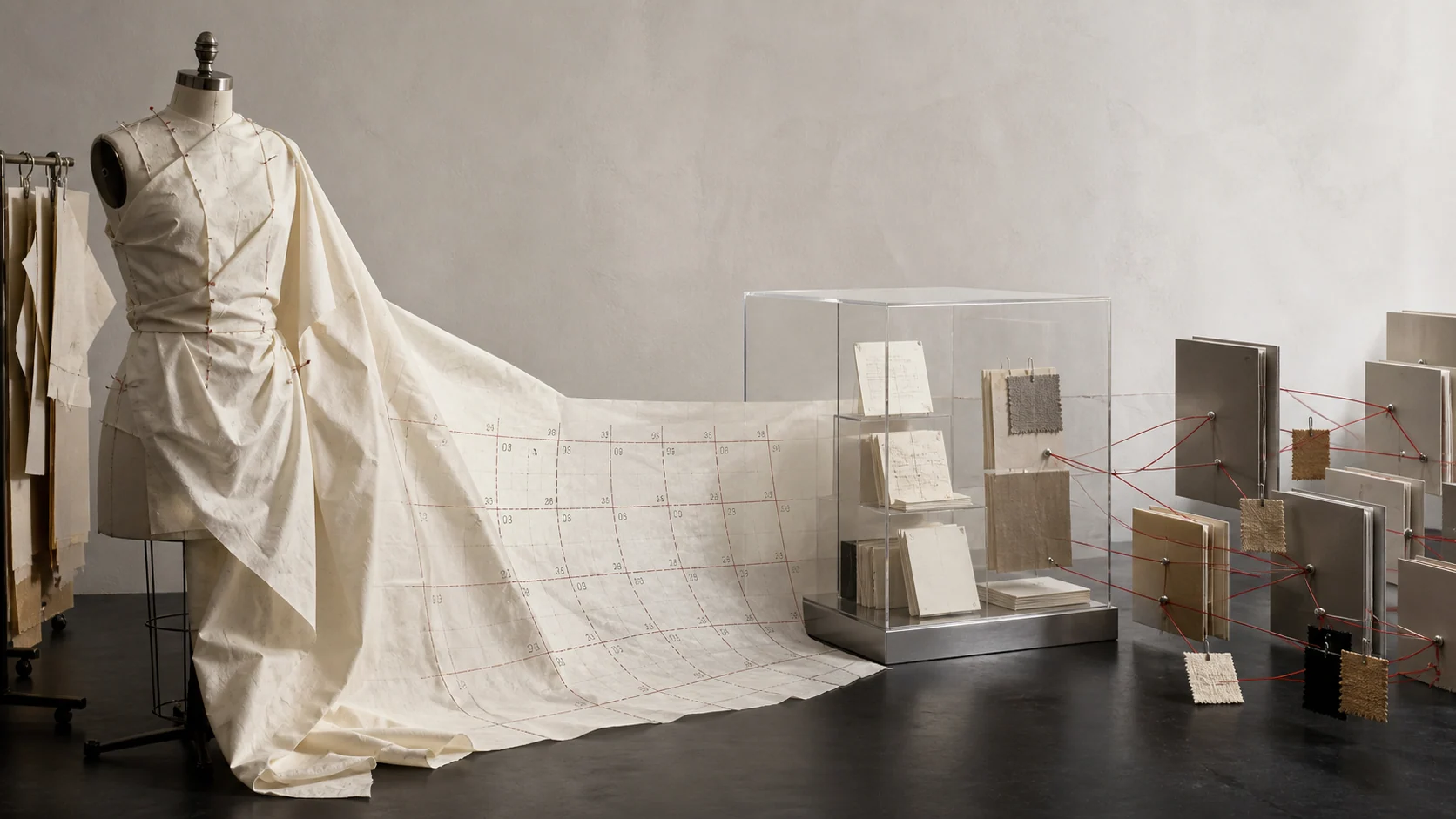
A house is more than its clothes
Imagine a Paris atelier in the second half of the nineteenth century. A client no longer arrives only with a dress she wants made. Live models appear in designs that have already been proposed; she selects one, and the workshop adapts it to her measurements.5 The initiative begins to shift from client to creator: the house is no longer merely fulfilling a request but presenting a point of view.
In this article's analytical framework, this is where the fashion house begins to operate as a system. We propose looking at its influence through four questions: who is recognized as the author, when something new becomes visible, how design is interpreted and remembered, and how far a name travels beyond its original atelier.
This article follows four such mechanisms. It does not claim that a handful of famous brands controls all of fashion. Instead, it examines the infrastructure that forms around clothes: authorship, the calendar, cultural memory, and licensing.
1. The author becomes a house
In 1858, Charles Frederick Worth opened his own Paris firm with a business partner.5 The FHCM attributes to Worth the founding that same year of the first true haute couture house on rue de la Paix.2 What matters here is less the competition for the title of “first” than the changing role of the creator.
According to The Met, the House of Worth prepared design options, presented them on live models, and then made a client's selection to measure.5 The V&A, meanwhile, credits Worth with presenting collections to clients four times a year.1 Together these practices create a structure that remains familiar: the designer proposes a direction, the collection turns individual garments into a statement, and the recurring presentation gives creativity a rhythm.
The word “house” promises something more: continuity after the founder. When Worth died in 1895, the business passed to his sons Gaston-Lucien and Jean-Philippe; The Met traces the house's work under them and into the 1920s.5 The name no longer referred to one person alone. It became a framework within which generations, employees, and collections could change.
In the article's analytical framework, this can be read as the first mechanism of influence: the specific case of Worth shows personal authorship gaining institutional continuity. A particular dress passes out of current fashion, while the house's name connects different generations of work.
2. The collection organizes time
The article's second mechanism concerns time. Recurring collections make the calendar more than a schedule: the show becomes the moment when different professional and public audiences encounter the same body of work in sequence.
The V&A describes how literally this system controlled access in the twentieth century. At Dior and Balenciaga, collections were shown first to the fashion press, then to commercial buyers from North America and Europe, later to private clients, and only afterward to the interested public.1 The same garments became, in sequence, news, a commercial proposition, a private order, and a public spectacle.
According to the Fédération de la Haute Couture et de la Mode's own history, its predecessor organization was founded in 1868; after several transformations, the federation adopted its current name in 2017.22 The FHCM states that haute couture collections are now presented twice a year, in January and July.2
Within these documented examples, the calendar can be read as an instrument for synchronizing attention. The sequence described by the V&A shows the press, buyers, private clients, and the public encountering a collection not simultaneously but at assigned moments.1
This produces the article's second analytical mechanism: a fashion house works not only with the shape of clothes but also with the moment of their appearance. The calendar turns a new collection into an event with a defined sequence of access.
3. The museum turns a season into cultural memory
The third mechanism concerns what happens after a season. In this article's analytical reading, archives, researchers, and museums give individual collections a longer temporal frame and assemble work from different years into an interpretation.
The Met's exhibition “Rei Kawakubo/Comme des Garçons: Art of the In-Between” ran in New York from May to September 2017.7 Rather than arranging Rei Kawakubo's work as a chronological parade of collections, the museum organized it through nine forms of “in-betweenness,” including fashion and anti-fashion, object and subject, and clothes and not-clothes.7
This changes the terms of attention. On the runway, a garment exists within a season; in a museum, it becomes part of an argument about beauty, the body, boundaries, and the language of design. The commercial history of a house acquires a research structure in which different years can be read at once.
Museum recognition alone does not prove that Kawakubo or a particular exhibition changed the entire industry.7 In the article's analytical framework, however, this case illustrates a third mechanism: work by a fashion house can be removed from a single season and enter cultural memory. The Met describes the exhibition design as a collaboration between the museum and Kawakubo,7 so cultural interpretation here emerges not in place of the author's voice but in dialogue with it.
4. The name separates from the object
The most radical transformation occurs when a house distributes not only things made in its own atelier but the right to use its name.
Pierre Cardin's official history states that the designer founded his own Paris house in 1950.8 The same source credits him with introducing licensing to develop Pierre Cardin products first in North and South America and then worldwide.8 In the article's analytical reading, this marks an important turn: the house's name begins to appear on products whose manufacture and sale are organized through licensing relationships, not only through the originating atelier.
This separation of name and manufacture creates opportunities, but it also raises questions of control. The European Commission's official summary of its Pierre Cardin decision says that, during the relevant period, Cardin's main business was licensing its trademark for the manufacture and sale of branded products.3 The Commission also found that between 2008 and 2021 certain licensing terms and coordinated practices by Cardin and Ahlers restricted passive cross-border sales and sales to certain categories of retailers in the EEA.44
The episode matters as more than a moral attached to one brand. Within the article, it can be read as a limit of the system: distributing a name through licenses connects a house to contracts, manufacturers, territories, and rules. Influence gains a legal and economic dimension—and encounters the boundaries of competition law.
What a fashion house actually shapes
A fashion house cannot be reduced to a designer, a logo, or a building containing an archive. It is a way of connecting several processes so that they reinforce one another.
In the analytical framework proposed here, the House of Worth demonstrates the institutional continuation of personal authorship. The show and professional calendar organize the sequence of access to a new collection. The museum case shows how work from different years becomes the subject of a shared interpretation. The Cardin history shows a name circulating through licenses and the contractual and legal boundaries that follow.
These four cases do not establish a universal model for the entire industry. They offer a more substantive way to discuss the influence of a fashion house than the formula “dictating trends”: by looking at the infrastructure around objects—authorship, the timing of appearance, cultural memory, and the circulation of a name. Clothes remain at the center; the article maps the connections that can form around them.