encyclopedia · cnt_ef00cd439868050b
Prada: How a Fashion House Became a System
Prada's history unfolds through more than its collections: a Milan shop, nylon, Miu Miu, Fondazione Prada, joint creative direction and the group's modern structure form a single system for the fashion house.
What Prada Is
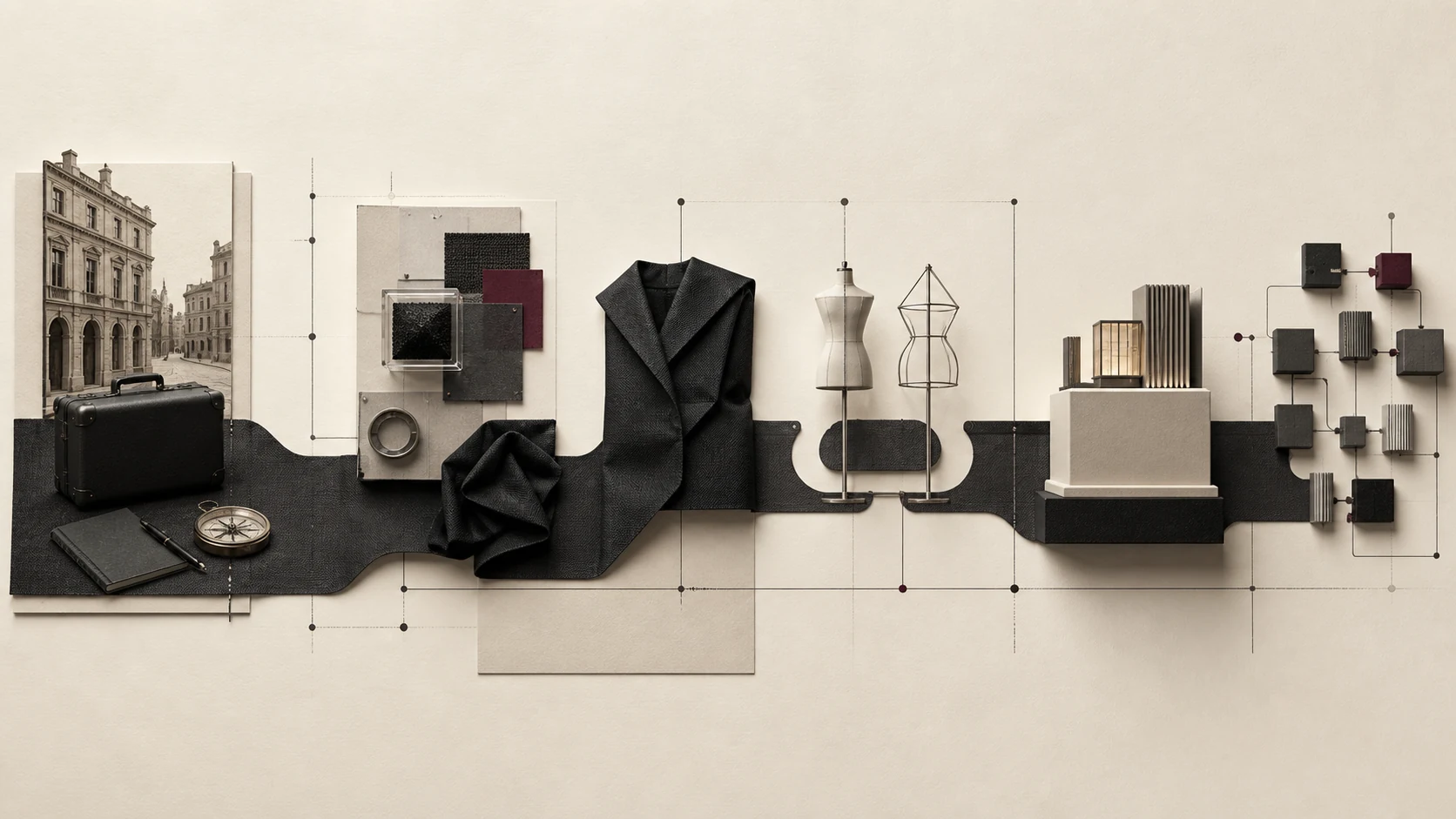
Prada is easier to understand not as a sequence of famous items but as a system. Within it, the house's historical memory, material choices, multiple brands, a cultural institution, a model of joint creative direction and a corporate infrastructure all operate at once. This system took shape gradually — from a shop in Milan to an international group.
The starting point requires careful wording. In its 2017 Annual Report, Prada Group states that in 1913 Mario Prada opened a shop in the Galleria Vittorio Emanuele II in Milan.1 The same report describes its range as bags, trunks, beauty cases, accessories, jewellery and other luxury items.1
It is important that the house's original logic is already visible here: Prada did not begin with an abstract idea of "fashion" but with a specific place and a set of objects. The subsequent history shows how this foundation expanded — first into clothing, then into standalone brands, art and a complex group.
From Shop to Clothing
According to Prada Group's 2017 Annual Report, the first clothing collection was launched in Milan in 1988.1 The same corporate source dates Prada's menswear debut to 1993, tied to the first men's clothing and footwear collection.1
These two dates mark more than an expanded range. They show a shift from a house of objects and accessories to a house capable of building a coherent clothing language across different lines. That is why ready-to-wear in Prada's history should be seen as a change in the scale of the whole system, rather than a single calendar episode.
Nylon: Material as Method
The most telling part of this system is nylon. In its own historical materials, Prada Group writes that Miuccia Prada's collection of nylon bags dates back to the 1980s, and roughly a decade later nylon entered the men's and women's ready-to-wear collections.2
Museum records let us see this history through specific objects. The Museum at FIT records a Prada nylon backpack from the early 1990s, made in Italy, catalogued under accession number 2017.1.1.3 The Metropolitan Museum of Art holds a Prada dress from the fall–winter 1995–1996 season, designed by Miuccia Prada; the materials listed include nylon, metal and Velcro.4
Together, these sources do not prove the legend of a single "invention moment," nor do they support attributing an unconfirmed commercial effect to any specific piece. Instead, they show something else: the material runs through both accessories and clothing and becomes a recurring way of linking different parts of the fashion house.
Two Expansions in 1993
In 1993, according to the 2017 Annual Report, the Miu Miu brand was established.1 The same report states that in 1993 Miuccia Prada and Patrizio Bertelli created Milano Prada Arte, later Fondazione Prada, to pursue their interests and passions in art and culture.1
These events matter precisely as a pair. One expands the fashion structure through a new brand; the other creates a separate institutional framework for art and culture. This is how Prada stops being a single clothing label: distinct but connected platforms of work take shape around the core house.
Joint Creative Direction
Prada Group's official announcement states that, effective 2 April 2020, Raf Simons joined Prada as co-creative director and would work alongside Miuccia Prada with equal responsibility for creative input and decisions.5
For the house's structure, this is not merely a personnel date. The phrase "equal responsibility" describes a model in which creative direction is built as joint work rather than a one-way handover of authorship. That is precisely why this episode belongs to the makeup of Prada itself, not only to the biography of two designers.
Versace and the Group's Current Scale
On 2 December 2025, Prada S.p.A. completed its acquisition of Versace from Capri Holdings.7 Prada S.p.A.'s statement on the deal's closing says that the necessary regulatory approvals had been obtained by the time it closed.6
As of 31 December 2025, Prada Group's Company Profile listed the group as comprising Prada, Miu Miu, Church's, Car Shoe, Versace, Pasticceria Marchesi and Luna Rossa.9 As of the same date, the group reported 25 company-owned factories,9 17,901 employees including Versace,9 and 843 directly operated stores.9
The financial snapshot helps convey scale, but it does not replace design history. For fiscal year 2025, Prada Group's net revenue came to €5.718 billion; the results statement cites 9% year-on-year growth and 8% organic growth.8 The same statement puts Miu Miu's growth at 35% year-on-year at constant exchange rates,8 while Versace's contribution to net revenue from the deal's closing date was €65 million.8
Why Prada Is a System
Prada's history brings together several distinct logics. The 1913 shop gives the house its origin and the memory of a place. Clothing expands the world of objects into a full fashion language. Nylon links accessories and ready-to-wear through a recurring material method. Miu Miu and Fondazione Prada grow the system in two directions — fashion and culture. Joint creative direction sets a way of making authorial decisions, and today's Prada Group provides production, retail and corporate scale.
That is why Prada's influence cannot be reduced to a single bag, a single material or a single designer. Objects become easier to understand once the infrastructure that lets them appear, move between categories and stay connected to the house's history becomes visible.
Boundaries of This Edition
This public version does not include the disputed Versace deal amount, the unconfirmed exact chronology of Pocono and Vela, claims about the commercial effect of individual pieces, a weak lead on SS1998 menswear, or expanded corporate-governance details. These remain in the research ledger until sufficiently traceable sources become available.