collection
How a chair explains the twentieth century
The chair as a laboratory of body, material, ideology, and production: one object on which every technology of the century was tested.
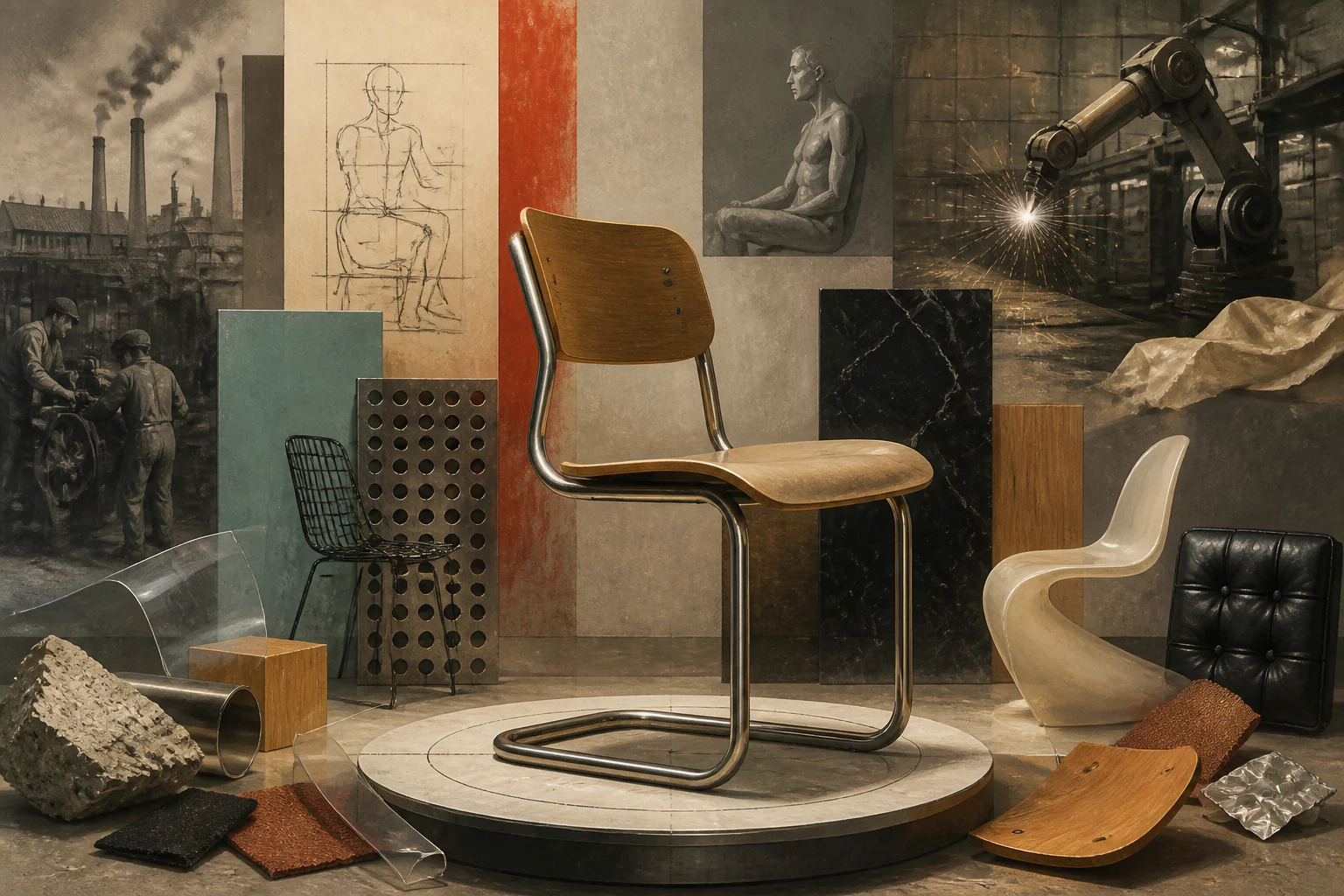
About this collection
The chair is the most convenient object for a history of design: small enough to be remade often, complex enough for every new technology to be tested on it. This route reads the century through a sequence of constructional decisions.
Metal and the modernist manifesto
- Barcelona Chair — a chair designed as part of a building.
- LC4 — a chaise longue as a calculated system of rest.
- Steel — structure, frame, and industrial honesty.
The shell: plywood and composites
- Eames Lounge Chair — industrial production and craft quality in one object.
- Eames: plywood, house, film, and experiment as one method — plywood as a years-long research programme.
- Birch plywood — layers, pressure, and modern form.
- Fibreglass composite — composite, shell, lightness, industrial form.
Plastic and the monolith
- Panton Chair — the first single-piece plastic chair.
- Sacco — a form that follows the body rather than a frame.
- UP5/UP6 — an inflatable object as a statement.
Lightness, cardboard, and citation
- Superleggera — super-lightness as a verifiable principle.
- Wiggle Side Chair — cardboard as a structural material.
- Mezzadro — a tractor seat moved into the interior.
- Carlton — a postmodern figure in place of function.
Method and norm
- Ulm Stool — multifunctionality as a principle of economy of means.
- How logistics changes the form of an object — stacking and demountability as form-giving requirements.