encyclopedia
Birch plywood
Wood: veneer layers, glue, pressure, forming and modernist precision.
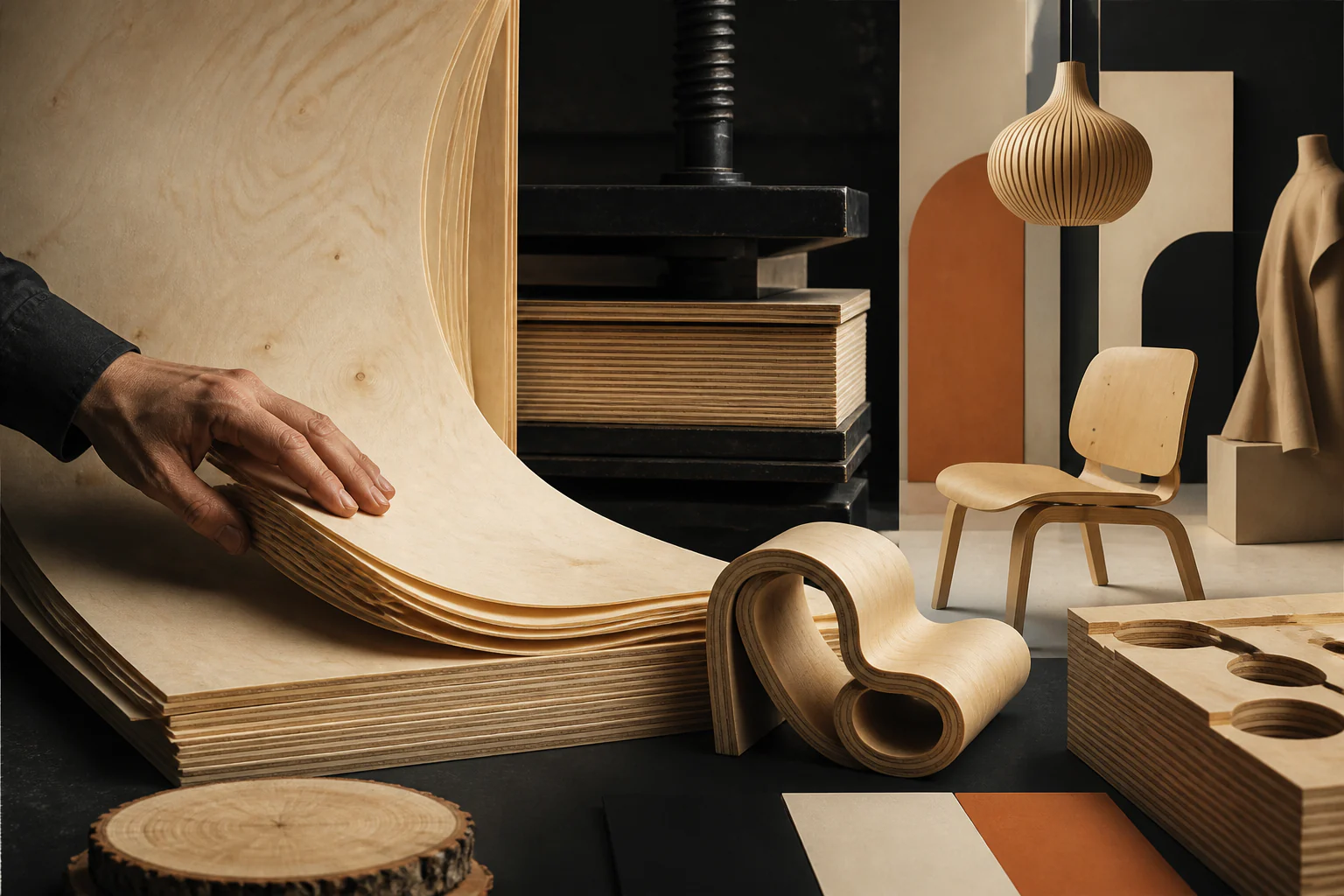
Birch plywood matters to VANSMITHLAB not as a decorative sample but as a system of decisions: composition, production, light, tactility, ageing, care and cultural meaning must be read together.
Editorial thesis
Birch plywood is treated as an active design material: it changes form, light, scale, gesture and cultural status. What matters is not only appearance but also production chain, limitations, ageing and display.1
Reader question
Why can Birch plywood not be described only as a finish or commercial sample?1
Short answer
Because Birch plywood is a relation among composition, processing, scale, light and cultural memory. A material becomes language only when design accounts for its physics and history.
1. family and material boundary
Birch plywood belongs to the Wood family, but it should not disappear into a generic family label. Its design meaning is defined by how it carries veneer layers, glue, pressure, forming and modernist precision. It should therefore be described through origin, processing and spatial behaviour, not through one attractive photograph.
2. composition and inner logic
Composition sets the limits of expression. The value of Birch plywood does not come from a marketing name but from inner structure: particles, fibres, crystals, layers, binder or chemistry define strength, weight, sheen and response to time.
3. origin and extraction or production
Origin matters to the designer as much as the finished object. Place of extraction, growing, firing, melting or printing shapes availability, colour range, sheet or slab size, possible thickness and the ethical history of the project.1
4. from raw matter to design surface
On the path from raw matter to surface, the material is translated several times. It is cut, dried, melted, formed, fired, polished, woven, developed or assembled. Each translation leaves a trace: direction, seam, edge, grain, smoothness or slight technical irregularity.
5. structure: grain, fibre, crystal, layer or matrix
Structure is the hidden drawing. In Birch plywood it may appear as grain, fibre, layer, porosity, crystal, weave or emulsion. If this structure is ignored, the material easily becomes a flat image without weight or behaviour.
6. processing and tools
Processing should strengthen the material's logic rather than disguise it. For Birch plywood, tool, pressure, temperature, cut direction, forming or tension are decisive. A processing error often reads not as a technical flaw but as a weak design decision.1
7. surface and texture
Surface defines the first encounter. A material may be matte, polished, rough, dry, velvety, glass-like or grainy. With Birch plywood, the surface is crucial because it translates technical basis into visible character: layered, pale, engineered and honest.
8. light and reflection
Light reveals material more strongly than a colour chip. Diffuse light shows overall tone; grazing light reveals relief; point light strengthens shine; reflection can make a surface feel expensive or cheap and noisy.
9. colour and range of variation
Colour cannot be fixed by a small fragment. In Birch plywood, range shifts by batch, moisture, thickness, finish, grain or fibre orientation and neighbouring materials. A specification should include accepted variation.
10. touch and sound
Touch includes temperature, friction, elasticity and sound. Some materials feel cold before they are touched; others give a dry rustle, soft rebound or heavy dull sound. These qualities matter to the object as much as appearance.
11. form, scale and joint
Form depends on scale and joint. The same material behaves differently as thin edge, massive block, flexible sheet, tile, fibre or large print. The joint reveals whether the designer understands the material or only uses its image.
12. ageing, care and repair
Ageing is not a secondary technical matter. Birch plywood may darken, fade, scratch, polish through touch, absorb moisture, become brittle or develop patina. Good design decides in advance whether ageing will become value or problem.
13. architecture and public space
In architecture and public space, material is tested by scale, circulation and maintenance. Beauty and price are not enough: repairability, replacement, safety, resistance to dirt and legibility from distance all matter.
14. interior and object
In interiors and objects, Birch plywood works closer to the body. Small scale intensifies detail: countertop edge, handle touch, textile fold, footstep sound, seam or reflection becomes part of the scenario of living.
15. fashion, body or image
For fashion, body or image, the material must be read through movement. Even when Birch plywood is not a textile, it can be lit, photographed and combined with skin, metal, glass or clothing to reveal weight, coldness, softness, transparency or technical precision.
16. production limitations
Limitations should not be hidden at the end. Birch plywood has its own limits: fragility, weight, chipping, shrinkage, fading, staining, installation complexity, chemical sensitivity or recycling difficulty. These limits do not cancel the material, but they require honest specification.
17. historical moment
The historical moment explains why the material gained cultural weight. Sometimes it belongs to industrialisation, sometimes to the home, war, modernism, laboratory, luxury, mass clothing, photography or museum practice.
18. authors and institutions
Authors and institutions matter not as a list of names but as evidence that material receives meaning through use. Architect, designer, photographer, fashion house, museum or factory turns a technical property into language.
19. myths and specification errors
The main myth around Birch plywood is to treat it as an automatic guarantee of quality. A material can be expensive and poorly used, ecological only in advertising language, beautiful in a sample and weak at real scale.
20. ecology and material footprint
Environmental footprint depends on the entire chain: extraction or growing, energy, water, chemistry, transport, service life, repair, disassembly and reuse. VANSMITHLAB must separate material honesty from attractive declarations.
21. how to read a sample
A sample should be read at three scales: small fragment, working mock-up and real surface. With Birch plywood, edge, reverse side, joint, grazing light and changes after touch or water are especially important.
22. how to photograph and display the material
The material should be photographed as character, not as a product swatch. One frame shows mass, another edge and thickness, a third surface under grazing light, a fourth a trace of use or ageing.
23. comparison with neighbouring materials
Neighbouring materials help define the role more precisely. Birch plywood should be compared not to rank it, but to choose: what is lighter, what ages more honestly, what holds an edge, what gives depth of light, and what merely imitates another material's status.
24. material as cultural code
The cultural code of a material is built by repetition. When Birch plywood repeatedly appears in banks, hotels, laboratories, kitchens, archives, runways or museums, it begins to carry the memory of those places into new projects.
25. links to existing VANSMITHLAB nodes
Inside VANSMITHLAB the material should connect to authors, objects, styles and technologies. Birch plywood can link architecture to fashion, object to photography, production to exhibition, and ageing to sustainability.
26. media plan
Media plan: material portrait, raw or production context, macro structure, processing map, light test, scale example, ageing diagram, comparison with neighbouring materials, use route and final analytical map.
27. fact and rights review
Before publication, three reviews are required: factual, technical and rights. An archival image cannot be used without rights; composition cannot be described without a source; sustainability cannot be claimed without a clear chain of evidence.
28. reading routes
Reading routes: material → processing → object → interior → image → cultural code. For Birch plywood, the most useful links are to existing materials and future articles in the Wood family.
29. why it matters now
Birch plywood matters now because design increasingly evaluates not only visual effect but origin, service life, repair, tactility, production footprint and the ability of a material to outlive one visual trend.
30. editorial conclusion
Editorial conclusion: Birch plywood should be published as a full material-technique profile, not as a reference card. Its power lies in the relation among physics, production, visual language and cultural memory. Only then does the materials section become a system rather than a catalogue of finishes.