encyclopedia
The Dress Form — a Tool Between Body and Form
A three-dimensional working surface on which fabric tests an idea before meeting a living body.
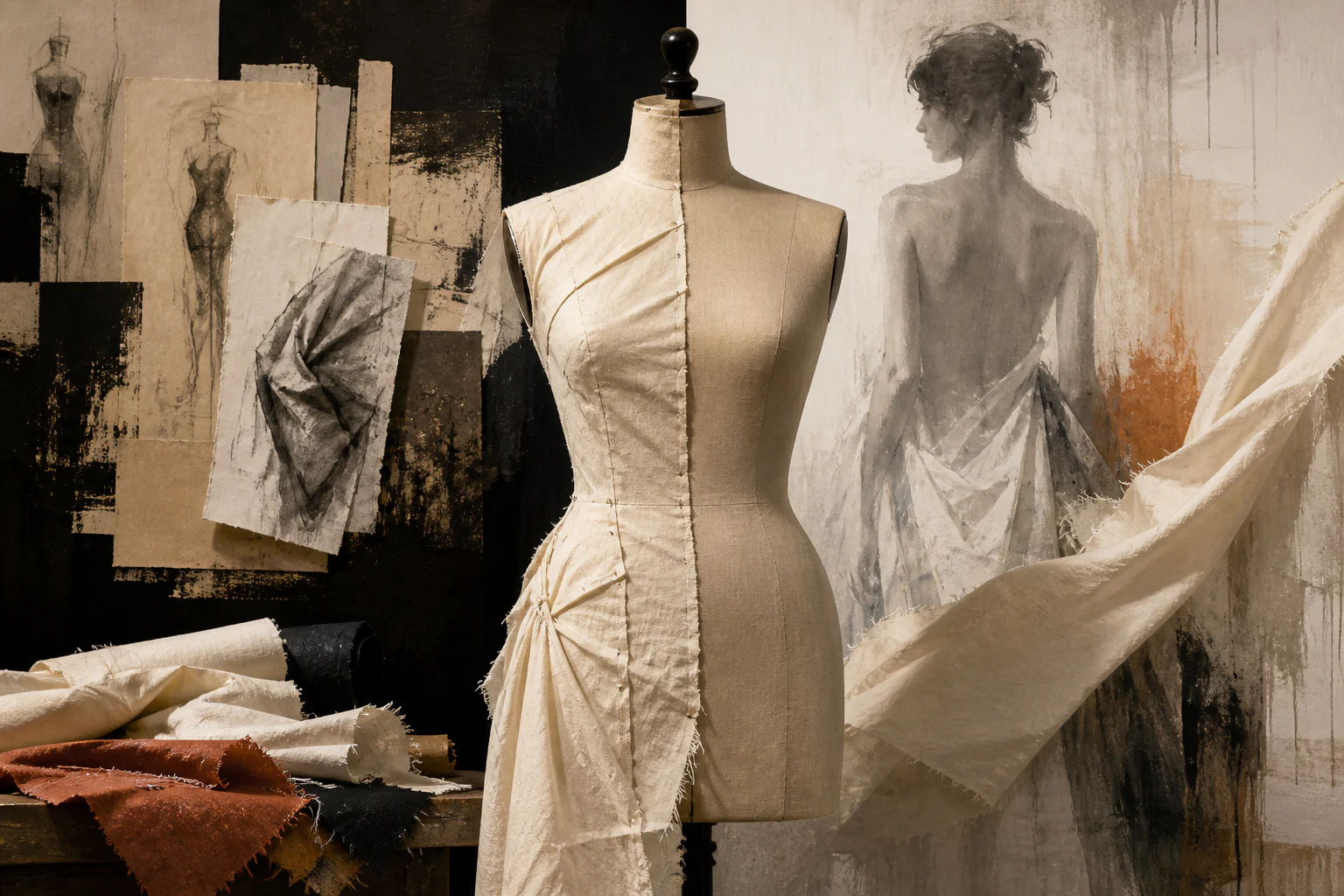
A dress form is an approximation of the human torso used for draping, proportion, balance and placement of construction lines. It turns the body into a stable working surface and enables direct design in three-dimensional space. The dress form disciplines vision: the designer begins to see clothing not as a front-view drawing but as volume around a figure. It also exposes the politics of standardization—which body is accepted as the “norm.”
Editorial thesis
A dress form is an approximation of the human torso used for draping, proportion, balance and placement of construction lines. It turns the body into a stable working surface and enables direct design in three-dimensional space. The dress form disciplines vision: the designer begins to see clothing not as a front-view drawing but as volume around a figure. It also exposes the politics of standardization—which body is accepted as the “norm.”
Reader question
What is actually being designed here: the visible form, or the system that makes it possible?
Short answer
Fabric is pinned to the form, moved, folded and fixed; lines are then transferred to paper or refined through a toile. The form is particularly useful for draping and asymmetry, where flat drafting does not produce an immediate spatial answer. body → standard → dress form → draping → toile → pattern.
1. Definition and boundaries
A dress form is an approximation of the human torso used for draping, proportion, balance and placement of construction lines. It turns the body into a stable working surface and enables direct design in three-dimensional space.
2. Origins and prehistory
Working forms existed in tailoring long before the modern mass-produced mannequin. Size standardization and professional equipment manufacturing made adjustable and standardized forms normal tools of ateliers and fashion schools.
3. Why the system emerged when it did
The historical necessity of this system does not come from a single invention but from changes in production scale, professional specialization and ideas about the body. Working forms existed in tailoring long before the modern mass-produced mannequin. Size standardization and professional equipment manufacturing made adjustable and standardized forms normal tools of ateliers and fashion schools.
4. Material, construction and composition
Its material logic becomes clear when physical properties are treated as constraints that also generate form. The quality of a form depends on proportions, stability, pinnable surface and reliable reference lines. Yet no mannequin fully reproduces breathing, movement, soft tissue or individual posture.
5. Principle of operation or production
Fabric is pinned to the form, moved, folded and fixed; lines are then transferred to paper or refined through a toile. The form is particularly useful for draping and asymmetry, where flat drafting does not produce an immediate spatial answer.
6. Key technical or cultural turning point
The decisive shift occurs when local skill becomes transferable as a standard, professional role, calendar, machine or technical document. Fabric is pinned to the form, moved, folded and fixed; lines are then transferred to paper or refined through a toile. The form is particularly useful for draping and asymmetry, where flat drafting does not produce an immediate spatial answer.
7. First anchor example
The atelier flou uses the form for soft draping.
8. Second anchor example
the school dress form provides a neutral base for learning volume.
9. Third anchor example
a custom padded form can bring the tool closer to an individual client..
10. Form and geometry
Form is not a shell placed over technology here; geometry emerges from production method and the relation to the body. A dress form is an approximation of the human torso used for draping, proportion, balance and placement of construction lines. It turns the body into a stable working surface and enables direct design in three-dimensional space.
11. Surface, light and color
Surface, light and color are read through material and finish, yet their expression depends on construction. The quality of a form depends on proportions, stability, pinnable surface and reliable reference lines. Yet no mannequin fully reproduces breathing, movement, soft tissue or individual posture.
12. Tactility, sound and movement
Tactility appears through weight, friction, stretch and bodily contact; movement reveals how accurately the system has been designed. Fabric is pinned to the form, moved, folded and fixed; lines are then transferred to paper or refined through a toile. The form is particularly useful for draping and asymmetry, where flat drafting does not produce an immediate spatial answer.
13. Production system
The quality of a form depends on proportions, stability, pinnable surface and reliable reference lines. Yet no mannequin fully reproduces breathing, movement, soft tissue or individual posture.
14. Tools and infrastructure
Infrastructure includes tools, documents, workspaces, suppliers and specialists; its design determines whether a result can be repeated. The quality of a form depends on proportions, stability, pinnable surface and reliable reference lines. Yet no mannequin fully reproduces breathing, movement, soft tissue or individual posture.
15. Mass diffusion
Mass diffusion becomes possible when knowledge is translated into repeatable sizes, operations, components, images or calendar formats. The dress form disciplines vision: the designer begins to see clothing not as a front-view drawing but as volume around a figure. It also exposes the politics of standardization—which body is accepted as the “norm.”
16. Professional practice
Professional practice depends on specialization: a design idea becomes real only through people who translate it into material and procedure. Fabric is pinned to the form, moved, folded and fixed; lines are then transferred to paper or refined through a toile. The form is particularly useful for draping and asymmetry, where flat drafting does not produce an immediate spatial answer.
17. Connection to architecture
The connection to architecture appears in designing a shell around the body, distributing loads, layering and sequencing assembly. body → standard → dress form → draping → toile → pattern.
18. Connection to product design
The connection to product design is strongest where clothing incorporates a standardized component, mechanism or interface. body → standard → dress form → draping → toile → pattern.
19. Connection to fashion
The dress form disciplines vision: the designer begins to see clothing not as a front-view drawing but as volume around a figure. It also exposes the politics of standardization—which body is accepted as the “norm.”
20. Connection to image
Image does not merely document the result: photography, runway, catalogue and screen alter how the system is perceived and distributed. The dress form disciplines vision: the designer begins to see clothing not as a front-view drawing but as volume around a figure. It also exposes the politics of standardization—which body is accepted as the “norm.”
21. Connection to technology
Technology is not novelty for its own sake here; it is a way to make an operation more precise or repeatable, or to reorganize labor. Physical forms now coexist with digital avatars. Avatars accelerate simulation and remote work, but real cloth on a physical form still allows material to behave in ways that are difficult to predict completely.
22. Connection to materials
Material defines the field of possibility: thickness, resilience, friction, stretch and workability become design parameters. The quality of a form depends on proportions, stability, pinnable surface and reliable reference lines. Yet no mannequin fully reproduces breathing, movement, soft tissue or individual posture.
23. Institutions and canon
Museums, professional federations, schools, archives and trade bodies form the canon by preserving not only objects but knowledge of how they are made. Working forms existed in tailoring long before the modern mass-produced mannequin. Size standardization and professional equipment manufacturing made adjustable and standardized forms normal tools of ateliers and fashion schools.
24. Market and commercial logic
Commercial logic determines how much time and hand labor can be invested, what scale is viable and through which channels the result reaches an audience. The dress form disciplines vision: the designer begins to see clothing not as a front-view drawing but as volume around a figure. It also exposes the politics of standardization—which body is accepted as the “norm.”
25. Critique and limitations
The central mistake is to treat the form as a substitute for fitting. It is a development tool; the living body remains the final test of movement, comfort and psychological perception of form.
26. Errors and myths
A common error is to judge the system only by visible effect while ignoring the hidden chain of operations, tolerances, skills and maintenance. The central mistake is to treat the form as a substitute for fitting. It is a development tool; the living body remains the final test of movement, comfort and psychological perception of form.
27. Sustainability, durability and maintenance
Sustainability should be assessed through service life, repair, component replacement, material use and actual production volume rather than a single symbolic attribute. Physical forms now coexist with digital avatars. Avatars accelerate simulation and remote work, but real cloth on a physical form still allows material to behave in ways that are difficult to predict completely.
28. Contemporary condition
Physical forms now coexist with digital avatars. Avatars accelerate simulation and remote work, but real cloth on a physical form still allows material to behave in ways that are difficult to predict completely.
29. What the subject changed in the discipline
The major disciplinary change is the transformation of clothing from a single image into a system linking body, material, labor, standard and representation. body → standard → dress form → draping → toile → pattern.
30. How to read the subject today
Today the subject is best read not as a vocabulary list but as a chain of decisions: body → standard → dress form → draping → toile → pattern. The visible image is only the last layer of a much larger production construction.
See also
- The Pattern — Translating the Three-Dimensional Body into a Plane — A geometric interface between figure, design intention and the cutting of material.
- Tailoring Construction — the Inner Architecture of the Jacket — Canvas, front, shoulder, sleeve, iron and balance as an invisible spatial system.
- Draping — Creating form without rigid construction.
- Haute Couture — the Production System of High Fashion — Not a luxury style but a regulated ecosystem of ateliers, handwork, fittings, calendar and public presentation.