encyclopedia
The Fashion Show — from Collection Presentation to Media Event
Route, body, music, light, seating, camera and distribution network as one image-producing system.
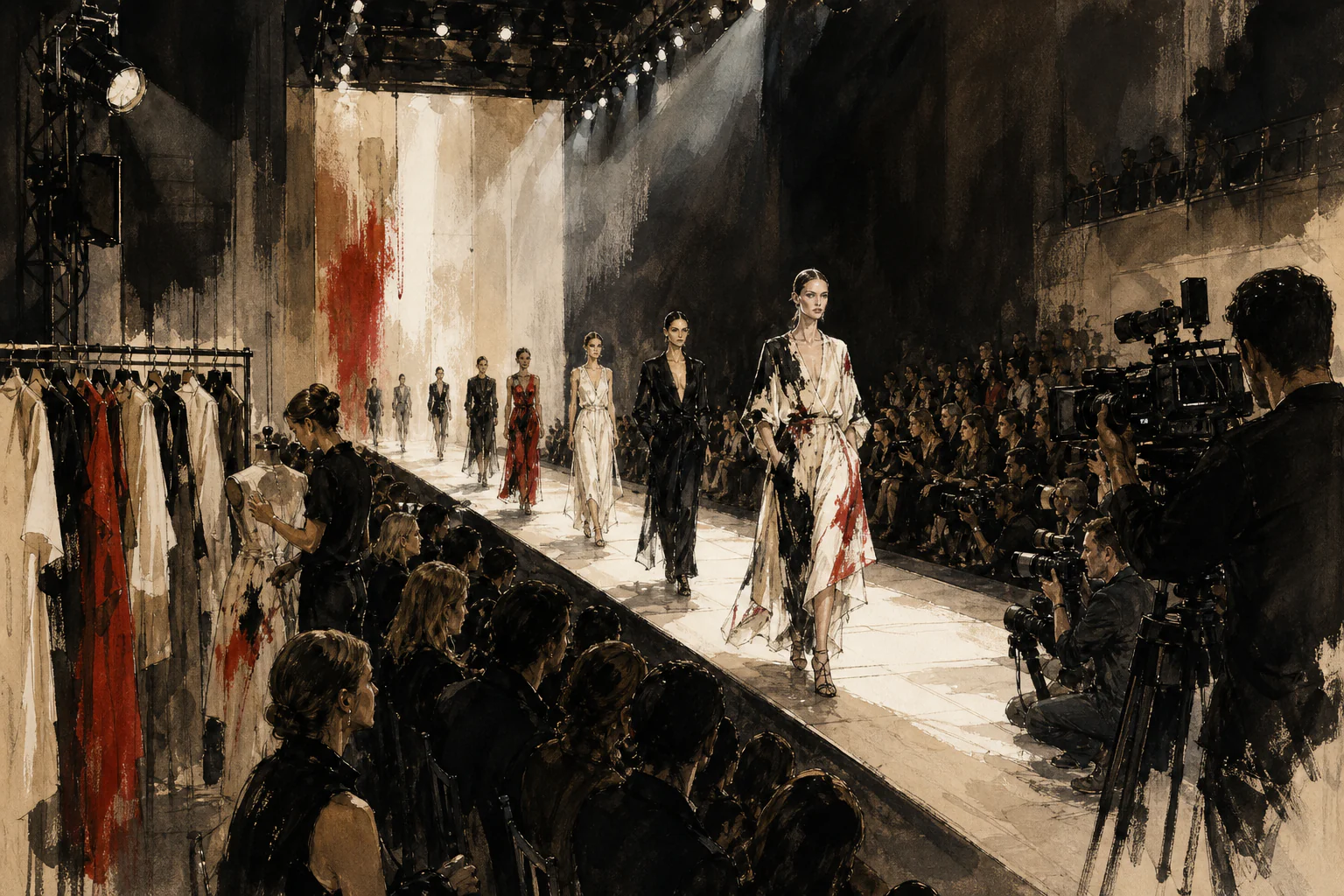
A fashion show is a temporary system in which clothing is presented on moving bodies to a selected audience and simultaneously produced as image. The runway connects collection, model, space, direction, music, press, buyers, photographers and digital transmission. The show turned clothing into sequence, atmosphere and collective anticipation. It shapes not only opinion about garments but the image of a brand, city, period and fashion industry itself.
Editorial thesis
A fashion show is a temporary system in which clothing is presented on moving bodies to a selected audience and simultaneously produced as image. The runway connects collection, model, space, direction, music, press, buyers, photographers and digital transmission. The show turned clothing into sequence, atmosphere and collective anticipation. It shapes not only opinion about garments but the image of a brand, city, period and fashion industry itself.
Reader question
What is actually being designed here: the visible form, or the system that makes it possible?
Short answer
A show is built as a sequence of exits: look order, walking pace, casting, light, sound, route architecture and seating control how the collection is read. Afterward, photographs and video become a secondary—and often far larger—form of the show itself. collection → model → space → light/sound → camera → media → market.
1. Definition and boundaries
A fashion show is a temporary system in which clothing is presented on moving bodies to a selected audience and simultaneously produced as image. The runway connects collection, model, space, direction, music, press, buyers, photographers and digital transmission.
2. Origins and prehistory
In the late nineteenth and early twentieth centuries fashion houses increasingly presented clothes on live models to clients. Across the twentieth century the intimate presentation became a seasonal public spectacle and then a globally distributed media event.
3. Why the system emerged when it did
The historical necessity of this system does not come from a single invention but from changes in production scale, professional specialization and ideas about the body. In the late nineteenth and early twentieth centuries fashion houses increasingly presented clothes on live models to clients. Across the twentieth century the intimate presentation became a seasonal public spectacle and then a globally distributed media event.
4. Material, construction and composition
Its material logic becomes clear when physical properties are treated as constraints that also generate form. Behind a brief event lies a dense chain: collection samples, styling, fittings, casting, scenography, light, sound, rehearsal, backstage, photo and video production, seating and press operations. A timing failure in one node affects the entire system.
5. Principle of operation or production
A show is built as a sequence of exits: look order, walking pace, casting, light, sound, route architecture and seating control how the collection is read. Afterward, photographs and video become a secondary—and often far larger—form of the show itself.
6. Key technical or cultural turning point
The decisive shift occurs when local skill becomes transferable as a standard, professional role, calendar, machine or technical document. A show is built as a sequence of exits: look order, walking pace, casting, light, sound, route architecture and seating control how the collection is read. Afterward, photographs and video become a secondary—and often far larger—form of the show itself.
7. First anchor example
The salon presentation associated with Worth illustrates an early model.
8. Second anchor example
the official fashion-week calendar organizes shows into shared industrial infrastructure.
9. Third anchor example
digital broadcasts and hybrid formats of the 2020s show that event location and audience location no longer need to coincide..
10. Form and geometry
Form is not a shell placed over technology here; geometry emerges from production method and the relation to the body. A fashion show is a temporary system in which clothing is presented on moving bodies to a selected audience and simultaneously produced as image. The runway connects collection, model, space, direction, music, press, buyers, photographers and digital transmission.
11. Surface, light and color
Surface, light and color are read through material and finish, yet their expression depends on construction. Behind a brief event lies a dense chain: collection samples, styling, fittings, casting, scenography, light, sound, rehearsal, backstage, photo and video production, seating and press operations. A timing failure in one node affects the entire system.
12. Tactility, sound and movement
Tactility appears through weight, friction, stretch and bodily contact; movement reveals how accurately the system has been designed. A show is built as a sequence of exits: look order, walking pace, casting, light, sound, route architecture and seating control how the collection is read. Afterward, photographs and video become a secondary—and often far larger—form of the show itself.
13. Production system
Behind a brief event lies a dense chain: collection samples, styling, fittings, casting, scenography, light, sound, rehearsal, backstage, photo and video production, seating and press operations. A timing failure in one node affects the entire system.
14. Tools and infrastructure
Infrastructure includes tools, documents, workspaces, suppliers and specialists; its design determines whether a result can be repeated. Behind a brief event lies a dense chain: collection samples, styling, fittings, casting, scenography, light, sound, rehearsal, backstage, photo and video production, seating and press operations. A timing failure in one node affects the entire system.
15. Mass diffusion
Mass diffusion becomes possible when knowledge is translated into repeatable sizes, operations, components, images or calendar formats. The show turned clothing into sequence, atmosphere and collective anticipation. It shapes not only opinion about garments but the image of a brand, city, period and fashion industry itself.
16. Professional practice
Professional practice depends on specialization: a design idea becomes real only through people who translate it into material and procedure. A show is built as a sequence of exits: look order, walking pace, casting, light, sound, route architecture and seating control how the collection is read. Afterward, photographs and video become a secondary—and often far larger—form of the show itself.
17. Connection to architecture
The connection to architecture appears in designing a shell around the body, distributing loads, layering and sequencing assembly. collection → model → space → light/sound → camera → media → market.
18. Connection to product design
The connection to product design is strongest where clothing incorporates a standardized component, mechanism or interface. collection → model → space → light/sound → camera → media → market.
19. Connection to fashion
The show turned clothing into sequence, atmosphere and collective anticipation. It shapes not only opinion about garments but the image of a brand, city, period and fashion industry itself.
20. Connection to image
Image does not merely document the result: photography, runway, catalogue and screen alter how the system is perceived and distributed. The show turned clothing into sequence, atmosphere and collective anticipation. It shapes not only opinion about garments but the image of a brand, city, period and fashion industry itself.
21. Connection to technology
Technology is not novelty for its own sake here; it is a way to make an operation more precise or repeatable, or to reorganize labor. A contemporary show can be physical, digital, a film, a performance or a hybrid. Its fundamental function remains to synchronize collection, professional audience and mass image in one moment.
22. Connection to materials
Material defines the field of possibility: thickness, resilience, friction, stretch and workability become design parameters. Behind a brief event lies a dense chain: collection samples, styling, fittings, casting, scenography, light, sound, rehearsal, backstage, photo and video production, seating and press operations. A timing failure in one node affects the entire system.
23. Institutions and canon
Museums, professional federations, schools, archives and trade bodies form the canon by preserving not only objects but knowledge of how they are made. In the late nineteenth and early twentieth centuries fashion houses increasingly presented clothes on live models to clients. Across the twentieth century the intimate presentation became a seasonal public spectacle and then a globally distributed media event.
24. Market and commercial logic
Commercial logic determines how much time and hand labor can be invested, what scale is viable and through which channels the result reaches an audience. The show turned clothing into sequence, atmosphere and collective anticipation. It shapes not only opinion about garments but the image of a brand, city, period and fashion industry itself.
25. Critique and limitations
Runway spectacle can eclipse the clothes, while audience exclusivity can reinforce industry hierarchies. Digital access does not make the system fully democratic: control of calendar, attention and invitation remains.
26. Errors and myths
A common error is to judge the system only by visible effect while ignoring the hidden chain of operations, tolerances, skills and maintenance. Runway spectacle can eclipse the clothes, while audience exclusivity can reinforce industry hierarchies. Digital access does not make the system fully democratic: control of calendar, attention and invitation remains.
27. Sustainability, durability and maintenance
Sustainability should be assessed through service life, repair, component replacement, material use and actual production volume rather than a single symbolic attribute. A contemporary show can be physical, digital, a film, a performance or a hybrid. Its fundamental function remains to synchronize collection, professional audience and mass image in one moment.
28. Contemporary condition
A contemporary show can be physical, digital, a film, a performance or a hybrid. Its fundamental function remains to synchronize collection, professional audience and mass image in one moment.
29. What the subject changed in the discipline
The major disciplinary change is the transformation of clothing from a single image into a system linking body, material, labor, standard and representation. collection → model → space → light/sound → camera → media → market.
30. How to read the subject today
Today the subject is best read not as a vocabulary list but as a chain of decisions: collection → model → space → light/sound → camera → media → market. The visible image is only the last layer of a much larger production construction.
See also
- Haute Couture — the Production System of High Fashion — Not a luxury style but a regulated ecosystem of ateliers, handwork, fittings, calendar and public presentation.
- Ready-to-Wear — Designer Clothing as an Industrial System — How sizing, series, calendar, factory and retail turned designer clothing into a reproducible product.
- Fashion Photography — Not a Genre but a Production System — Clothing becomes an image through team, editorial context, pose, light, printing and distribution.
- Magazine Cover — Image as the Interface of an Issue — One frame, a name, a masthead and a few lines must sell the issue while stating its position.
- Art Direction — Who Designs the Image Before the Shoot — An image begins before the camera: brief, research, casting, location, light, clothing, props and layout define the field of possibility in advance.