encyclopedia
The Zipper — the Technology That Changed Clothing
Two rows of elements, a slider and industrial precision as a small machine inside the garment.
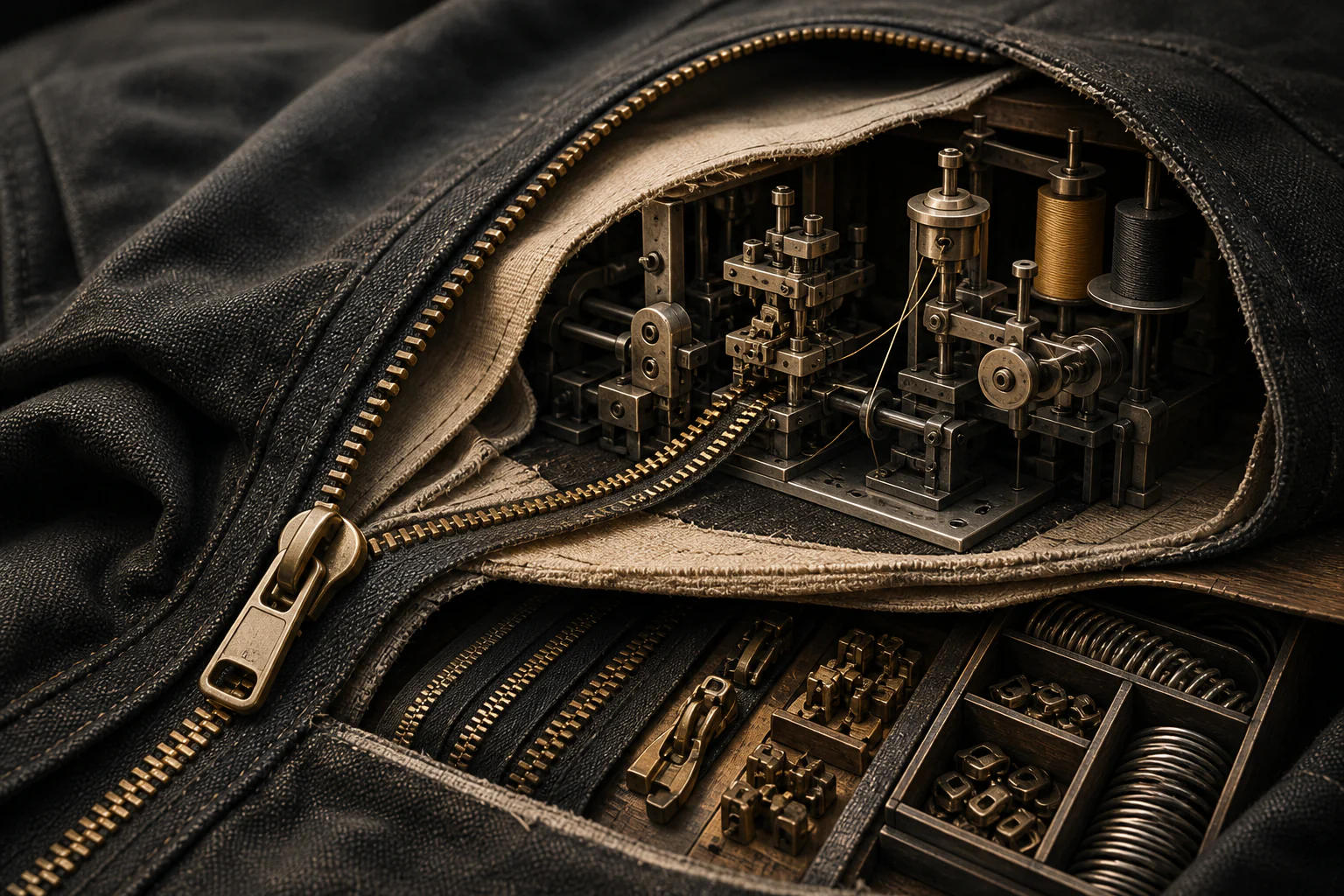
A zipper joins two edges of flexible material through interlocking elements and a slider. Its significance lies less in appearance than in rapid repeated opening and closing, which changed trousers, jackets, bags, footwear and technical clothing. The zipper reduced the number of gestures required to close clothing and enabled new opening lines. Its sound and movement became part of the bodily experience of modern dress.
Editorial thesis
A zipper joins two edges of flexible material through interlocking elements and a slider. Its significance lies less in appearance than in rapid repeated opening and closing, which changed trousers, jackets, bags, footwear and technical clothing. The zipper reduced the number of gestures required to close clothing and enabled new opening lines. Its sound and movement became part of the bodily experience of modern dress.
Reader question
What is actually being designed here: the visible form, or the system that makes it possible?
Short answer
The slider brings two rows together at a calculated angle so their elements interlock, and separates them in reverse. Reliability depends on tooth or coil geometry, tape, stops, slider lock and assembly precision. patent → elements → slider → garment → gesture → industrial standard.
1. Definition and boundaries
A zipper joins two edges of flexible material through interlocking elements and a slider. Its significance lies less in appearance than in rapid repeated opening and closing, which changed trousers, jackets, bags, footwear and technical clothing.
2. Origins and prehistory
Various mechanical fasteners preceded the modern zipper. Early-twentieth-century developments associated with Gideon Sundback produced a more reliable interlocking system; widespread clothing use expanded later, especially in the interwar years and beyond.
3. Why the system emerged when it did
The historical necessity of this system does not come from a single invention but from changes in production scale, professional specialization and ideas about the body. Various mechanical fasteners preceded the modern zipper. Early-twentieth-century developments associated with Gideon Sundback produced a more reliable interlocking system; widespread clothing use expanded later, especially in the interwar years and beyond.
4. Material, construction and composition
Its material logic becomes clear when physical properties are treated as constraints that also generate form. Manufacturing requires precise repetition of many small components. Element material, coil type, gauge, water resistance and load are selected for uses ranging from light dresses to luggage and outerwear.
5. Principle of operation or production
The slider brings two rows together at a calculated angle so their elements interlock, and separates them in reverse. Reliability depends on tooth or coil geometry, tape, stops, slider lock and assembly precision.
6. Key technical or cultural turning point
The decisive shift occurs when local skill becomes transferable as a standard, professional role, calendar, machine or technical document. The slider brings two rows together at a calculated angle so their elements interlock, and separates them in reverse. Reliability depends on tooth or coil geometry, tape, stops, slider lock and assembly precision.
7. First anchor example
Sundback’s patent model presents the zipper as an engineering object.
8. Second anchor example
the trouser fly shows its normalization in daily clothing.
9. Third anchor example
Elsa Schiaparelli in the 1930s made zippers visibly expressive, turning technique into a visual sign..
10. Form and geometry
Form is not a shell placed over technology here; geometry emerges from production method and the relation to the body. A zipper joins two edges of flexible material through interlocking elements and a slider. Its significance lies less in appearance than in rapid repeated opening and closing, which changed trousers, jackets, bags, footwear and technical clothing.
11. Surface, light and color
Surface, light and color are read through material and finish, yet their expression depends on construction. Manufacturing requires precise repetition of many small components. Element material, coil type, gauge, water resistance and load are selected for uses ranging from light dresses to luggage and outerwear.
12. Tactility, sound and movement
Tactility appears through weight, friction, stretch and bodily contact; movement reveals how accurately the system has been designed. The slider brings two rows together at a calculated angle so their elements interlock, and separates them in reverse. Reliability depends on tooth or coil geometry, tape, stops, slider lock and assembly precision.
13. Production system
Manufacturing requires precise repetition of many small components. Element material, coil type, gauge, water resistance and load are selected for uses ranging from light dresses to luggage and outerwear.
14. Tools and infrastructure
Infrastructure includes tools, documents, workspaces, suppliers and specialists; its design determines whether a result can be repeated. Manufacturing requires precise repetition of many small components. Element material, coil type, gauge, water resistance and load are selected for uses ranging from light dresses to luggage and outerwear.
15. Mass diffusion
Mass diffusion becomes possible when knowledge is translated into repeatable sizes, operations, components, images or calendar formats. The zipper reduced the number of gestures required to close clothing and enabled new opening lines. Its sound and movement became part of the bodily experience of modern dress.
16. Professional practice
Professional practice depends on specialization: a design idea becomes real only through people who translate it into material and procedure. The slider brings two rows together at a calculated angle so their elements interlock, and separates them in reverse. Reliability depends on tooth or coil geometry, tape, stops, slider lock and assembly precision.
17. Connection to architecture
The connection to architecture appears in designing a shell around the body, distributing loads, layering and sequencing assembly. patent → elements → slider → garment → gesture → industrial standard.
18. Connection to product design
The connection to product design is strongest where clothing incorporates a standardized component, mechanism or interface. patent → elements → slider → garment → gesture → industrial standard.
19. Connection to fashion
The zipper reduced the number of gestures required to close clothing and enabled new opening lines. Its sound and movement became part of the bodily experience of modern dress.
20. Connection to image
Image does not merely document the result: photography, runway, catalogue and screen alter how the system is perceived and distributed. The zipper reduced the number of gestures required to close clothing and enabled new opening lines. Its sound and movement became part of the bodily experience of modern dress.
21. Connection to technology
Technology is not novelty for its own sake here; it is a way to make an operation more precise or repeatable, or to reorganize labor. Contemporary zippers pursue lower weight, sealing, hidden installation, recycled materials and specialized technical applications. The core principle of mechanical interlocking remains readily recognizable.
22. Connection to materials
Material defines the field of possibility: thickness, resilience, friction, stretch and workability become design parameters. Manufacturing requires precise repetition of many small components. Element material, coil type, gauge, water resistance and load are selected for uses ranging from light dresses to luggage and outerwear.
23. Institutions and canon
Museums, professional federations, schools, archives and trade bodies form the canon by preserving not only objects but knowledge of how they are made. Various mechanical fasteners preceded the modern zipper. Early-twentieth-century developments associated with Gideon Sundback produced a more reliable interlocking system; widespread clothing use expanded later, especially in the interwar years and beyond.
24. Market and commercial logic
Commercial logic determines how much time and hand labor can be invested, what scale is viable and through which channels the result reaches an audience. The zipper reduced the number of gestures required to close clothing and enabled new opening lines. Its sound and movement became part of the bodily experience of modern dress.
25. Critique and limitations
The myth of a single “inventor of the zipper” simplifies a chain of patents and refinements. Nor is the zipper universally superior to buttons: it is faster but harder to repair, and failure can disable a large part of a garment.
26. Errors and myths
A common error is to judge the system only by visible effect while ignoring the hidden chain of operations, tolerances, skills and maintenance. The myth of a single “inventor of the zipper” simplifies a chain of patents and refinements. Nor is the zipper universally superior to buttons: it is faster but harder to repair, and failure can disable a large part of a garment.
27. Sustainability, durability and maintenance
Sustainability should be assessed through service life, repair, component replacement, material use and actual production volume rather than a single symbolic attribute. Contemporary zippers pursue lower weight, sealing, hidden installation, recycled materials and specialized technical applications. The core principle of mechanical interlocking remains readily recognizable.
28. Contemporary condition
Contemporary zippers pursue lower weight, sealing, hidden installation, recycled materials and specialized technical applications. The core principle of mechanical interlocking remains readily recognizable.
29. What the subject changed in the discipline
The major disciplinary change is the transformation of clothing from a single image into a system linking body, material, labor, standard and representation. patent → elements → slider → garment → gesture → industrial standard.
30. How to read the subject today
Today the subject is best read not as a vocabulary list but as a chain of decisions: patent → elements → slider → garment → gesture → industrial standard. The visible image is only the last layer of a much larger production construction.
See also
- The Button — Function, Sign and Industrial Object — A small object connecting textile, technology, ornament and social code.
- Tailoring Construction — the Inner Architecture of the Jacket — Canvas, front, shoulder, sleeve, iron and balance as an invisible spatial system.
- Haute Couture — the Production System of High Fashion — Not a luxury style but a regulated ecosystem of ateliers, handwork, fittings, calendar and public presentation.