analysis
How clothing behaves inside a photograph
On a hanger, clothing is form. In a photograph, it becomes gesture, reflection, fold and character.
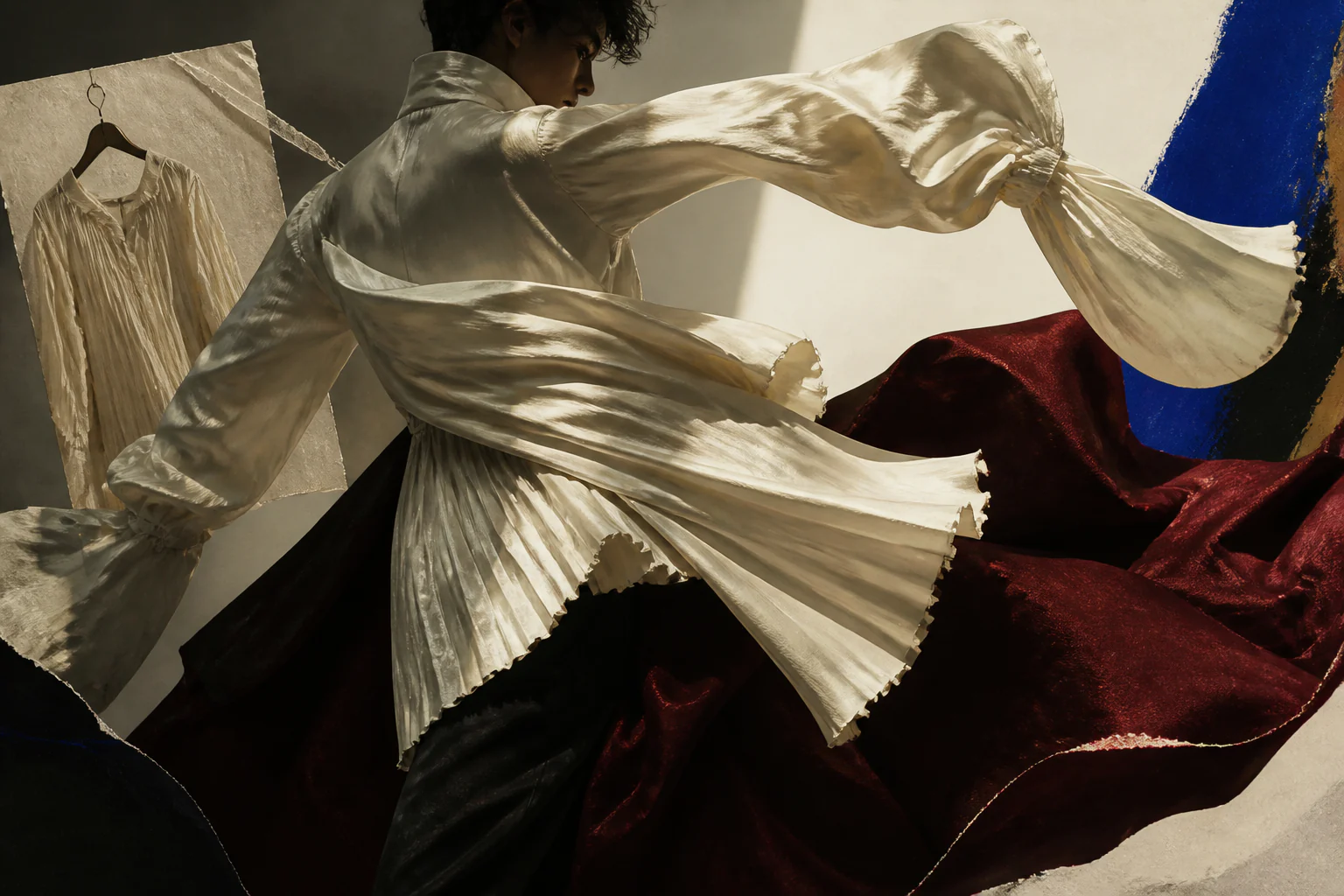
On a hanger, clothing is form. In a photograph, it becomes gesture, reflection, fold and character.
Editorial question
Why can a photograph feel strong before we understand its plot?
Short answer
On a hanger, clothing is form. In a photograph, it becomes gesture, reflection, fold and character.
Thesis
Clothing in photography does not live like an object in a boutique, but as a surface under light and a body in motion. The frame can reveal cut, or destroy it.
On a hanger, clothing is form. In a photograph, it becomes gesture, reflection, fold and character.
Evidence and cases
Distance by category
A jacket, dress, knitwear and coat require different distances; otherwise construction, weight and air disappear.
A jacket, a dress, knitwear, and a coat require different distances. One distance for a whole shoot means some garments were shot wrong.
The fold as proof
A fold can be a mistake, or the only proof that the fabric is alive.
A crease is sometimes a preparation defect and sometimes the only evidence that a fabric is alive. The difference lies in whether the fold follows the construction.
Black requires an edge
Black clothing easily becomes a stain if light does not show edge and texture.
Dark clothing becomes a patch without light that shows edge and texture. A rim or side source is mandatory here.
White requires exposure for the material
White clothing easily loses form when exposure respects the background more than the material.
A light garment loses form when exposure is set for the background. Priority goes to the fabric, even at the cost of blowing out the surroundings.
Shiny fabric
Shiny fabric does not tolerate accidental light: it immediately reveals who controls the shoot and who does not.
Satin and patent reflect the whole room and therefore forgive no accidental light. Such fabric immediately reveals the level of preparation.
Movement and legibility
In movement, clothing is often more interesting than in pose, but motion must be legible to the camera.
In movement clothing is more expressive but demands a shutter and a moment at which form stays discernible. Blurred fabric destroys cut.
Styling and knowledge of light
Styling works in a photograph only when the photographer understands what fabric does to light.
Selection works in a frame only when the photographer understands how a material behaves. Otherwise a look falls apart between two authors.
Clothing as architecture
Clothing can turn a person into architecture: shoulder, waist, sleeve and hem become spatial lines.
Shoulder, waist, sleeve, and hem become spatial lines. A frame can use them as construction on equal terms with the lines of a room.
Retouching versus cut
Bad retouching removes folds and with them destroys cut.
Removing folds removes the evidence of construction with them. A garment becomes drawn and stops reporting how it was made.
Behaviour instead of appearance
Strong fashion photography shows not only a look, but how clothing behaves in the world.
Strong fashion photography shows not a look but how clothing behaves in the world. This is tested by movement rather than by pose.
Visual analysis
The article's visual logic can be tested through «Distance by category», «The fold as proof», «Black requires an edge», «White requires exposure for the material», «Shiny fabric», «Movement and legibility». Compare these signs within one object or sequence rather than judging them as an isolated style.
Practical implication
Practical use begins by testing the thesis against a specific object, frame, or production decision. For this subject, the working criterion is: On a hanger, clothing is form. In a photograph, it becomes gesture, reflection, fold and character.
Limitations
“How clothing behaves inside a photograph” is limited to its stated subject: on a hanger, clothing is form. in a photograph, it becomes gesture, reflection, fold and character. The analysis does not replace examination of a specific original, project, or production context.
Sources
- The Metropolitan Museum of Art — The Collection
- MoMA — Collection
- V&A — 100 years of fashion photography
- International Color Consortium
- Adobe — Understanding colour management