analysis
How photography turns an ordinary place into a scene
A room becomes an image when the photographer sees light, lines and pause before furniture.
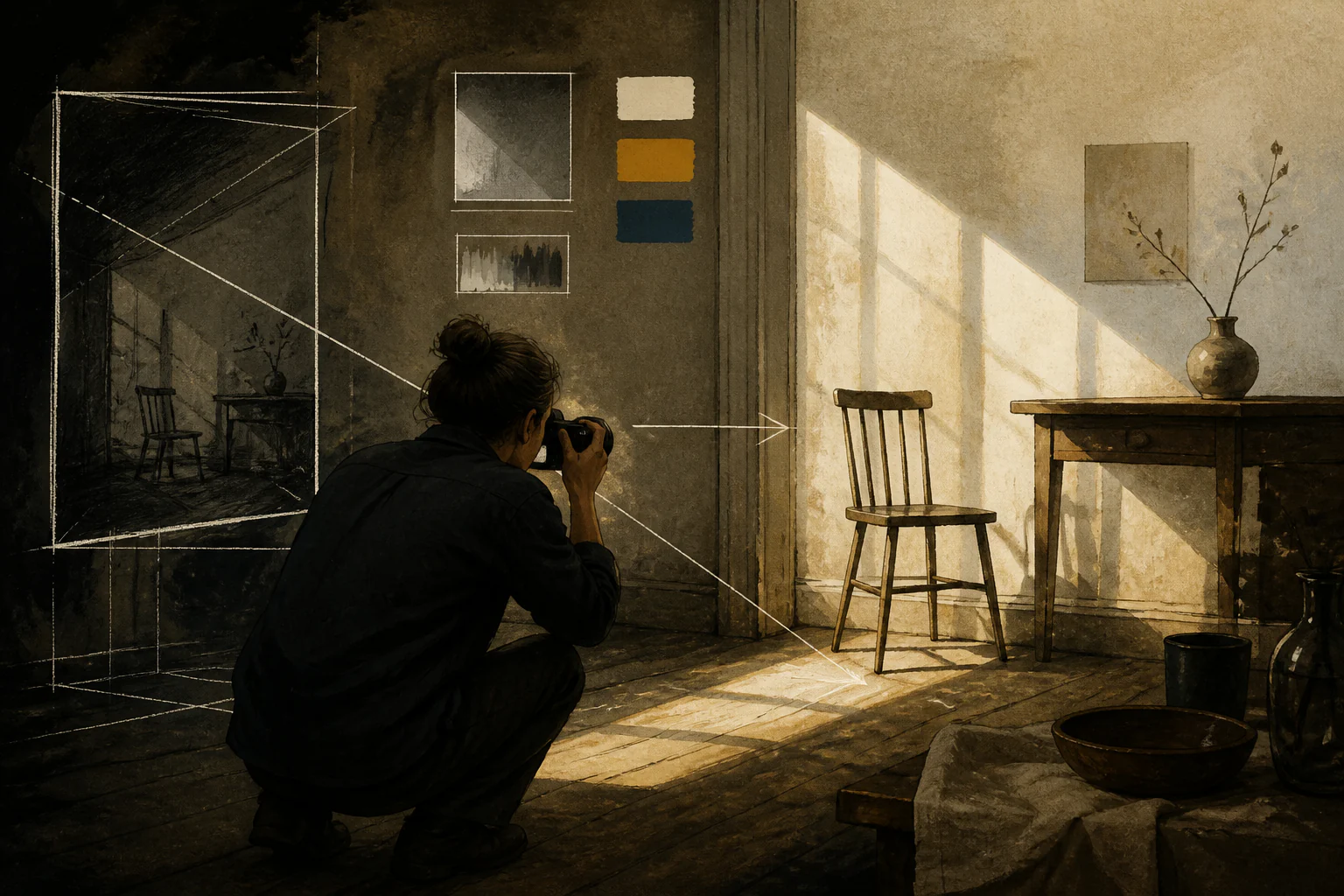
A room becomes an image when the photographer sees light, lines and pause before furniture.
Editorial question
Why can a photograph feel strong before we understand its plot?
Short answer
A room becomes an image when the photographer sees light, lines and pause before furniture.
Thesis
Photography does not have to search for a “beautiful location.” It can turn an ordinary place into a scene by reading its light, axes, background, scale and hidden drama.
A room becomes an image when the photographer sees light, lines and pause before furniture.
Evidence and cases
One source and one line
An ordinary room often seems boring until the photographer finds one light source and one strong line.
A dull room usually comes alive on finding a single light source and a single strong guiding line. The rest is removed.
Role instead of cost
A location does not have to be expensive. It needs a role: scale, resistance or silence.
A location need not be expensive. It needs a purpose: to give scale, to offer resistance, or to provide silence.
Distance assigns the genre
A chair against a wall can be domesticity, loneliness, office, waiting or fashion image - distance decides.
A chair against a wall becomes domesticity, loneliness, an office, or a fashion image depending on camera distance and height. Changing genre here is free.
The figure as a scale indicator
Architecture becomes the protagonist in photography when a person only reveals its scale instead of taking all attention.
Architecture becomes principal when a figure only reports size and does not take attention. This is settled by the person’s placement in the frame.
Poor but precise
A bad location is often overloaded. A good one can be poor, but precise.
A bad location is usually overloaded rather than poor. An empty room with one correct element works better than a crowded one.
Light gives time, composition gives event
Light turns a place into a time of day; composition turns a place into an event.
Illumination dates a frame; construction turns a place into an occurrence. These two operations are settled separately.
Details as clues
Background details work like clues: a socket, curtain, floor seam or mark on a wall can make the frame alive.
A socket, a curtain, a floor seam, or a mark on a wall report a room’s life. Keeping them separates a scene from a set.
An ordinary place as a test of clothing
In fashion shooting, an ordinary place is especially valuable: it does not decorate clothing, but tests it against reality.
In fashion photography an ordinary location is valuable because it does not flatter a garment but tests it against reality. A weak look shows immediately.
Relationships instead of furniture
In an interior image, the scene emerges not from furniture, but from relationships between objects, emptiness and person.
An interior frame is built on relations between objects, emptiness, and a person. An inventory of furnishings is not a scene.
Removal instead of addition
The photographer turns a place into a scene not by adding beauty, but by removing unnecessary explanations.
A place becomes a scene not by adding beauty but by removing unnecessary explanation. It is the genre’s cheapest and hardest operation.
Visual analysis
The article's visual logic can be tested through «One source and one line», «Role instead of cost», «Distance assigns the genre», «The figure as a scale indicator», «Poor but precise», «Light gives time, composition gives event». Compare these signs within one object or sequence rather than judging them as an isolated style.
Practical implication
Practical use begins by testing the thesis against a specific object, frame, or production decision. For this subject, the working criterion is: A room becomes an image when the photographer sees light, lines and pause before furniture.
Limitations
“How photography turns an ordinary place into a scene” is limited to its stated subject: a room becomes an image when the photographer sees light, lines and pause before furniture. The analysis does not replace examination of a specific original, project, or production context.
Sources
- The Metropolitan Museum of Art — The Collection
- MoMA — Collection
- V&A — 100 years of fashion photography
- International Color Consortium
- Adobe — Understanding colour management