analysis
Why bad light ruins even a beautiful person
A beautiful face will not save a frame when light destroys form, skin and character.
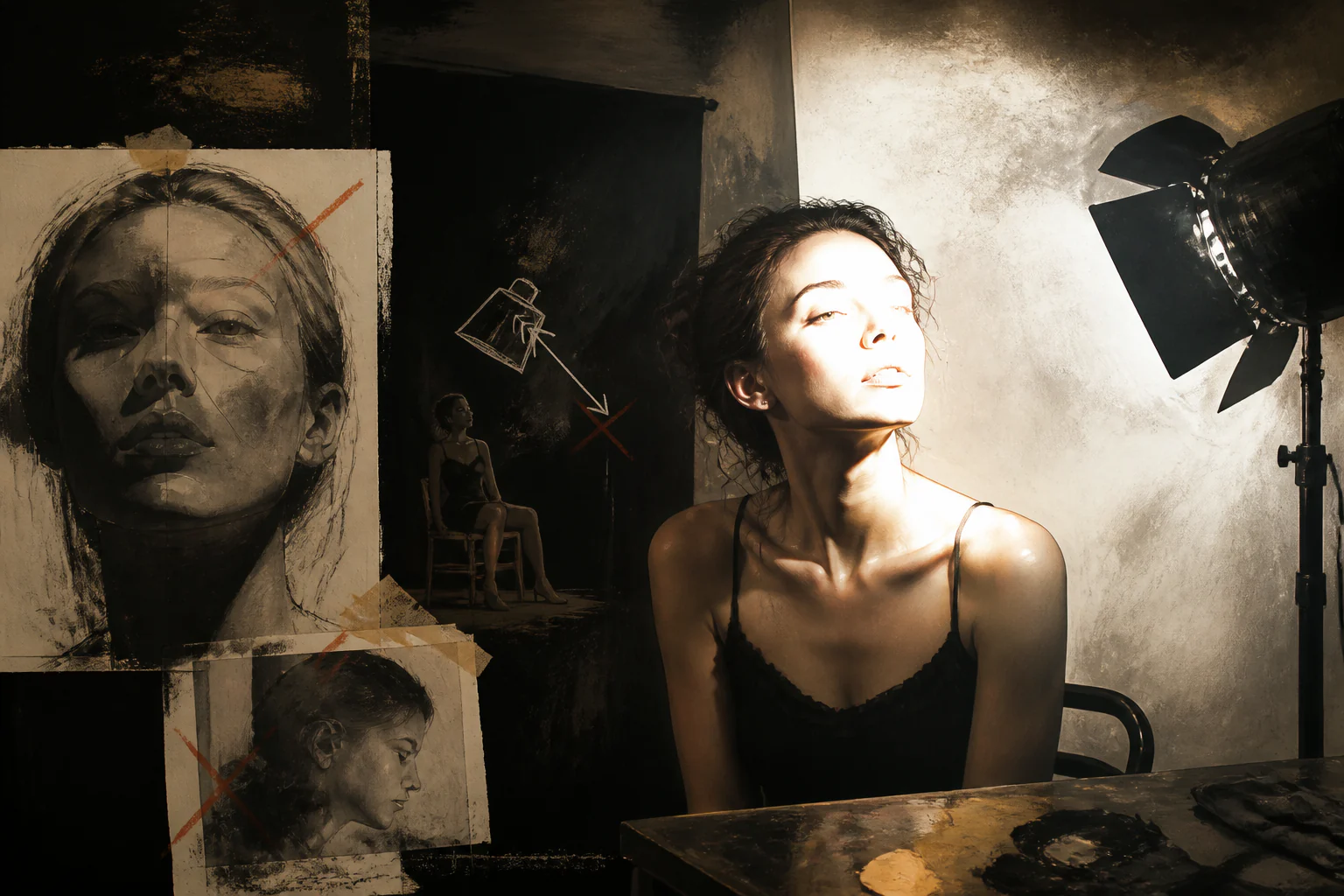
A beautiful face will not save a frame when light destroys form, skin and character.
Editorial question
Why can a photograph feel strong before we understand its plot?
Short answer
A beautiful face will not save a frame when light destroys form, skin and character.
Thesis
Bad light does not merely make a person look “unattractive.” It breaks volume, changes age, contaminates skin, consumes the gaze and turns the face into an accidental surface.
A beautiful face will not save a frame when light destroys form, skin and character.
Evidence and cases
Hard overhead light
Hard overhead light can add fatigue to a face even when the person is rested and beautiful.
A source above drops shadow into the eye sockets and under the cheekbone, adding fatigue. It is the commonest error when shooting under ceiling lighting.
Frontal flash
On-camera frontal flash kills volume: the face becomes flat, the skin plastic, the eyes empty.
Light on the lens axis eliminates shadow and with it volume. A face flattens and skin takes on a plastic sheen.
Light from below
Light from below almost always creates unease because it breaks the logic of everyday daylight.
Illumination from beneath violates the familiar logic of daylight and therefore reads as unease. The device is usable deliberately and almost never by accident.
Mixed light
Mixed light damages skin faster than retouching can repair it: warm face and green shadow rarely look expensive.
A warm face and a green shadow cannot be reconciled in post without losing skin tone. Mixed sources are resolved on set by switching one off.
Softness is not quality
Good portrait light does not have to be soft. It has to understand bone, skin and gaze.
Good portrait light need not be diffuse. It must account for the structure of the skull, the character of the skin, and the direction of the gaze.
Finding the architecture of a face
A beautiful person also has unflattering planes; the photographer’s task is not to hide the face, but to find its architecture.
Every face has unflattering planes. The task is not concealment but finding the angle at which its structure reads.
Face and fabric at once
In fashion portraiture, light has to hold both face and clothing. If the fabric dies, the portrait loses half its meaning.
In a fashion portrait light must hold both subjects. Exposing for the face frequently kills the texture of clothing, and this is a deliberate compromise rather than an oversight.
Between even and dramatic
Overly even light often makes everyone identical; overly dramatic light turns the person into an effect.
Light that is too even depersonalises; light that is too contrasty turns a person into an effect. The range between them is the portraitist’s working zone.
What is checked before shooting
A professional sees the problem before shooting: in the shadow under the nose, the catchlight, the neck color and the cheekbone shape.
The shadow under the nose, the catchlight, neck colour, and cheekbone shape are four points by which light is assessed before the shutter.
Beauty as an alliance of decisions
Beauty in a frame is not a face alone, but an alliance of face, light, distance and decision.
A frame is held not by a face but by the combination of face, light, distance, and moment. Removing any of the four destroys the rest.
Visual analysis
The article's visual logic can be tested through «Hard overhead light», «Frontal flash», «Light from below», «Mixed light», «Softness is not quality», «Finding the architecture of a face». Compare these signs within one object or sequence rather than judging them as an isolated style.
Practical implication
Practical use begins by testing the thesis against a specific object, frame, or production decision. For this subject, the working criterion is: A beautiful face will not save a frame when light destroys form, skin and character.
Limitations
“Why bad light ruins even a beautiful person” is limited to its stated subject: a beautiful face will not save a frame when light destroys form, skin and character. The analysis does not replace examination of a specific original, project, or production context.
Sources
- The Metropolitan Museum of Art — The Collection
- MoMA — Collection
- V&A — 100 years of fashion photography
- International Color Consortium
- Adobe — Understanding colour management