analysis
Why shadow is more important than light
Light reveals. Shadow makes form believable.
Light reveals. Shadow makes form believable.
Editorial question
Why can a photograph feel strong before we understand its plot?
Short answer
Light reveals. Shadow makes form believable.
Thesis
Shadow is not the absence of information, but a way of organizing it. Shadow creates volume, rhythm, pause, mystery and the feeling of reality.
Light reveals. Shadow makes form believable.
Evidence and cases
Diagram versus weight
Without shadow an object becomes a diagram. With shadow it gains weight.
An object without shadow is identified but not felt. Shadow restores mass and places a thing in space.
Soft and hard boundaries
Soft shadow speaks of closeness and air; hard shadow speaks of clarity, sun, power or anxiety.
The width of a transition reports the size of a source and its distance. It is the one marker by which a viewer unerringly reads shooting conditions.
Shadow as protagonist
Shadow can be the protagonist of the frame even when the viewer first looks at a face or object.
An image can be built on shadow rather than on a lit object. Such a decision requires the shadow to have form rather than be a remainder.
Shadow as a clock
In interiors, shadow shows time of day better than any clock.
In an interior the length and direction of shadow date a frame more accurately than any object. This works both as credibility and as an error when handled carelessly.
Shadow and the silhouette of clothing
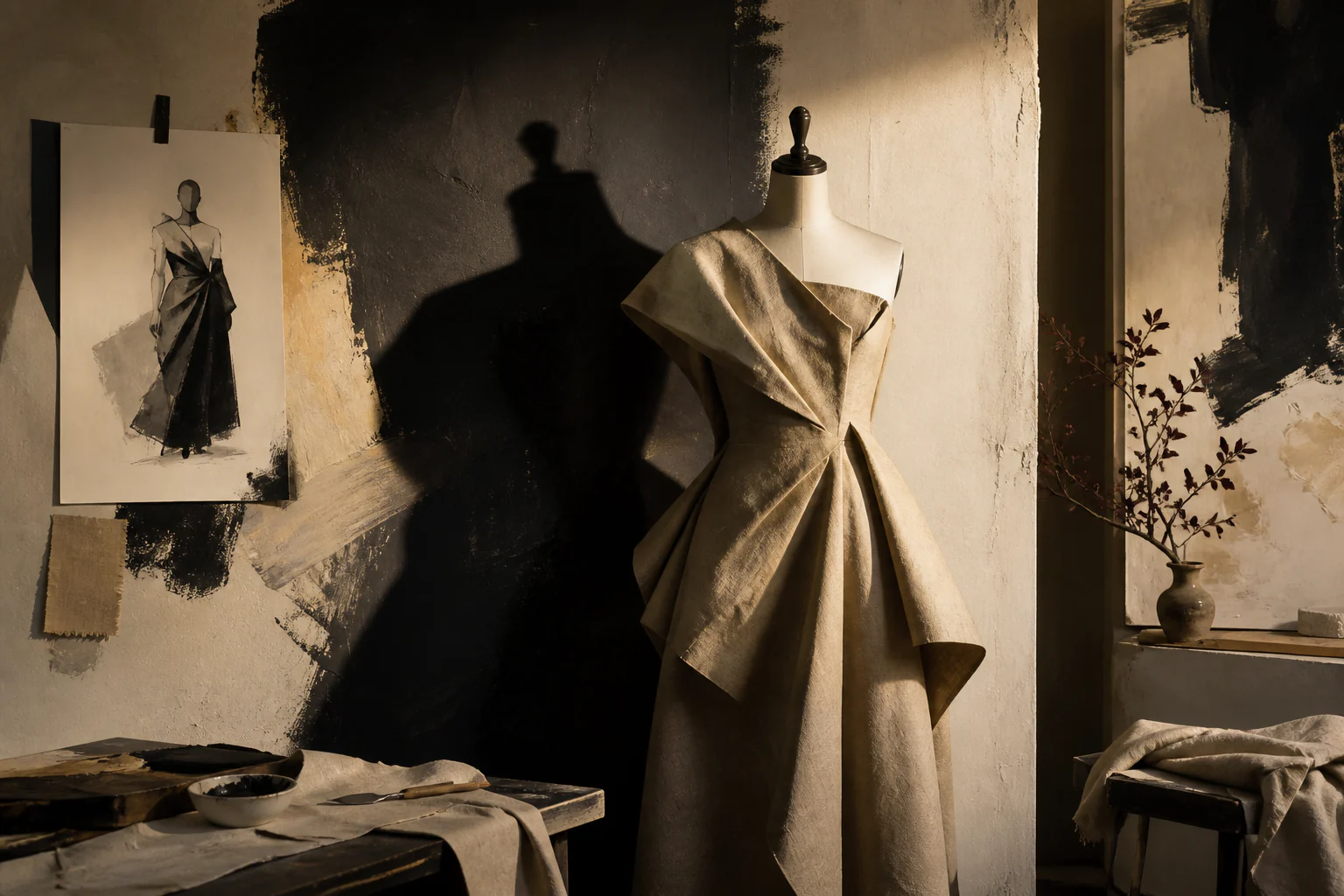
In fashion, shadow defines silhouette: it can make fabric sculptural or heavy.
A fabric’s own shadow makes it sculptural or heavy. The same garment under different light reads as construction or as mass.
The contact shadow
In product photography, shadow creates trust: the object must stand in the world, not float in emptiness.
Shadow where an object meets its support proves the thing is standing. Its absence leaves the object floating and destroys trust in the frame.
Signs of accidental shadow
Bad shadow is accidental: it cuts the body, stains the background, argues with the composition.
Bad shadow cuts the body, stains the background, and argues with the composition. All three defects are found before shooting by looking at the background rather than the model.
Inevitability as criterion
Good shadow looks inevitable: as if it had always been there.
Good shadow looks as though it could not be otherwise. This is the same criterion as in composition: the absence of visible arbitrariness.
Micro-shadow and materiality
Retouching often damages an image by removing micro-shadows and with them materiality.
Retouching that removes small shadows in pores and weave destroys the sense of material. The loss is irreversible and is not restored by sharpening.
The silence of an image
A photographer who sees shadow controls not only light, but the silence of the image.
Governing shadow is governing what a frame stays silent about. It is a resource available without additional equipment.
Visual analysis
The article's visual logic can be tested through «Diagram versus weight», «Soft and hard boundaries», «Shadow as protagonist», «Shadow as a clock», «Shadow and the silhouette of clothing», «The contact shadow». Compare these signs within one object or sequence rather than judging them as an isolated style.
Practical implication
Practical use begins by testing the thesis against a specific object, frame, or production decision. For this subject, the working criterion is: Light reveals. Shadow makes form believable.
Limitations
“Why shadow is more important than light” is limited to its stated subject: light reveals. shadow makes form believable. The analysis does not replace examination of a specific original, project, or production context.
Sources
- The Metropolitan Museum of Art — The Collection
- MoMA — Collection
- V&A — 100 years of fashion photography
- International Color Consortium
- Adobe — Understanding colour management