collection
Design Language
A curated collection of movements, principles and authors that shaped a shared professional vocabulary of visual design.
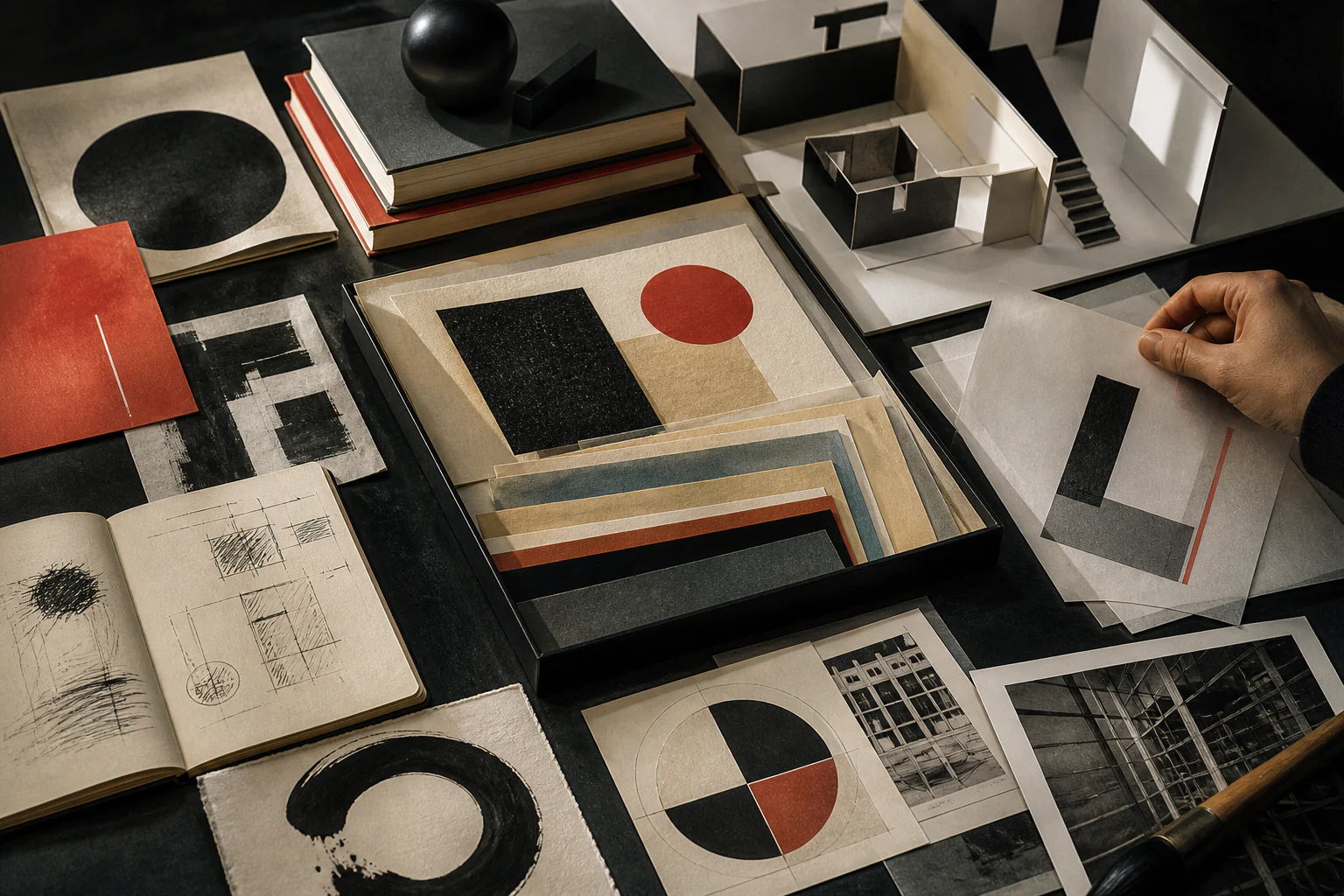
How visual systems become a language — and how to read them
What is design language
Design language is not a style or a set of techniques. It is a system of decisions: how form and function relate, how hierarchy is built, how visual elements address the viewer. This collection covers movements, principles and authors whose work formed a shared professional vocabulary.
Movements and principles
- Bauhaus — the first attempt to unite art, craft and industrial production into a single system.
- Modernism — "form follows function" as professional ethics.
- Constructivism — engineering, agitation and visual discipline.
- Swiss Style — grid, typography, objective information.
- De Stijl — grid, primary colours, universal order.
- Postmodernism — quotation, irony, the return of the sign.
- Memphis — colour, play, anti-functional energy.
- Minimalism — reduction, space, the discipline of form.
- Art Deco — luxury, geometry, the machine.
- Art Nouveau — line, nature, the total interior.
- Brutalism — mass, concrete, structural honesty.
- Deconstructivism — fracture, tension, unstable form.
- Pop Art — mass culture, commodity, image.
- Surrealism — dream, object, the logic of the impossible.
- Radical Design — protest, utopia, anti-commercial form.
Iconic objects
- Barcelona Chair — a chair as architectural manifesto.
- Eames Lounge Chair — comfort as visual language.
- LC4 — chaise longue as a system of rest.
- Panton Chair — the first monolithic plastic chair.
- Superleggera — super-lightness as principle.
- Mezzadro — a tractor seat in the interior.
- Sacco — a form that follows the body.
- UP5/UP6 — an inflatable object as feminist gesture.
- Wiggle Side Chair — cardboard as structural material.
- Carlton — a bookcase as postmodern figure.
- 606 Universal Shelving System — a storage system as visual order.
- Ulm Stool — multi-functionality as principle.
Clothing as language
- The Suit — constructing the modern social body.
- The Button — function, sign and industrial object.
Visual language in time
- Title Sequences — typography in time.
- Motion Design — graphic design that gained time.
- Storyboard — image before image.
Authors
- Josef Müller-Brockmann — the grid as a way of thinking.
- Massimo Vignelli — system, order, design is one.
- Paul Rand — modernism, wit, corporate identity.
- Otl Aicher — system, pictograms, public infrastructure.
- Paula Scher — typography, identity, urban voice.
- Wim Crouwel — grid, technology, design as system.
- Saul Bass — symbol, motion, film, visual system.
- Herb Lubalin — words as image, expressive typography.
- Neville Brody — typography, subculture, changing visual language.
- David Carson — intuition, illegibility, design as experience.
Studios and organisations
- Pentagram — a partnership model where each author works independently.
- Experimental Jetset — an Amsterdam studio that made language its subject of inquiry.
- Wolff Olins — identity as a position, not a set of graphic elements.
- Collins — a studio at the intersection of strategy and visual language.
- Porto Rocha — a New York studio with an editorial approach to identity.
- Lars Müller Publishers — a publisher that shaped the discourse around the Swiss tradition.