collection
Design Systems
Organisations, authors and movements that turned a method into reproducible practice — from Swiss typography to parametric architecture.
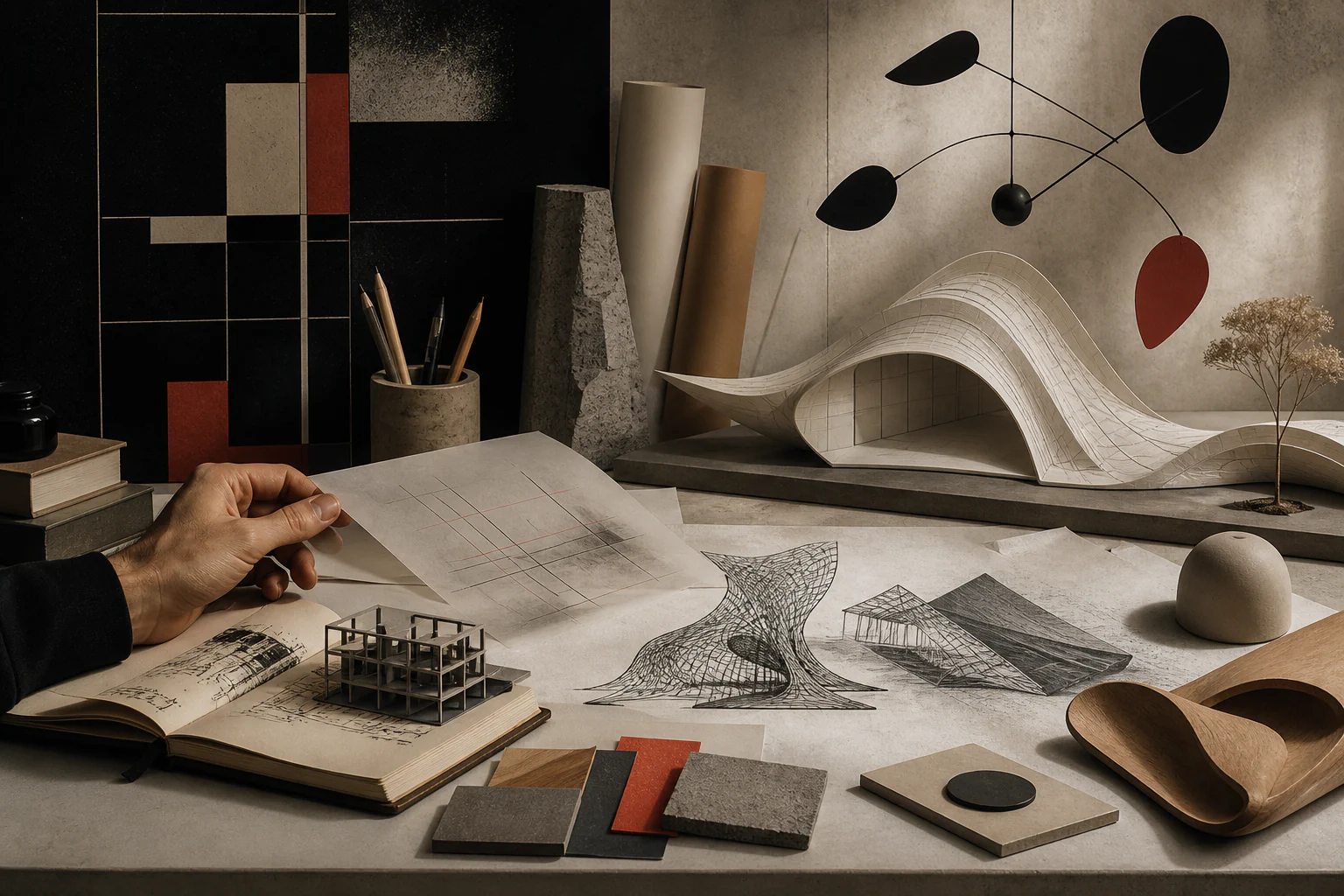
How organisational structures turn a method into a repeatable practice
About the collection
A design system is not a toolkit, a component library or a style guide. It is a way of organising decisions that lets a method work without the author's constant presence. This collection covers organisations, authors and movements that turned method into system.
Clothing production
- Haute Couture — the production system of high fashion.
- Ready-to-Wear — designer clothing as an industrial system.
- Tailoring Construction — the inner architecture of the jacket.
- The Pattern — translating the three-dimensional body into a plane.
- The Dress Form — a tool between body and form.
- Knitwear — form created by the loop.
- Knitting — producing surface and form at the same time.
- Lining — the invisible architecture of clothing.
- The Zipper — the technology that changed clothing.
- Bias Cut — Madeleine Vionnet and the remaking of the silhouette.
- Draping — soft construction.
- Pleating — Issey Miyake and permanent form.
- Couture Embroidery — the Lunéville needle.
Commercial spaces
- The Boutique — architecture of luxury.
- The Concept Store — from selling to curating.
- The Department Store — a city inside a building.
- The Store — commercial space as a visual system.
- The Showroom — between sample and sale.
- The Shop Window — product theatre between street and interior.
- The Hotel — temporary home as a design system.
Institutional spaces
- The Museum — route, display and the management of attention.
- The Exhibition — temporary architecture of an argument.
- The House — how design organises everyday ritual.
- Neue Nationalgalerie — as a space of display.
- Olivetti Showroom / Carlo Scarpa — shop as exhibition space.
- Prada Epicenter New York / OMA — retail as architectural manifesto.
- Vitra Campus — an encyclopedia of architecture and objects.
- Eames House — a house as manifesto.
Design studios and agencies
- Pentagram — a partnership model without a single design director.
- IDEO — design thinking as a reproducible process.
- Wolff Olins — identity as strategic system.
- Landor — a global branding system.
- Collins — strategy and visual language as a single system.
- Mucho — identity as editorial system.
- Porto Rocha — typography and structure as method.
- Experimental Jetset — a minimalist system grounded in typographic decisions.
- Studio Dumbar/DEPT — a Dutch studio working with public visual systems.
- Wieden+Kennedy — an advertising system grounded in authorial voice.
Architecture as system
- OMA — research as a design method.
- BIG — the diagram as a tool for organisation and communication.
- Snøhetta — a spatial system grounded in landscape and public use.
- Field Operations — landscape urbanism as infrastructural system.
- West 8 — the urban environment as a designable ecosystem.
Systematic authors
- Josef Müller-Brockmann — the grid as a transferable decision-making system.
- Massimo Vignelli — the systematic approach as professional ethics.
- Paul Rand — corporate identity as visual system.
- Otl Aicher — pictograms and public infrastructure as systemic project.
- Paula Scher — typography as the organising principle of identity.
- Wim Crouwel — design as a systematised technological process.
Movements and principles
- Swiss Style — the grid and objectivity as system-forming principles.
- Constructivism — visual communication production as a systemic discipline.
- Bauhaus — integrating art, craft and industrial production into a unified educational system.
- Modernism — functionality as the principle that organises form.
- Parametricism — algorithm, surface, continuous form system.