encyclopedia
3D Gaussian splatting
A scene is represented by millions of translucent blobs instead of surfaces, delivering display speed at high quality.
Editorial thesis
The method matters as a return to explicit scene representation after the neural one: quality remained while a hidden function was replaced by a set of objects that can be drawn quickly.
Reader question
Why did abandoning a neural network in favour of a set of elementary primitives turn out to be a step forward?
Short answer
Because an explicit representation is drawn directly by the existing graphics pipeline, without marching a ray through a volume or querying a network per pixel.
1. Definition and boundaries
A scene is described by a set of three-dimensional Gaussians — translucent ellipsoids, each with its own position, shape, colour, and opacity. An image is produced by projecting and compositing them.
2. Origin
The method was proposed in 2023 by a research group in France and almost immediately displaced the preceding approach in applied work thanks to its display speed.
3. Difference from a neural field
The preceding method stored a scene in network weights and required a query for every point along a ray. Here the scene is stored explicitly and drawing reduces to sorting and compositing primitives.
4. Why it is faster
Projecting an ellipsoid onto a plane is an operation for which graphics hardware has been optimised for decades. The method uses the existing pipeline instead of bypassing it.
5. Initialisation from a point cloud
Training begins with the sparse cloud obtained when computing camera positions. Each point becomes an initial primitive that is subsequently refined.
6. Adaptive densification
During training primitives are split where detail is lacking and removed where they are unnecessary. Density adapts to the scene automatically rather than being set in advance.
7. Anisotropy as the key property
An ellipsoid can be elongated along one axis, allowing thin structures — wires, grass, hair — to be described with few elements. An isotropic point would require an order of magnitude more.
8. View-dependent colour
Each primitive’s colour varies with viewing angle, reproducing highlights and reflections. This is inherited from the preceding method and remains a condition of plausibility.
9. Compositing order as bottleneck
Translucent elements must be composited in correct depth order. Sorting millions of primitives per frame is the method’s principal computational load.
10. Characteristic artefacts
Moving away from captured viewpoints produces elongated streaks and disintegrating edges. The defect indicates directly where capture coverage was insufficient.
11. Data volume
A scene occupies substantially more space than a neural representation: millions of primitives with parameters. Compressing such scenes has become a separate line of work.
12. Editability as an advantage
An explicit representation is easier to edit: primitives can be selected, moved, or deleted. This is markedly more practical than an opaque network in which objects are not localised.
13. The absence of a surface as a limitation
The method yields no geometry in the usual sense, so collision, shadow, and physics computation requires separate mesh extraction. In production this is a significant inconvenience.
14. Lighting is fixed
Light is baked into primitive colour at capture time. A scene cannot be relit without additional methods for separating material from illumination.
15. Capture requirements
Like its predecessor, the method requires dense viewpoint coverage under constant lighting. Result quality is determined by capture discipline more than by the algorithm.
16. Application in documentation
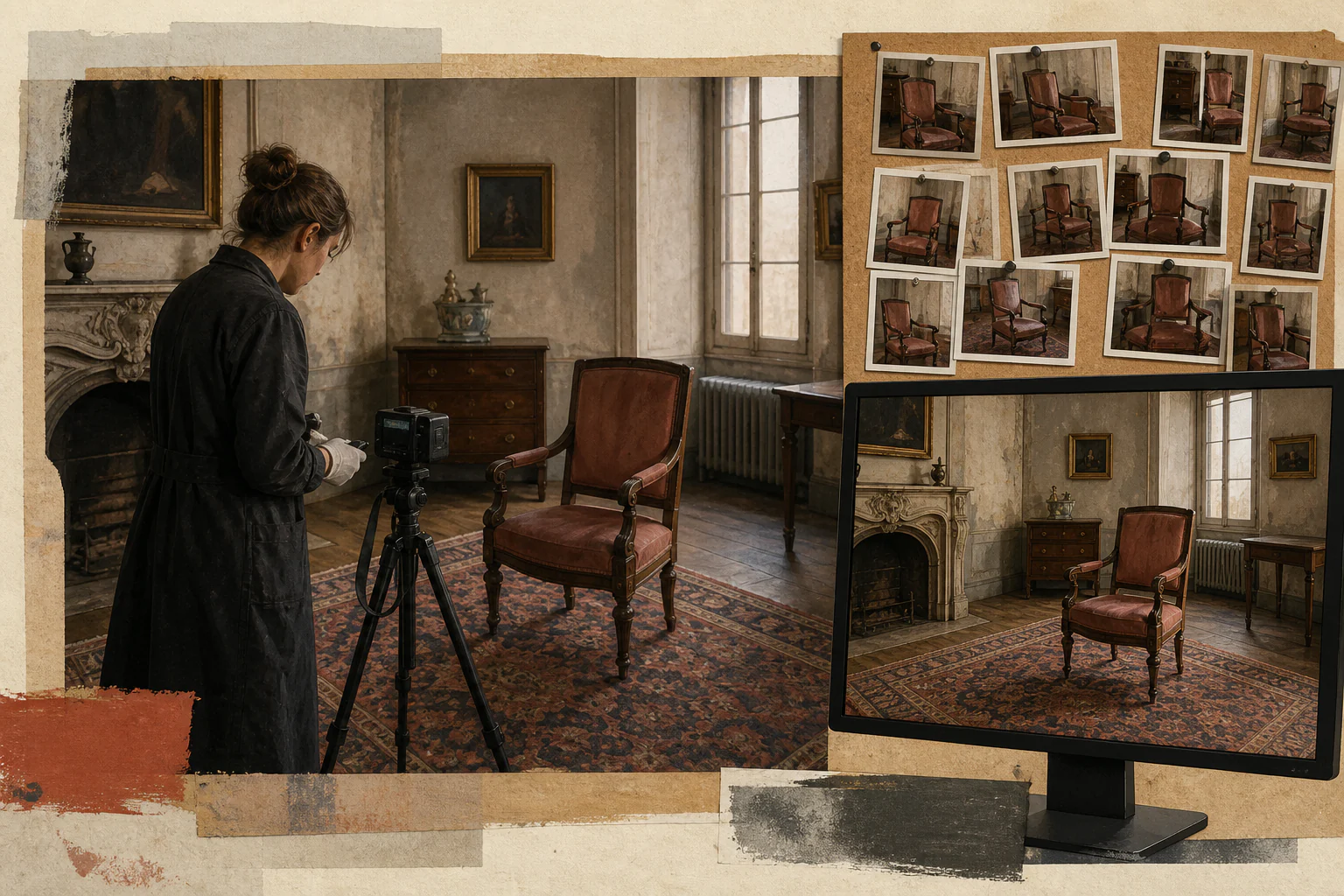
Capturing an interior or an object yields a navigable scene within minutes. For recording the state of a room this is faster and more complete than photography.
17. Application in film and advertising
Reconstructed locations serve as background and as a source of illumination. The method is especially convenient for vegetation and complex textures that are expensive to model.
18. Application in retail and property
Inspecting a room or a product from an arbitrary viewpoint has become practical. This is the method’s closest case to mass application.
19. Dynamic scenes
Extensions describe movement by making parameters time-dependent. Quality is below the static case, and the direction is under active development.
20. Pipeline compatibility
The method integrates poorly with existing polygon-oriented tools. Practical use usually requires conversion that loses some quality.
21. Documentary status
As with its predecessor, the result is synthesised and contains inferred regions. It documents appearance but is not photographic evidence.
22. What is usually misunderstood
The error is to treat the method as a form of photogrammetry. It does not build a surface and solves a different problem: synthesising a view rather than measuring a form.
23. Counterargument
The objection is practical: production needs a mesh, and a method that does not supply one remains an intermediate link rather than a final format.
24. Where the counterargument holds
It holds for tasks requiring physics, collision, and scene recomposition. There explicit geometry is mandatory.
25. Where it fails
It fails for inspection and presentation tasks where only a view is needed. In that class the method surpasses alternatives in the ratio of quality to speed.
26. Speed of adoption
Roughly a year passed between publication and appearance in commercial products — an unusually short interval, explained by compatibility with existing hardware.
27. Link to graphics history
Representing scenes by points was discussed for decades and considered a dead end. The method showed the old idea works given the right primitive parameterisation.
28. Impact on adjacent fields
The approach quickly entered robotics and mapping, where reconstructing surroundings from a camera is the founding task.
29. Current state
The method has become a practical standard for novel view synthesis, displacing its predecessor in applied work. Limitations on relighting remain unresolved.
30. How to read the subject today
Move away from the captured viewpoints. The method is tested precisely where the camera was not: disintegrating edges show the boundary of reliability.