encyclopedia
Augmented reality and spatial computing
The image stops being a frame and becomes a layer anchored to the real geometry of a room.
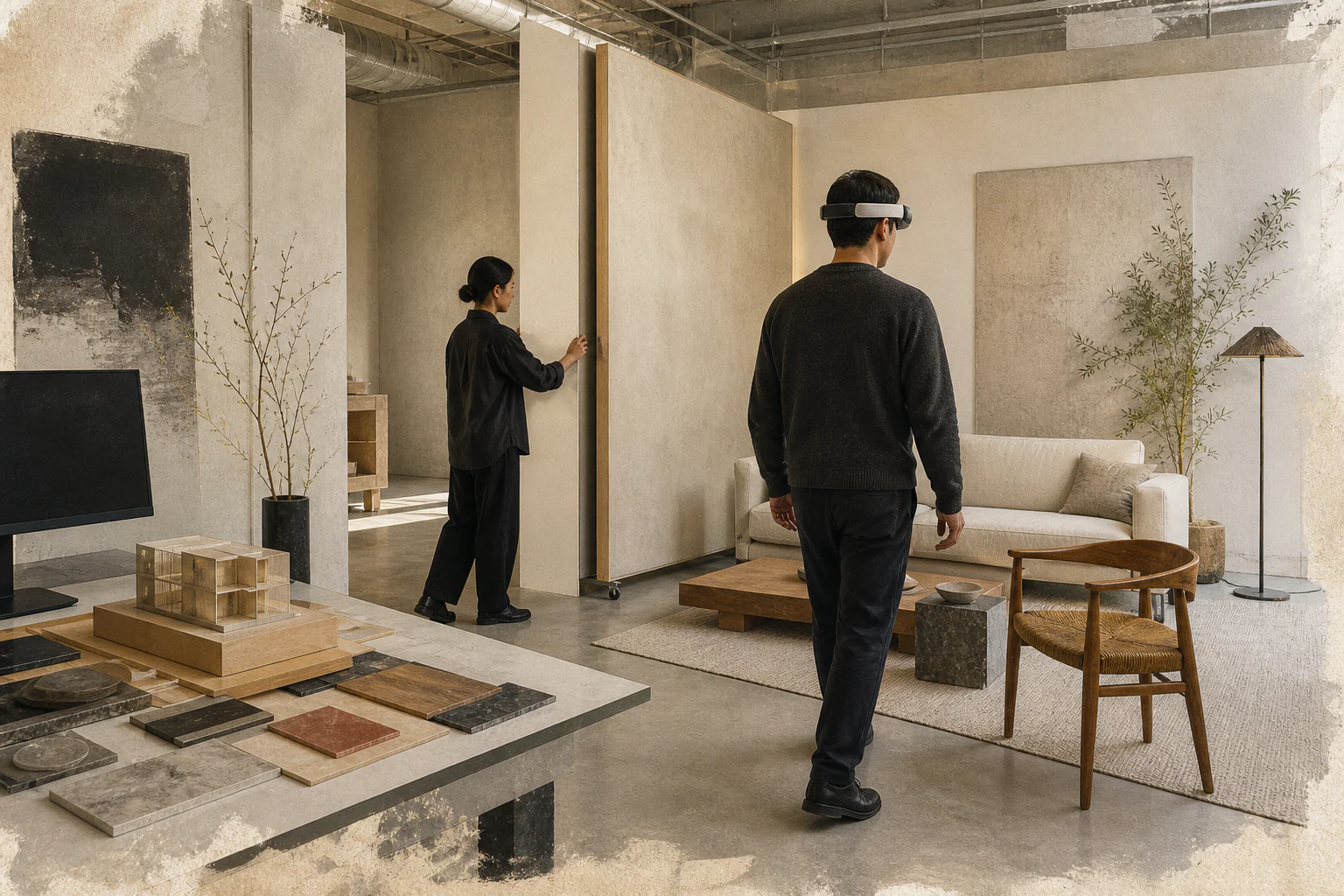
Editorial thesis
The technology matters not as a screen near the face but as the first case in which an image had to know the shape of a room in order to exist at all.
Reader question
What changes in design when an image must account for the real geometry and lighting of the place where it is shown?
Short answer
Composition stops being authorial: the frame is set by the room and the viewer’s position, and the author designs an object’s rules of behaviour rather than a picture.
1. Definition and boundaries
Augmented reality places a synthetic object into an image of real space while preserving its anchoring to that space’s geometry. Spatial computing is the broader term: it describes a system for which a room is a data structure.
2. Difference from virtual reality
Virtual reality replaces the surroundings entirely and therefore need not know them. Augmented reality must: it requires a map of surfaces, lighting, and viewer position, or the object will not sit in place.
3. Origins and prehistory
The line runs from head-mounted displays and laboratory head-tracking systems. For a long time the problem was military and aeronautical, where aligning a symbol with a real object solves a practical task.
4. Why the subject became mass
The decisive factor was not the display but the sensor: once camera, gyroscope, and sufficient compute entered consumer devices, the problem no longer required a laboratory.
5. Scene understanding
The system must recognise planes, boundaries, and obstacles before placing an object. This is a separate and difficult problem: an error of a few centimetres in locating the floor immediately destroys plausibility.
6. Positional tracking
The device continuously computes its own position from visible features and sensor data. Accumulated drift shows up as an object slowly sliding away — a characteristic defect that immediately reveals the technology.
7. Occlusion as a condition of plausibility
A virtual object must be hidden by real objects that come in front of it. Without correct occlusion it reads as a sticker on the image rather than as a thing present in the room.
8. Lighting as reconciliation
A synthetic object must take the room’s light: direction, temperature, and intensity. Estimating illumination from a camera remains approximate, and this is where credibility most often breaks.
9. Scale as a verifiable quantity
Unlike a screen image, scale here is absolute: an object has a size in metres and is compared with furniture. A scale error is not a stylistic decision; it reads as a fault.
10. Latency and bodily response
Permissible latency is measured in milliseconds, because a mismatch with head movement causes physical discomfort. It is a rare case of an engineering requirement set by physiology.
11. Composition without a frame
The author loses control of the frame: the viewer chooses viewpoint and distance. What is designed is not an image but an object that must survive viewing from any side.
12. Inheritance from scenography
The task is closer to exhibition than to screen work: visitor route, distance, and what is seen first all matter. Museum display experience transfers here more accurately than layout experience.
13. Interface without controls
Interaction is built on gaze, gesture, and voice rather than on a button. The absence of physical feedback makes confirmation of an action a design problem in its own right.
14. Fatigue as a constraint
Device weight, visual load, and the need to hold hands raised limit a session. This imposes hard limits on scenarios that a screen does not have.
15. Retail application
Placing furniture in an interior and trying footwear on the foot are the most justified cases: they solve a specific purchasing problem in which scale and colour cannot be judged from a photograph.
16. Production application
Overlaying a drawing on real construction on site gives measurable benefit: a discrepancy is visible at once. Here the technology works as an instrument of inspection rather than as an image.
17. Exhibition application
In a museum a layer can show an object’s lost state over its surviving one. The device has documentary value but demands a clear mark of where evidence ends and reconstruction begins.
18. Material in an augmented scene
Synthetic surfaces read convincingly only with correct reflection. Metal and glass expose an error immediately, whereas matt materials forgive lighting inaccuracy.
19. Photography as by-product
Most people see such scenes not through a device but through someone else’s photograph or video. This restores the frame and turns the result into an ordinary image with ordinary rules.
20. Privacy of the room
Operation requires continuous scanning of a dwelling, producing a detailed map of private space. This differs substantially from a camera: what is captured is not a frame but a geometry.
21. Standards and interoperability
Scenes are described by interchange formats inheriting the logic of three-dimensional production. Interoperability determines whether work survives a change of device, and therefore matters more than platform choice.
22. The production chain
Model, material, light, and behaviour logic are prepared with the same tools as in film. The only difference is at the end of the chain: the result is computed on the device in real time.
23. The compute budget
A standalone device is limited by heat and battery, so quality is bounded not by taste but by a frame budget. Design here is closer to engineering calculation than to visual choice.
24. What is usually misunderstood
The main error is treating the problem as graphical. The principal difficulty lies in scene understanding and tracking — that is, in computer vision rather than in model quality.
25. Counterargument
The objection is justified: over three decades the technology has repeatedly been declared mass-market and has each time remained niche. No durable consumer scenario has yet appeared.
26. Where the counterargument holds
It holds for entertainment use, where an advantage over the screen is unproven. Nobody will wear a device for something more conveniently viewed on a phone.
27. Where it fails
It fails in industrial tasks where alignment with a real object is mandatory: assembly, maintenance, surgery, navigation. There the benefit is measurable and demonstrated.
28. Impact on adjacent fields
The requirement to understand a room pushed forward scanning and scene reconstruction. These methods proved more useful than augmented reality itself and migrated into film and mapping.
29. Current state
The technology exists simultaneously as a professional tool with proven benefit and as a consumer product with an undefined scenario. These two states should be discussed separately.
30. What to check
When assessing a project, ask about occlusion, drift, and lighting estimation. These three parameters determine whether an object reads as present or as overlaid.
31. How to read the subject today
Separate demonstration from operation. A promotional clip is shot in a prepared room with ideal light; the technology’s working value is tested in an ordinary room under ordinary lighting.