encyclopedia
606 Universal Shelving System
Modularity, repairability and the long life of an object
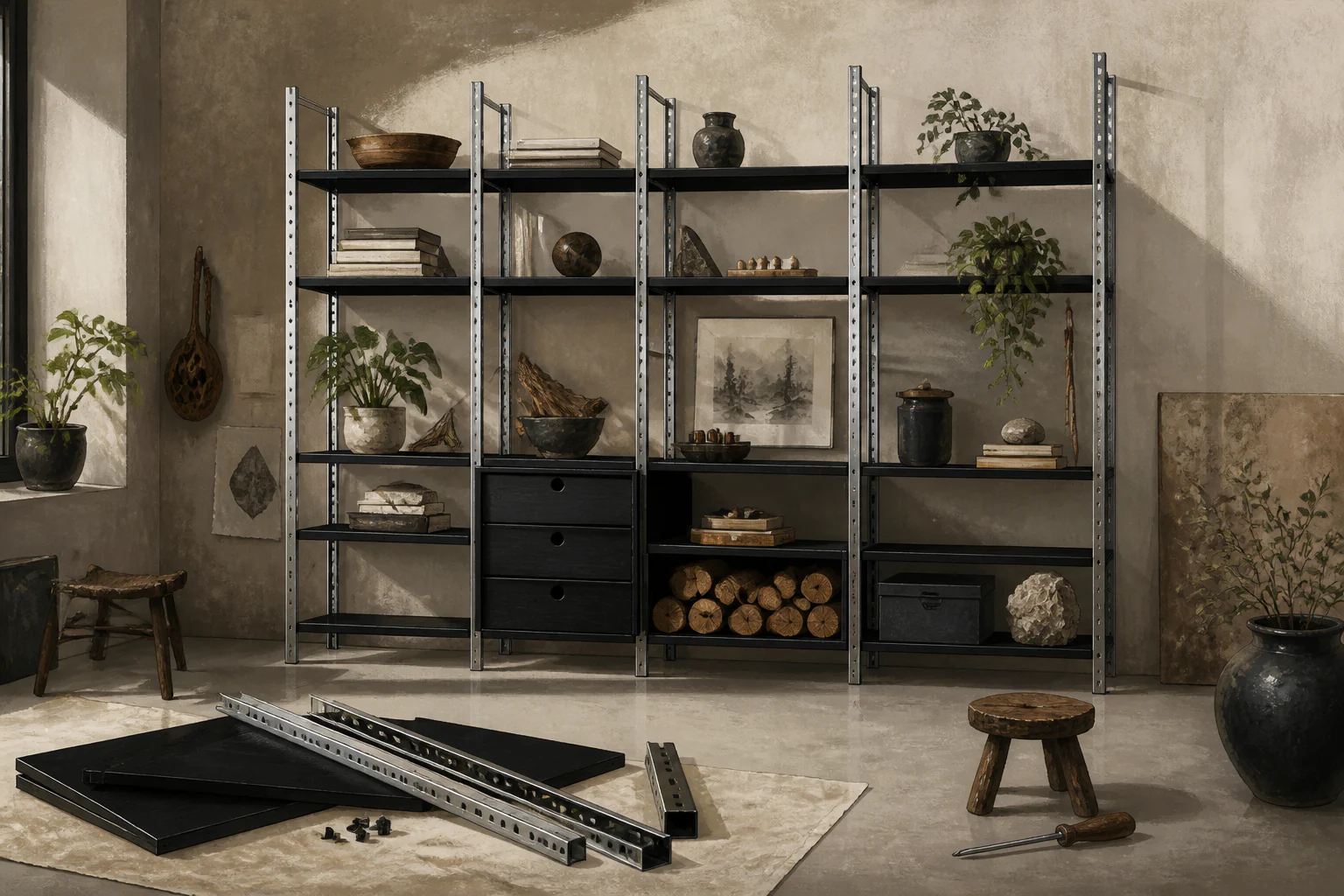
606 Universal Shelving System matters to VANSMITHLAB not because it is called an icon, but because one object reveals the chain author → material → production → space → image → canon. Modularity, repairability and the long life of an object.
Editorial thesis
606 Universal Shelving System matters to VANSMITHLAB not because it is called an icon, but because one object reveals the chain author → material → production → space → image → canon. Modularity, repairability and the long life of an object.
Reader question
Why did 606 Universal Shelving System become important to design history if it is only one piece of furniture?
Short answer
Because 606 Universal Shelving System makes a new relationship between form, body, material and production visible. Its historical role lies in the design problem it formulated and the way that formulation outlived its original moment.
1. Definition and boundaries of the object
The 606 Universal Shelving System is a modular storage system designed by Dieter Rams in 1960 for Vitsœ. Instead of a finished cabinet, the user receives infrastructure: tracks, shelves, cabinets, desks and fittings that can be assembled, rearranged and extended.
2. Origins and prehistory
The system emerged from postwar systems design, where an object could be treated as an adaptable structure rather than a one-off composition. Rams and Vitsœ made duration and adaptation central to the product decades before today’s circularity vocabulary.
3. Why the object emerged when it did
The system emerged from postwar systems design, where an object could be treated as an adaptable structure rather than a one-off composition. Rams and Vitsœ made duration and adaptation central to the product decades before today’s circularity vocabulary. The date 1960 matters not as an isolated timestamp but as the point where material, production and cultural programme converged in one object.
4. Material, construction and composition
The system is organised around aluminium tracks from which shelves, cabinets and work surfaces are hung. The supporting infrastructure remains visually quiet so different configurations continue to read as one family.
5. Principle of use and operation
The system is organised around aluminium tracks from which shelves, cabinets and work surfaces are hung. The supporting infrastructure remains visually quiet so different configurations continue to read as one family. Use cannot be separated from construction: how a person sits, moves, carries or reconfigures the object is part of the structural idea.
6. Key technical or cultural turning point
Vitsœ states that 606 has been in continuous production since 1960 and maintains compatibility between new components and existing systems. The production achievement is preservation of an interface across generations of parts. The turning point is the translation of experiment into a reproducible system, making 606 Universal Shelving System a node in design history rather than only an authorial gesture.
7. First reference context
The system emerged from postwar systems design, where an object could be treated as an adaptable structure rather than a one-off composition. Rams and Vitsœ made duration and adaptation central to the product decades before today’s circularity vocabulary. The first reference context explains the original problem addressed by Dieter Rams and why the familiar typology proved insufficient.
8. Second reference context
Vitsœ states that 606 has been in continuous production since 1960 and maintains compatibility between new components and existing systems. The production achievement is preservation of an interface across generations of parts. The second context is production and licensing, showing which properties survived repetition and which depended on period technology.
9. Third reference context
Vitsœ continues to make 606 and develops installation options, including new backward-compatible supports. It remains a rare product in which current versions are expected to work alongside systems several decades old. The third context is museum and contemporary life. Canonisation enables comparison between original purpose and later readings.
10. Form and geometry
The system is organised around aluminium tracks from which shelves, cabinets and work surfaces are hung. The supporting infrastructure remains visually quiet so different configurations continue to read as one family. The geometry of 606 Universal Shelving System is not an outer shell placed over function; it distributes load, organises the body and makes construction legible.
11. Surface, light and colour
In photographs 606 reads not as one object but as a rhythm of horizontal and vertical lines filled with books and belongings. The user layer reveals that the system is meant to change rather than remain in a sterile museum state. Surface and colour reinforce geometry: material communicates age, technology and making before the viewer reads a caption.
12. Tactility, movement and bodily posture
The 606 Universal Shelving System is a modular storage system designed by Dieter Rams in 1960 for Vitsœ. Instead of a finished cabinet, the user receives infrastructure: tracks, shelves, cabinets, desks and fittings that can be assembled, rearranged and extended. Tactility emerges where body meets material, while movement appears through posture, carrying or reconfiguration. This bodily sequence remains part of the project.
13. Production system
Vitsœ states that 606 has been in continuous production since 1960 and maintains compatibility between new components and existing systems. The production achievement is preservation of an interface across generations of parts.
14. Tools and infrastructure
The production infrastructure of 606 Universal Shelving System includes drawings, tooling, machines, hand operations, tolerances, supply and quality control. Vitsœ states that 606 has been in continuous production since 1960 and maintains compatibility between new components and existing systems. The production achievement is preservation of an interface across generations of parts.
15. Diffusion and canonisation
Vitsœ continues to make 606 and develops installation options, including new backward-compatible supports. It remains a rare product in which current versions are expected to work alongside systems several decades old. Diffusion occurred not only through sales: exhibitions, museums, magazines, catalogues and photographs turned a thing into a recognisable type and teaching example.
16. Professional practice
For professional designers, 606 Universal Shelving System is useful as a methodological case. 606 moves design from form to rules. The customer buys not a final composition but a grammar able to respond to moving house, a growing library, a new room or a new function. The practical value lies in seeing where form follows material and production and where it becomes cultural statement.
17. Relationship to architecture
606 occupies the wall as a secondary architectural grid. It can become a library, workplace, cabinet or free-standing divider, changing the programme of a room without rebuilding it.
18. Relationship to product design
606 moves design from form to rules. The customer buys not a final composition but a grammar able to respond to moving house, a growing library, a new room or a new function. The object changes not only furniture appearance but the design question itself: what counts as structure, comfort, system, material or authorship.
19. Relationship to fashion
The system became a practical expression of Rams’s less, but better principles. Its cultural influence lies less in silhouette than in a long-term model of relations between designer, manufacturer and user.
20. Relationship to image-making
In photographs 606 reads not as one object but as a rhythm of horizontal and vertical lines filled with books and belongings. The user layer reveals that the system is meant to change rather than remain in a sterile museum state.
21. Relationship to technology
Vitsœ states that 606 has been in continuous production since 1960 and maintains compatibility between new components and existing systems. The production achievement is preservation of an interface across generations of parts. Technology is a co-author of form: change material, tool or process and the field of possible geometry changes too.
22. Relationship to materials
The system is organised around aluminium tracks from which shelves, cabinets and work surfaces are hung. The supporting infrastructure remains visually quiet so different configurations continue to read as one family. Material must therefore be read through thickness, direction, joints, ageing, repair and component interaction, not by substance name alone.
23. Institutions and the canon
Vitsœ continues to make 606 and develops installation options, including new backward-compatible supports. It remains a rare product in which current versions are expected to work alongside systems several decades old. Canonisation through museums and archives preserves documentation and early versions, but also turns domestic furniture into cultural signs. Both roles matter.
24. Market and commercial logic
The market value of 606 Universal Shelving System reflects production, licensing, brand, historical status and demand rather than raw-material price alone. Systems demand discipline: infrastructure, planning and proprietary components create dependence on the maker. A high initial cost can also restrict access, even if long service changes the economics of ownership. High cost by itself proves nothing about design quality.
25. Criticism and limitations
Systems demand discipline: infrastructure, planning and proprietary components create dependence on the maker. A high initial cost can also restrict access, even if long service changes the economics of ownership.
26. Mistakes and myths
The visual minimalism of 606 is sometimes mistaken for an absence of design. Much of the design is hidden in dimensional standards, tolerances, fixings, backward compatibility and planning service — in rules rather than decoration.
27. Sustainability, longevity and maintenance
Starting small, adding parts, rearranging them, taking the system when moving and combining old components with new ones makes longevity part of the product architecture. That is more concrete than a single green material.
28. Contemporary status
Vitsœ continues to make 606 and develops installation options, including new backward-compatible supports. It remains a rare product in which current versions are expected to work alongside systems several decades old.
29. What the object changed in the discipline
606 moves design from form to rules. The customer buys not a final composition but a grammar able to respond to moving house, a growing library, a new room or a new function. The primary contribution is a changed design question: the object offers a new example of linking body, material, production and cultural meaning.
30. How to read the object today
Today 606 Universal Shelving System should be read at three scales: as a thing for the body, as a production system and as an image loaded with history. Systems demand discipline: infrastructure, planning and proprietary components create dependence on the maker. A high initial cost can also restrict access, even if long service changes the economics of ownership. This makes iconic status testable and meaningful.
See also
- Carlton — Memphis: furniture as sign, colour and refusal of neutrality.
- Eames Lounge Chair — Moulded plywood, comfort and postwar luxury.
- Vitra Campus as an Encyclopedia of Architecture and Objects — A production site where factory, museum, fire station, pavilions, and landscape form a long-term collection of architectural methods.
- Ulm Stool — An object as a tool: furniture, education and systems thinking.