encyclopedia
Eames Lounge Chair
Moulded plywood, comfort and postwar luxury
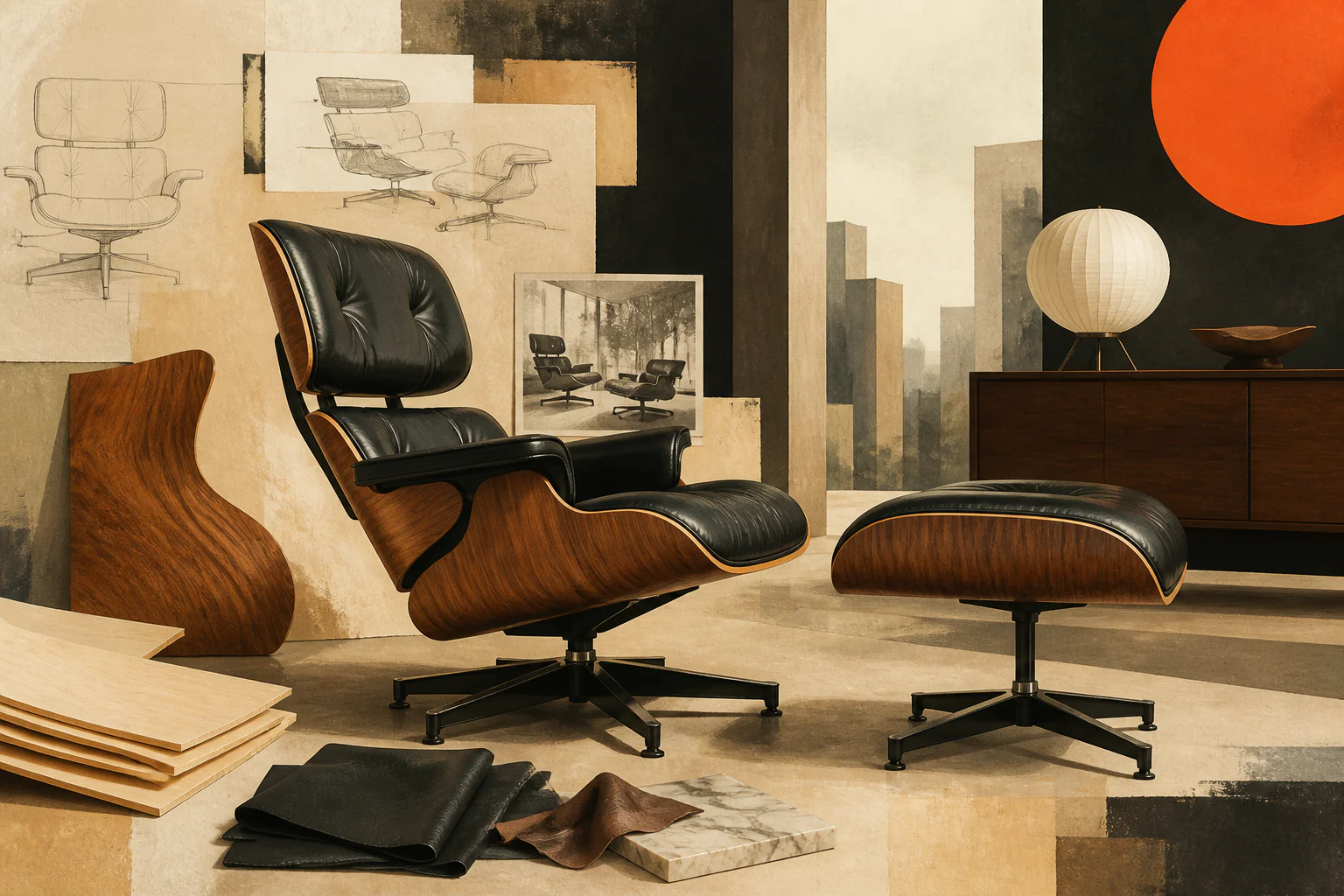
Eames Lounge Chair matters to VANSMITHLAB not because it is called an icon, but because one object reveals the chain author → material → production → space → image → canon. Moulded plywood, comfort and postwar luxury.
Editorial thesis
Eames Lounge Chair matters to VANSMITHLAB not because it is called an icon, but because one object reveals the chain author → material → production → space → image → canon. Moulded plywood, comfort and postwar luxury.
Reader question
Why did Eames Lounge Chair become important to design history if it is only one piece of furniture?
Short answer
Because Eames Lounge Chair makes a new relationship between form, body, material and production visible. Its historical role lies in the design problem it formulated and the way that formulation outlived its original moment.
1. Definition and boundaries of the object
The Eames Lounge Chair and Ottoman is a reclining chair with separate footrest, introduced by Herman Miller in 1956 from a design by Charles and Ray Eames. It combines three moulded plywood shells, removable cushions, a cast metal base and concealed resilient connections.
2. Origins and prehistory
The project grew from the Eameses’ long experimentation with moulded plywood beginning in the 1940s. Unlike their more democratic earlier seating, the new model consciously revisited the English club chair and translated its comfort into industrial modernism.
3. Why the object emerged when it did
The project grew from the Eameses’ long experimentation with moulded plywood beginning in the 1940s. Unlike their more democratic earlier seating, the new model consciously revisited the English club chair and translated its comfort into industrial modernism. The date 1956 matters not as an isolated timestamp but as the point where material, production and cultural programme converged in one object.
4. Material, construction and composition
Back and seat are formed from separate curved plywood shells joined through shock-mount elements; cushions sit inside the shells and the base allows rotation. Veneer, leather or textile and metal remain visually distinct layers.
5. Principle of use and operation
Back and seat are formed from separate curved plywood shells joined through shock-mount elements; cushions sit inside the shells and the base allows rotation. Veneer, leather or textile and metal remain visually distinct layers. Use cannot be separated from construction: how a person sits, moves, carries or reconfigures the object is part of the structural idea.
6. Key technical or cultural turning point
Herman Miller has produced the model since 1956. Manufacturing combines serial plywood moulding, precision casting, upholstery and assembly; this mixture of industrial repeatability and luxurious finish defines the object. The turning point is the translation of experiment into a reproducible system, making Eames Lounge Chair a node in design history rather than only an authorial gesture.
7. First reference context
The project grew from the Eameses’ long experimentation with moulded plywood beginning in the 1940s. Unlike their more democratic earlier seating, the new model consciously revisited the English club chair and translated its comfort into industrial modernism. The first reference context explains the original problem addressed by Charles Eames; Ray Eames and why the familiar typology proved insufficient.
8. Second reference context
Herman Miller has produced the model since 1956. Manufacturing combines serial plywood moulding, precision casting, upholstery and assembly; this mixture of industrial repeatability and luxurious finish defines the object. The second context is production and licensing, showing which properties survived repetition and which depended on period technology.
9. Third reference context
The chair remains in Herman Miller production, with licensed versions on other markets. It operates simultaneously as domestic furniture, museum object and one of the most recognisable signs of American modernism. The third context is museum and contemporary life. Canonisation enables comparison between original purpose and later readings.
10. Form and geometry
Back and seat are formed from separate curved plywood shells joined through shock-mount elements; cushions sit inside the shells and the base allows rotation. Veneer, leather or textile and metal remain visually distinct layers. The geometry of Eames Lounge Chair is not an outer shell placed over function; it distributes load, organises the body and makes construction legible.
11. Surface, light and colour
Photographically, the contrast between soft cushions and wooden shells is crucial. The segmented back and five-star base keep the silhouette recognisable from several angles. Surface and colour reinforce geometry: material communicates age, technology and making before the viewer reads a caption.
12. Tactility, movement and bodily posture
The Eames Lounge Chair and Ottoman is a reclining chair with separate footrest, introduced by Herman Miller in 1956 from a design by Charles and Ray Eames. It combines three moulded plywood shells, removable cushions, a cast metal base and concealed resilient connections. Tactility emerges where body meets material, while movement appears through posture, carrying or reconfiguration. This bodily sequence remains part of the project.
13. Production system
Herman Miller has produced the model since 1956. Manufacturing combines serial plywood moulding, precision casting, upholstery and assembly; this mixture of industrial repeatability and luxurious finish defines the object.
14. Tools and infrastructure
The production infrastructure of Eames Lounge Chair includes drawings, tooling, machines, hand operations, tolerances, supply and quality control. Herman Miller has produced the model since 1956. Manufacturing combines serial plywood moulding, precision casting, upholstery and assembly; this mixture of industrial repeatability and luxurious finish defines the object.
15. Diffusion and canonisation
The chair remains in Herman Miller production, with licensed versions on other markets. It operates simultaneously as domestic furniture, museum object and one of the most recognisable signs of American modernism. Diffusion occurred not only through sales: exhibitions, museums, magazines, catalogues and photographs turned a thing into a recognisable type and teaching example.
16. Professional practice
For professional designers, Eames Lounge Chair is useful as a methodological case. The Eameses demonstrated that modernism did not have to mean hardness or austerity. The chair combines technical rationality with bodily pleasure and helped define a postwar model of modern luxury. The practical value lies in seeing where form follows material and production and where it becomes cultural statement.
17. Relationship to architecture
In the Eames House and wider Eames practice, furniture, graphics, film and architecture were never isolated disciplines. The Lounge Chair continues that environmental approach rather than acting as a detached sculpture.
18. Relationship to product design
The Eameses demonstrated that modernism did not have to mean hardness or austerity. The chair combines technical rationality with bodily pleasure and helped define a postwar model of modern luxury. The object changes not only furniture appearance but the design question itself: what counts as structure, comfort, system, material or authorship.
19. Relationship to fashion
The chair became a visual sign of intellectual comfort in offices, homes, cinema and advertising. It is frequently used to communicate taste, status and design literacy at a glance.
20. Relationship to image-making
Photographically, the contrast between soft cushions and wooden shells is crucial. The segmented back and five-star base keep the silhouette recognisable from several angles.
21. Relationship to technology
Herman Miller has produced the model since 1956. Manufacturing combines serial plywood moulding, precision casting, upholstery and assembly; this mixture of industrial repeatability and luxurious finish defines the object. Technology is a co-author of form: change material, tool or process and the field of possible geometry changes too.
22. Relationship to materials
Back and seat are formed from separate curved plywood shells joined through shock-mount elements; cushions sit inside the shells and the base allows rotation. Veneer, leather or textile and metal remain visually distinct layers. Material must therefore be read through thickness, direction, joints, ageing, repair and component interaction, not by substance name alone.
23. Institutions and the canon
The chair remains in Herman Miller production, with licensed versions on other markets. It operates simultaneously as domestic furniture, museum object and one of the most recognisable signs of American modernism. Canonisation through museums and archives preserves documentation and early versions, but also turns domestic furniture into cultural signs. Both roles matter.
24. Market and commercial logic
The market value of Eames Lounge Chair reflects production, licensing, brand, historical status and demand rather than raw-material price alone. Its comfort and prestige have made it exceptionally copied, producing a large culture of replicas and counterfeits. Its premium materiality also sits in tension with the Eameses’ earlier reputation for affordable mass furniture. High cost by itself proves nothing about design quality.
25. Criticism and limitations
Its comfort and prestige have made it exceptionally copied, producing a large culture of replicas and counterfeits. Its premium materiality also sits in tension with the Eameses’ earlier reputation for affordable mass furniture.
26. Mistakes and myths
The chair is sometimes treated as a spontaneous perfect shape of comfort, but it emerged from a long sequence of plywood, connection and production experiments. Its luxury is built on engineering history.
27. Sustainability, longevity and maintenance
Long production life, replaceable cushions and periodic material updates support extended service. Environmental evaluation depends on veneer sourcing, upholstery, metals and the logistics of the licensed producer.
28. Contemporary status
The chair remains in Herman Miller production, with licensed versions on other markets. It operates simultaneously as domestic furniture, museum object and one of the most recognisable signs of American modernism.
29. What the object changed in the discipline
The Eameses demonstrated that modernism did not have to mean hardness or austerity. The chair combines technical rationality with bodily pleasure and helped define a postwar model of modern luxury. The primary contribution is a changed design question: the object offers a new example of linking body, material, production and cultural meaning.
30. How to read the object today
Today Eames Lounge Chair should be read at three scales: as a thing for the body, as a production system and as an image loaded with history. Its comfort and prestige have made it exceptionally copied, producing a large culture of replicas and counterfeits. Its premium materiality also sits in tension with the Eameses’ earlier reputation for affordable mass furniture. This makes iconic status testable and meaningful.
See also
- Barcelona Chair — A chair as architectural manifesto: steel, leather and ceremony.
- Eames House — Case Study House No. 8: industrial system, home-studio, collection of things, and laboratory of everyday creativity.
- 606 Universal Shelving System — Modularity, repairability and the long life of an object.
- Panton Chair — One material, continuous form and a new plastics industry.