encyclopedia
Display systems — the vitrine as an architecture of attention
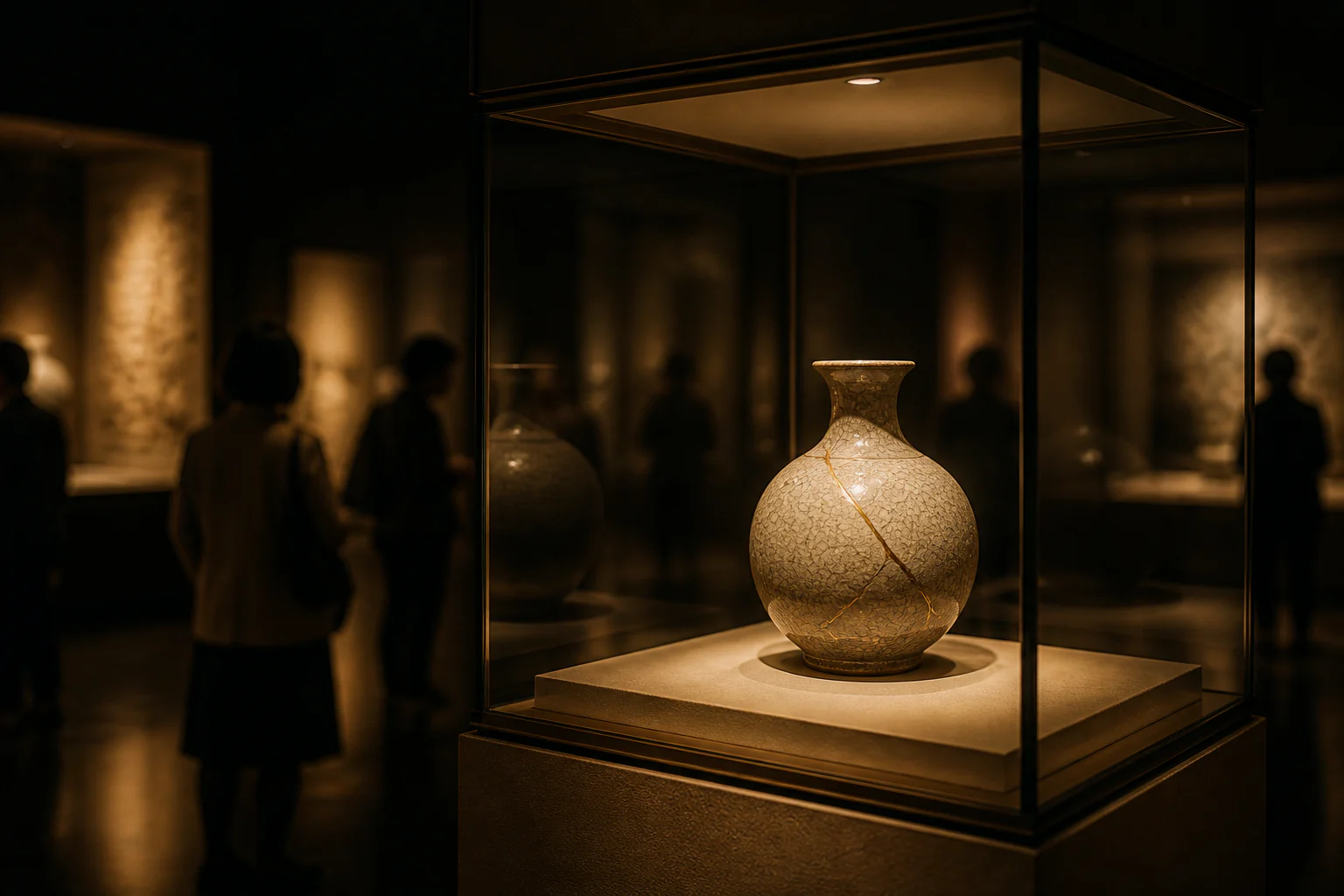
A glass case solves four incompatible problems at once: conservation, security, visibility, and explanation.
Editorial thesis
The vitrine matters not as furniture but as a device that simultaneously protects an object and prescribes the distance and angle from which it is to be seen.
Reader question
What does a vitrine actually decide, beyond preventing an object from being touched?
Short answer
It sets distance, angle, lighting, microclimate, and viewing order — determining the conditions of perception no less than the conditions of storage.
1. Definition and boundaries
A vitrine is a closed or semi-closed volume with a transparent envelope in which an object is both presented and isolated. The key word is "both": the two functions conflict.
2. Four incompatible requirements
Conservation demands darkness and airtightness, security demands strength, visibility demands thin clear glass, explanation demands room for a label. A vitrine design is a compromise between four contradictory conditions.
3. Microclimate as the principal task
Stable humidity is maintained inside the case, since fluctuation damages organic materials more than an incorrect level does. Stability matters more than any particular value.
4. Airtightness and air exchange
The rate of air exchange with the gallery is measured and specified. A tight case protects its contents from pollutants and simultaneously accumulates emissions from its own materials.
5. Case materials as a risk
Adhesives, lacquers, and wood-based boards emit volatile compounds that corrode metal and darken lead. Case materials are tested on the same terms as the exhibit.
6. Light as an agent of damage
Illuminance is specified in lux and totalled annually, because fading accumulates. Works on paper and textiles are shown for limited periods and then return to storage.
7. Ultraviolet and heat
A source must be free of ultraviolet and must not heat the volume. The move to light-emitting diodes solved both and changed vitrine construction more than any stylistic shift.
8. Reflection as the principal defect
Glass reflects the gallery and a visitor sees themselves instead of the object. Anti-reflective coating, tilted glazing, and darkening the opposite wall are the three standard remedies.
9. Transparency as a technical quantity
Ordinary glass has a greenish cast from iron in its composition. Low-iron glass costs more and is used where colour distortion of an exhibit is unacceptable.
10. Security and resistance class
Laminated glass and locks are specified by resistance time. The requirement is set by the object’s insurance valuation rather than by an architectural decision.
11. Access for installation
A case must open so an object can be brought in and positioned without risk. The opening method frequently determines the entire construction.
12. Mounting the object
An exhibit is held by an individually made mount. The mount must be reversible, must not damage the object, and should ideally be invisible — three requirements rarely compatible.
13. Height as a decision about the body
An object’s level relative to the floor sets the viewer’s posture: head angle, distance, the possibility of walking around. This is an ergonomic decision taken before any aesthetic one.
14. Accessibility
Height and angle must work for a seated visitor and for a child. A single level for everyone is rarely achievable, so the decision is usually a compromise with a stated priority.
15. The label as part of the construction
Space for a label is designed in: it must be legible, must not obscure the object, and must not require a change of posture. A badly placed label undoes the work of the whole case.
16. Single and grouped display
One object in a case asserts its exceptionality; twenty in a row present a typology. The choice between these regimes is editorial rather than spatial.
17. Open storage as an alternative
Showing an entire collection at once abolishes the hierarchy of selection and transfers the work of comparison to the viewer. It is a different contract with the visitor, not different furniture.
18. Historical origin
The type descends from cabinets of curiosities, where a case served both as storage and as a way to order the heterogeneous. The contemporary vitrine inherited both functions.
19. Department store and museum
The retail window and the museum case solve one problem by different means: both govern distance and attention, differing only in the right to take an object away.
20. First turn: climate became controllable
Humidity control inside a case allowed materials previously confined to storage to be shown. The technology expanded exhibitions more than curatorial daring did.
21. Second turn: glass became invisible
Low-iron glass with anti-reflective coating almost removed the mediator between viewer and object. The ideal became a case that cannot be seen.
22. Third turn: the information layer detached
Explanation moved to screens and applications, freeing the case from text. This unburdened the vitrine and simultaneously broke the link between object and label.
23. What is usually misunderstood
The error is to treat a vitrine as neutral. It sets the single permitted viewpoint and thereby decides on the curator’s behalf, frequently without their noticing.
24. Counterargument
The objection is that glass destroys contact with an object: a thing designed for the hand loses its principal property behind glass.
25. Where the counterargument holds
It holds entirely for product design. A chair that cannot be sat on and a tool that cannot be picked up are presented as sculpture and read incorrectly.
26. Where it fails
It fails for the fragile and the unique. For textile, paper, and archaeology the alternative to a vitrine is not touch but loss.
27. The replica compromise
The standard solution is an original under glass and an accurate replica alongside for handling. It is an honest answer to the conflict, requiring extra budget and therefore rarely applied.
28. Link to retail
The devices of the museum case moved into luxury retail almost unchanged: lighting, distance, singular presentation. The store borrowed from the museum a language for ratifying value.
29. Current state
Climate and light requirements have tightened while constructions have become lighter and more transparent. The vitrine is moving toward physical disappearance while retaining all its functions.
30. How to read the subject today
Look at the case before the object: where the light sits, where reflection falls, at what height the label is fixed. These decisions determine what is seen no less than the exhibit does.