encyclopedia
Ethnic Kazakh Design: A Complete Visual Code
Yurt, structure, ornament, material, rhythm and colour — how to read heritage without decorative folklore
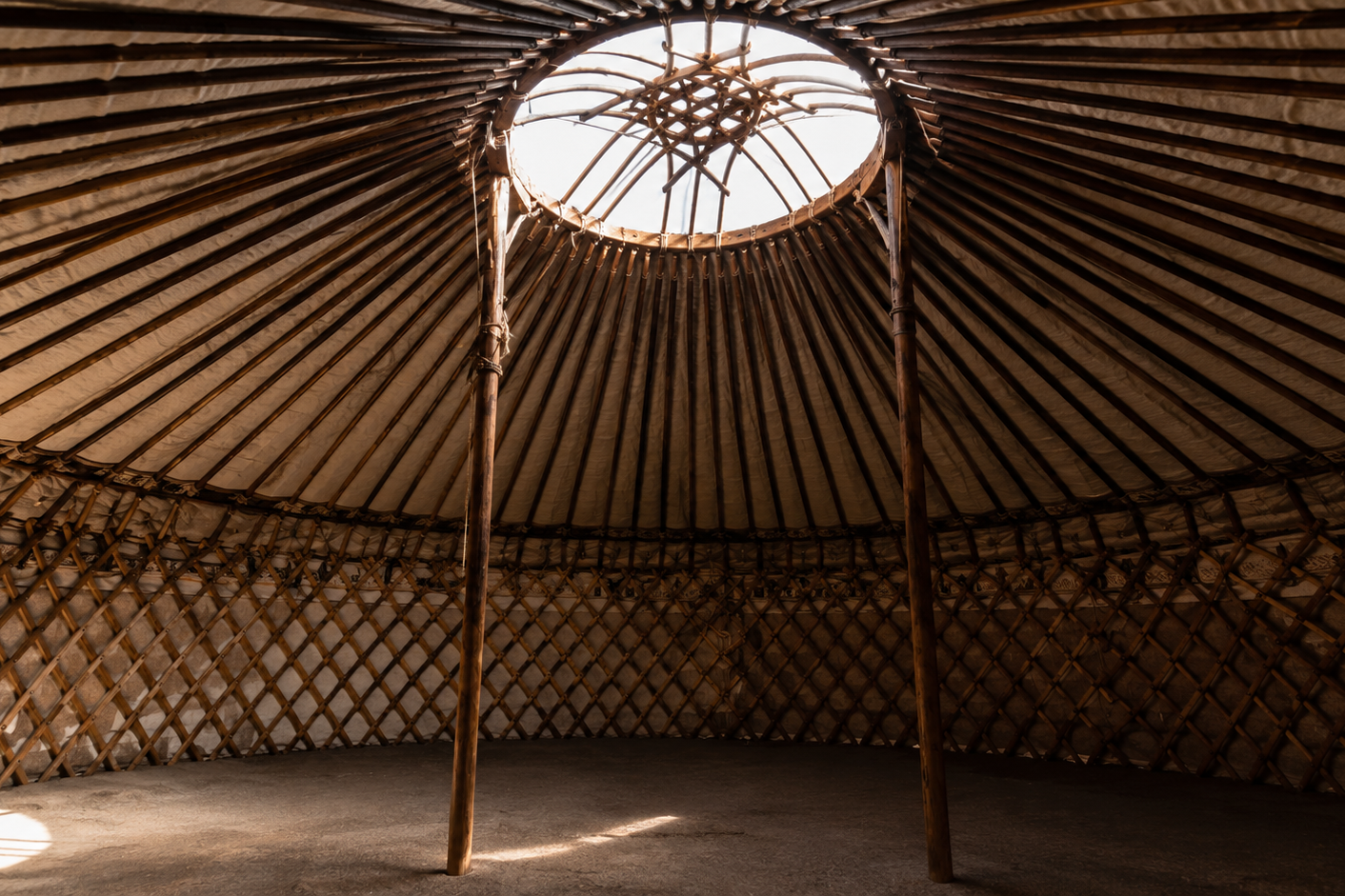
Kazakh design code is built on mobility, collapsibility, circular space, the central role of textile and felt, repetition, rhythm, natural materials and an ability for decoration to perform structural work. Ornament is only one layer. Remove it and Kazakh character can still survive through proportion, connection, colour, material and use.
Editorial thesis
Strong contemporary Kazakh design begins when heritage stops being decoration and becomes a method of decision-making: not adding a national sign, but understanding why an object folds, where its centre is, how it connects, what covers it, how light enters and how repetition becomes pattern.
Reader question
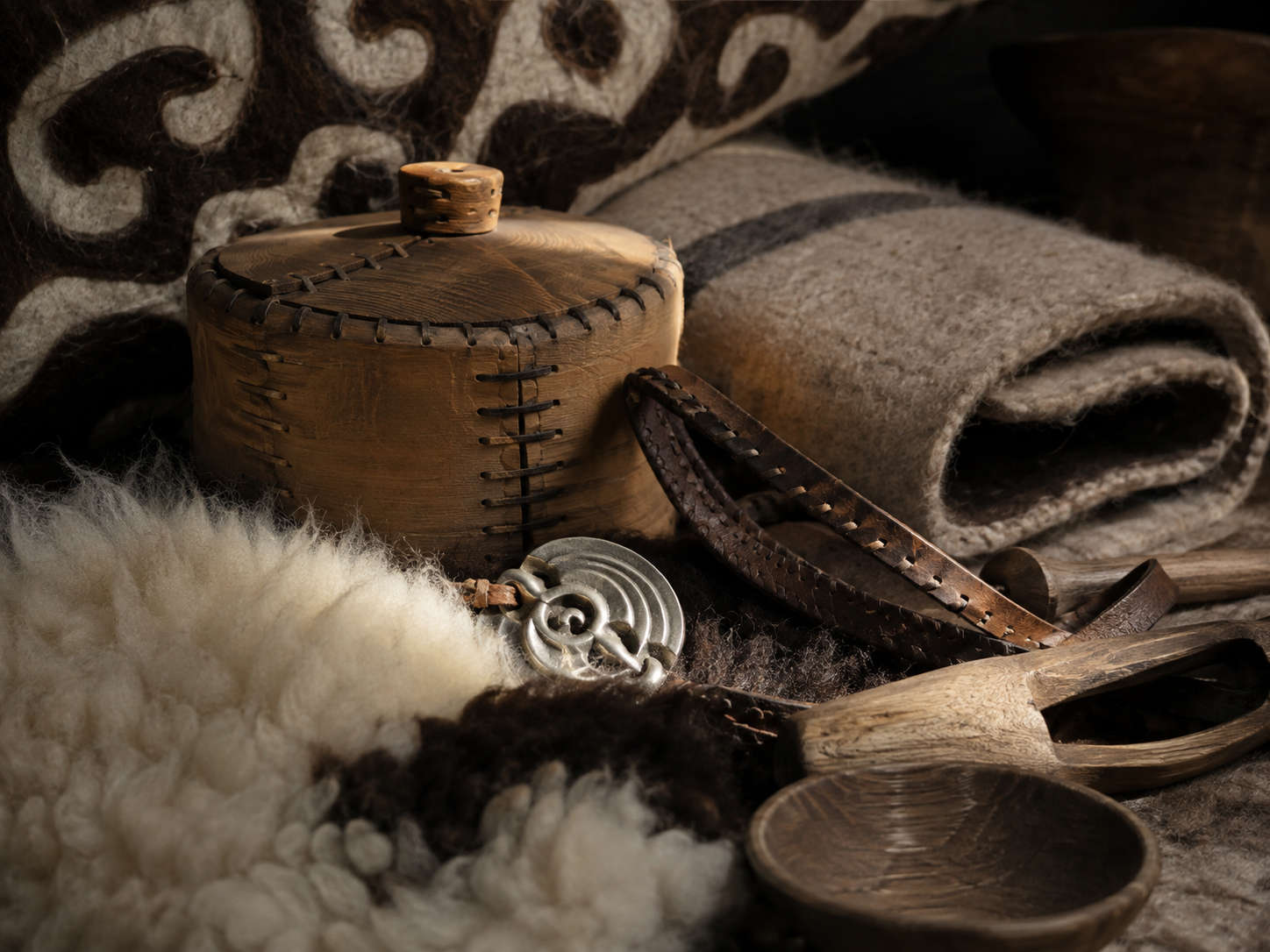
Can an interior, garment or object read as Kazakh if it contains no obvious qoshqar-muiz ornament or ethnic quotation?
Short answer
Yes — through circular organisation, modularity, lightweight assembly, natural materials, tactile surface, radial light, relations of empty and filled space, connection rhythm and disciplined colour hierarchy.
Context: Nomadic life as a design condition
The yurt emerged not as an architectural image but as a response to movement, climate, transport and available materials. UNESCO emphasises the collapsible timber structure, felt cover, ropes and woven ties, as well as the distribution of craft knowledge between frame-making and textile work.
For a designer the important point is that an object is not separated from how it is made. Structure, material, repair, storage and decoration belong to the same system.
Core Idea: The yurt as engineering
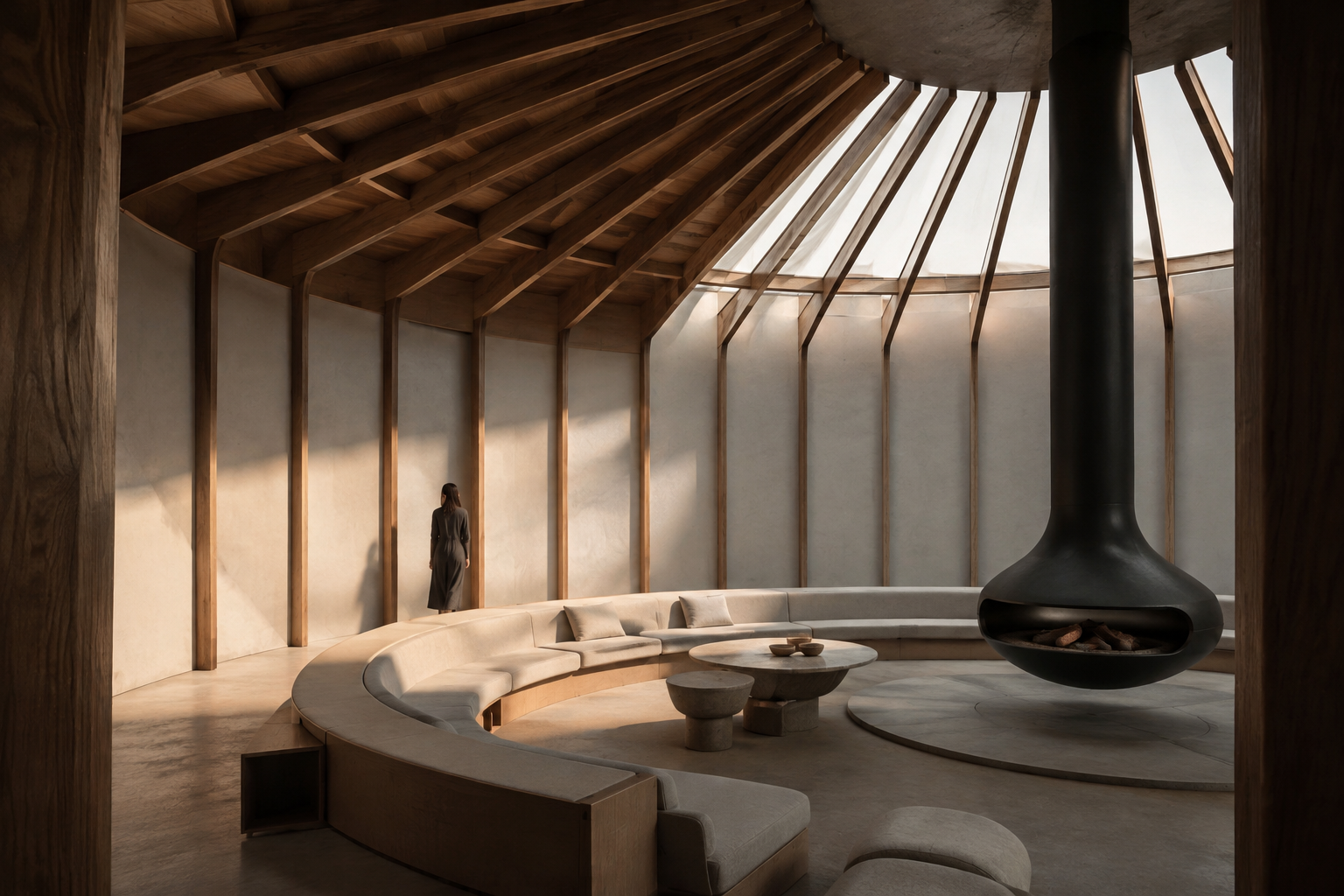
Kerege forms the folding lattice wall. Uyks transform the horizontal circle into a dome. Shanyrak gathers the radial members while acting as a light and ventilation centre. Each element performs several roles at once.
The contemporary lesson is not to make every room circular. It is to seek economy of gesture: one detail can be structure, rhythm and image simultaneously.
Core Idea: Ornament as grammar
Kazakh ornament is better understood through rules than a dictionary of meanings: repetition, symmetry, rotation, mirroring, rhythm and the relation between ground and motif. The muiz, or horn, generates many variations.
Copying a contour onto any surface produces decoration. Understanding repetition, scale and negative space allows ornament to migrate into graphics, façades, textiles or digital systems without literal quotation.
Core Idea: Material carries meaning
Felt is central because it combines insulation, lightness, plasticity and the possibility of making pattern part of the surface itself. Timber provides frame and objects, leather gives flexible connections and vessels, metal becomes jewellery and tool. Material is not neutral support; it is language.
Deep Explanation: When decoration becomes structure
Traditional craft often makes beauty useful. Woven bands and cords stabilise the frame; patterned felt is the enclosure; the lattice rhythm is already ornament before any motif is added. This is the best antidote to pseudo-ethnic design: if a decorative element does nothing, ask whether it is needed.
Practice / Example: Textile and felt
Tekemet and syrmaq reveal two different surface strategies. One forms pattern within felting; the other uses mosaic cutting and joining. In contemporary terms: colour as material mass versus colour as assembly.
Practice / Example: Contemporary space
A space can inherit the yurt without copying it. Circle or semicircle can organise conversation; top light can gather the room around a centre; timber can reveal load paths; textile can soften sound and temperature. Kazakh code then appears through behaviour rather than décor.
Relation To Fashion
Fashion has the richest opportunities in silhouette, volume, layering, material and fastening systems. A coat can inherit the idea of protective enclosure; an accessory can use strap logic; a headpiece can be structurally clear. This is stronger than printing a large ornament onto a generic base garment.
Relation To Architecture / Space
The spatial code includes centre, circle, threshold, disassembly, lightweight frame, soft enclosure, top light and limited internal partitioning. These ideas suit pavilions, public interiors, exhibitions and temporary architecture.
Relation To Image / Photography
Culture is best photographed through material and action: a hand making a joint, felt in backlight, tool marks on timber, shanyrak as a light source. A staged model in costume against the steppe rarely adds new knowledge.
Relation To Object / Material
Object design can inherit tradition through joints, tactility and repairability. A container, bag, chair or lamp can feel Kazakh not because it carries ornament, but because it folds, stretches, ties, connects and ages honestly.
Relation To Technology
Parametric systems offer a new way to work with traditional rhythm. Motifs can be encoded as rules whose density, scale and direction respond to function. Digital cutting and weaving can return ornament to construction rather than printing a ready-made image.
Critical View: Why pseudo-ethnic design fails
Gold ornament on black, synthetic royal luxury, mixing Kazakh, Uzbek, Kyrgyz and generic ‘Eastern’ motifs, or using shanyrak as a decorative icon without spatial function quickly turns culture into marketing scenery.
The problem is not contemporary adaptation but lack of research. Good adaptation knows its source and transforms a principle deliberately; bad adaptation uses a recognisable sign as a label.
Local / Contemporary Context
Contemporary Kazakh design faces two opposite risks: dissolving into global minimalism or becoming trapped in decorative nationality. The interesting territory is between them — where a local method generates contemporary form without needing an ‘ethnic’ label.
Practical Takeaways
- Define the principle before the form. 2. Study construction, not only ornament. 3. Distinguish Kazakh motifs from the wider Central Asian vocabulary. 4. Work with material physically. 5. If nationality is visible only through print, the concept is not deep enough.
Key Terms
Kerege — folding lattice wall; uyk — radial roof pole; shanyrak — upper ring; kiiz — felt; tekemet — felted carpet; syrmaq — mosaic felt carpet; muiz — horn motif; qoshqar-muiz — ram’s horn motif.
Related Nodes
Textile; felt; craft; modularity; parametric ornament; object design; interior; fashion heritage; sustainable design.
Timeline
Pre-industrial period: nomadic material culture and craft systems. 19th–early 20th centuries: rich regional variation of ornament and felt techniques. Soviet period: museum documentation and transformation of craft. After 1991: renewed search for a national language in architecture, graphics, fashion and commercial design. 2014/2025: UNESCO recognition of traditional yurt-making knowledge.
Article Close
The most contemporary way to work with Kazakh heritage is to stop fearing the removal of the symbol. If logic, material, proportion, rhythm and assembly remain, the design can still read as Kazakh — and that is when it stops being a souvenir.