encyclopedia
LC4
The body as a mechanism of rest: adjustable posture, tubular steel and a new ergonomics
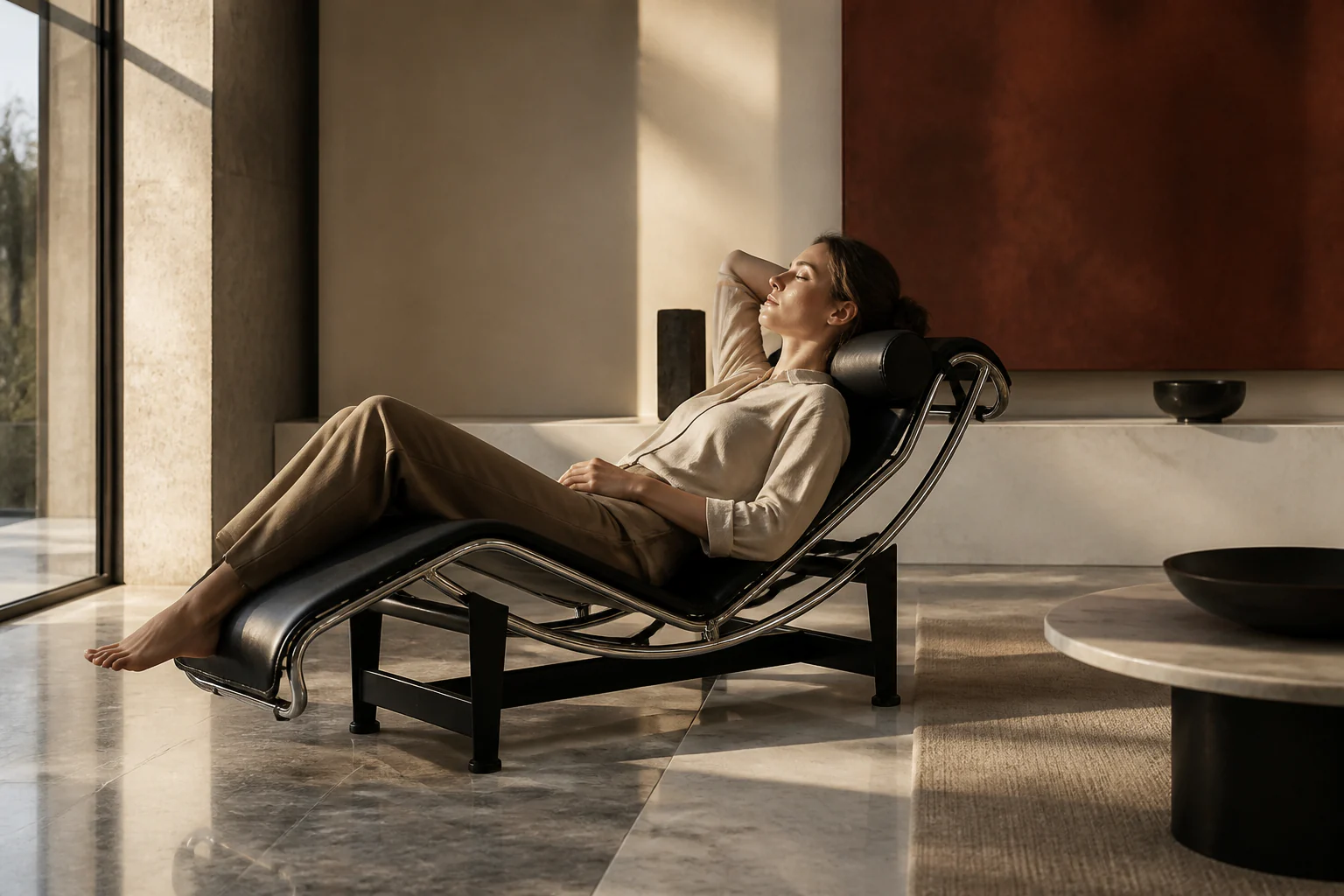
LC4 matters to VANSMITHLAB not because it is called an icon, but because one object reveals the chain author → material → production → space → image → canon. The body as a mechanism of rest: adjustable posture, tubular steel and a new ergonomics.
Editorial thesis
LC4 matters to VANSMITHLAB not because it is called an icon, but because one object reveals the chain author → material → production → space → image → canon. The body as a mechanism of rest: adjustable posture, tubular steel and a new ergonomics.
Reader question
Why did LC4 become important to design history if it is only one piece of furniture?
Short answer
Because LC4 makes a new relationship between form, body, material and production visible. Its historical role lies in the design problem it formulated and the way that formulation outlived its original moment.
1. Definition and boundaries of the object
LC4 is an adjustable chaise longue designed by Le Corbusier, Pierre Jeanneret and Charlotte Perriand in 1928. Its upper frame can shift on the base, allowing the body to move from a near-seated to a reclined posture.
2. Origins and prehistory
The project emerged while the collaborators investigated equipment for living and replaced historical furniture types with clear objects for modern life. Perriand brought a particularly strong concern for the body, metal construction and actual use.
3. Why the object emerged when it did
The project emerged while the collaborators investigated equipment for living and replaced historical furniture types with clear objects for modern life. Perriand brought a particularly strong concern for the body, metal construction and actual use. The date 1928 matters not as an isolated timestamp but as the point where material, production and cultural programme converged in one object.
4. Material, construction and composition
Construction is split into two systems: a curved tubular frame carries the body while a separate base supports and guides it. Mattress, headrest and tensioned surfaces make the hard metal logic suitable for sustained rest.
5. Principle of use and operation
Construction is split into two systems: a curved tubular frame carries the body while a separate base supports and guides it. Mattress, headrest and tensioned surfaces make the hard metal logic suitable for sustained rest. Use cannot be separated from construction: how a person sits, moves, carries or reconfigures the object is part of the structural idea.
6. Key technical or cultural turning point
The chaise was shown at the end of the 1920s and passed through early manufacturers; Cassina began licensed production of the collection in 1965. Serial production depends on precision in tubes, joints, tension and soft elements. The turning point is the translation of experiment into a reproducible system, making LC4 a node in design history rather than only an authorial gesture.
7. First reference context
The project emerged while the collaborators investigated equipment for living and replaced historical furniture types with clear objects for modern life. Perriand brought a particularly strong concern for the body, metal construction and actual use. The first reference context explains the original problem addressed by Le Corbusier; Pierre Jeanneret; Charlotte Perriand and why the familiar typology proved insufficient.
8. Second reference context
The chaise was shown at the end of the 1920s and passed through early manufacturers; Cassina began licensed production of the collection in 1965. Serial production depends on precision in tubes, joints, tension and soft elements. The second context is production and licensing, showing which properties survived repetition and which depended on period technology.
9. Third reference context
LC4 remains in Cassina’s collection and in major museum holdings. It is read both as furniture and as a document of early modernist research into the body. The third context is museum and contemporary life. Canonisation enables comparison between original purpose and later readings.
10. Form and geometry
Construction is split into two systems: a curved tubular frame carries the body while a separate base supports and guides it. Mattress, headrest and tensioned surfaces make the hard metal logic suitable for sustained rest. The geometry of LC4 is not an outer shell placed over function; it distributes load, organises the body and makes construction legible.
11. Surface, light and colour
Its side profile is almost diagrammatic: the long curve, cylindrical headrest and separate base reveal the operating principle before the viewer notices the finish. Surface and colour reinforce geometry: material communicates age, technology and making before the viewer reads a caption.
12. Tactility, movement and bodily posture
LC4 is an adjustable chaise longue designed by Le Corbusier, Pierre Jeanneret and Charlotte Perriand in 1928. Its upper frame can shift on the base, allowing the body to move from a near-seated to a reclined posture. Tactility emerges where body meets material, while movement appears through posture, carrying or reconfiguration. This bodily sequence remains part of the project.
13. Production system
The chaise was shown at the end of the 1920s and passed through early manufacturers; Cassina began licensed production of the collection in 1965. Serial production depends on precision in tubes, joints, tension and soft elements.
14. Tools and infrastructure
The production infrastructure of LC4 includes drawings, tooling, machines, hand operations, tolerances, supply and quality control. The chaise was shown at the end of the 1920s and passed through early manufacturers; Cassina began licensed production of the collection in 1965. Serial production depends on precision in tubes, joints, tension and soft elements.
15. Diffusion and canonisation
LC4 remains in Cassina’s collection and in major museum holdings. It is read both as furniture and as a document of early modernist research into the body. Diffusion occurred not only through sales: exhibitions, museums, magazines, catalogues and photographs turned a thing into a recognisable type and teaching example.
16. Professional practice
For professional designers, LC4 is useful as a methodological case. LC4 makes posture part of the design. Rather than imposing one fixed angle, it offers controlled movement and turns ergonomics into visible mechanics. The practical value lies in seeing where form follows material and production and where it becomes cultural statement.
17. Relationship to architecture
The object transfers architecture’s separation of support and infill into furniture: one system carries loads while another mediates contact with the body. That makes the chaise close to frame-based modern architecture.
18. Relationship to product design
LC4 makes posture part of the design. Rather than imposing one fixed angle, it offers controlled movement and turns ergonomics into visible mechanics. The object changes not only furniture appearance but the design question itself: what counts as structure, comfort, system, material or authorship.
19. Relationship to fashion
In visual culture LC4 became a sign of intellectual modernism and machine aesthetics, while its mattress and headrest keep returning the project to bodily comfort.
20. Relationship to image-making
Its side profile is almost diagrammatic: the long curve, cylindrical headrest and separate base reveal the operating principle before the viewer notices the finish.
21. Relationship to technology
The chaise was shown at the end of the 1920s and passed through early manufacturers; Cassina began licensed production of the collection in 1965. Serial production depends on precision in tubes, joints, tension and soft elements. Technology is a co-author of form: change material, tool or process and the field of possible geometry changes too.
22. Relationship to materials
Construction is split into two systems: a curved tubular frame carries the body while a separate base supports and guides it. Mattress, headrest and tensioned surfaces make the hard metal logic suitable for sustained rest. Material must therefore be read through thickness, direction, joints, ageing, repair and component interaction, not by substance name alone.
23. Institutions and the canon
LC4 remains in Cassina’s collection and in major museum holdings. It is read both as furniture and as a document of early modernist research into the body. Canonisation through museums and archives preserves documentation and early versions, but also turns domestic furniture into cultural signs. Both roles matter.
24. Market and commercial logic
The market value of LC4 reflects production, licensing, brand, historical status and demand rather than raw-material price alone. The idea of a relaxation machine is easy to romanticise: actual comfort depends on body type, upholstery and chosen angle. Chrome-plated steel and leather also made later versions a premium sign of modernism rather than a mass domestic standard. High cost by itself proves nothing about design quality.
25. Criticism and limitations
The idea of a relaxation machine is easy to romanticise: actual comfort depends on body type, upholstery and chosen angle. Chrome-plated steel and leather also made later versions a premium sign of modernism rather than a mass domestic standard.
26. Mistakes and myths
Calling it simply the Le Corbusier chaise longue erases collaboration. Museum and manufacturer records identify three authors — Le Corbusier, Pierre Jeanneret and Charlotte Perriand — and that attribution should be preserved.
27. Sustainability, longevity and maintenance
Longevity benefits from a separable structural logic and replaceable soft parts, while environmental assessment depends on metals, leather, fillings and the exact production cycle. Its durable quality is the ability to maintain the same construction principle across decades.
28. Contemporary status
LC4 remains in Cassina’s collection and in major museum holdings. It is read both as furniture and as a document of early modernist research into the body.
29. What the object changed in the discipline
LC4 makes posture part of the design. Rather than imposing one fixed angle, it offers controlled movement and turns ergonomics into visible mechanics. The primary contribution is a changed design question: the object offers a new example of linking body, material, production and cultural meaning.
30. How to read the object today
Today LC4 should be read at three scales: as a thing for the body, as a production system and as an image loaded with history. The idea of a relaxation machine is easy to romanticise: actual comfort depends on body type, upholstery and chosen angle. Chrome-plated steel and leather also made later versions a premium sign of modernism rather than a mass domestic standard. This makes iconic status testable and meaningful.
See also
- Barcelona Chair — A chair as architectural manifesto: steel, leather and ceremony.
- Eames Lounge Chair — Moulded plywood, comfort and postwar luxury.
- Mezzadro — A found industrial element transformed into a domestic object.