encyclopedia
Panton Chair
One material, continuous form and a new plastics industry
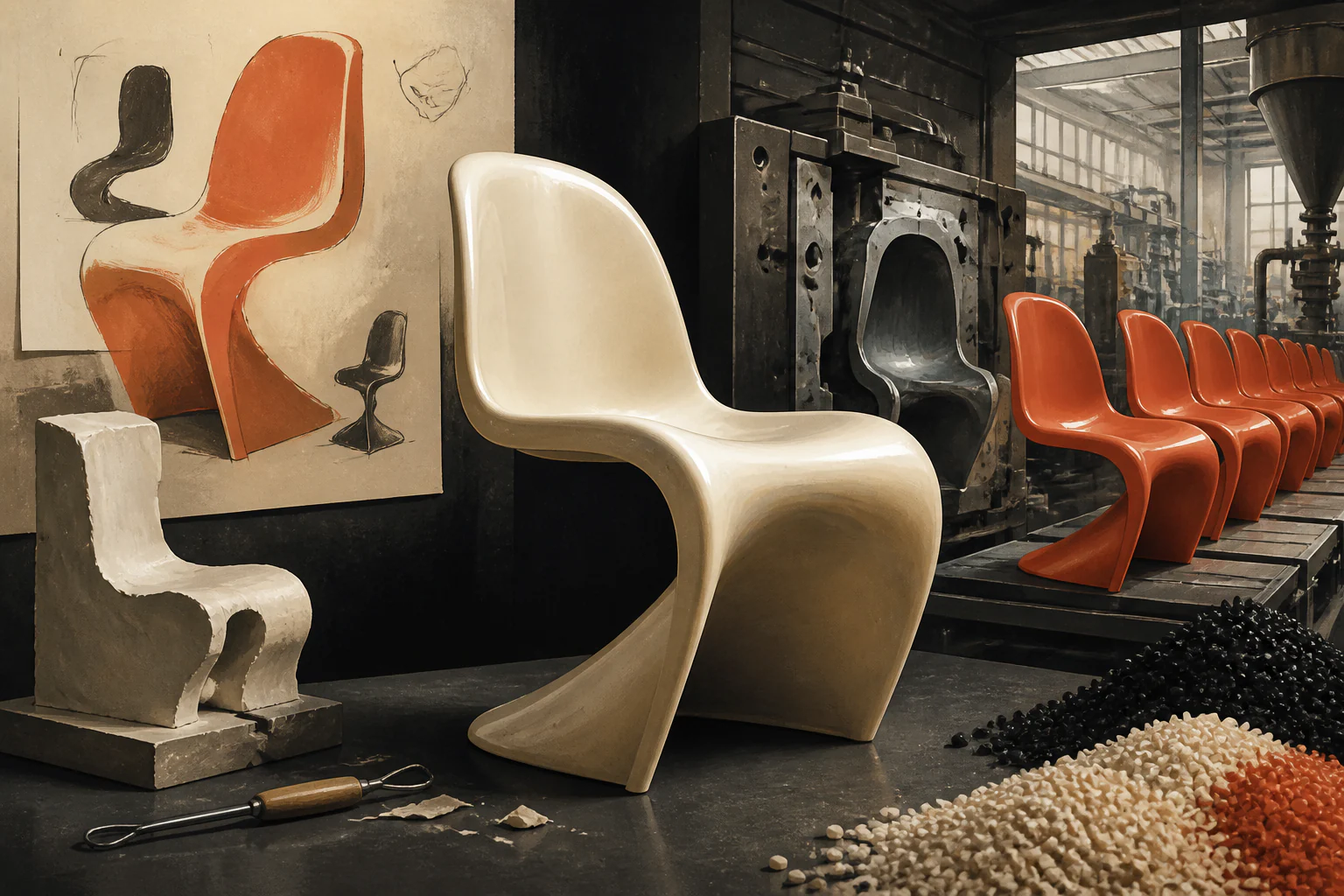
Panton Chair matters to VANSMITHLAB not because it is called an icon, but because one object reveals the chain author → material → production → space → image → canon. One material, continuous form and a new plastics industry.
Editorial thesis
Panton Chair matters to VANSMITHLAB not because it is called an icon, but because one object reveals the chain author → material → production → space → image → canon. One material, continuous form and a new plastics industry.
Reader question
Why did Panton Chair become important to design history if it is only one piece of furniture?
Short answer
Because Panton Chair makes a new relationship between form, body, material and production visible. Its historical role lies in the design problem it formulated and the way that formulation outlived its original moment.
1. Definition and boundaries of the object
The Panton Chair is an S-profile cantilever chair developed by Verner Panton and brought to serial production with Vitra. Its historical importance lies in making a complete chair as a continuous plastic shell without a conventional frame or separate legs.
2. Origins and prehistory
Panton explored the monolithic plastic chair from the late 1950s. Vitra entered development in 1963; pre-series examples appeared in 1967, followed by a long sequence of material and manufacturing revisions.
3. Why the object emerged when it did
Panton explored the monolithic plastic chair from the late 1950s. Vitra entered development in 1963; pre-series examples appeared in 1967, followed by a long sequence of material and manufacturing revisions. The date 1960s; pre-series 1967 matters not as an isolated timestamp but as the point where material, production and cultural programme converged in one object.
4. Material, construction and composition
The silhouette acts as one resilient cantilever: the base rises into the seat and then the back without a visual break. Geometry must carry load, flex slightly and still release reliably from an industrial mould.
5. Principle of use and operation
The silhouette acts as one resilient cantilever: the base rises into the seat and then the back without a visual break. Geometry must carry load, flex slightly and still release reliably from an industrial mould. Use cannot be separated from construction: how a person sits, moves, carries or reconfigures the object is part of the structural idea.
6. Key technical or cultural turning point
The same form passed through different plastics and manufacturing processes. Vitra changed materials when early solutions proved expensive, brittle or unstable, and the current polypropylene version is the result of prolonged technical learning. The turning point is the translation of experiment into a reproducible system, making Panton Chair a node in design history rather than only an authorial gesture.
7. First reference context
Panton explored the monolithic plastic chair from the late 1950s. Vitra entered development in 1963; pre-series examples appeared in 1967, followed by a long sequence of material and manufacturing revisions. The first reference context explains the original problem addressed by Verner Panton and why the familiar typology proved insufficient.
8. Second reference context
The same form passed through different plastics and manufacturing processes. Vitra changed materials when early solutions proved expensive, brittle or unstable, and the current polypropylene version is the result of prolonged technical learning. The second context is production and licensing, showing which properties survived repetition and which depended on period technology.
9. Third reference context
Vitra continues to produce the Panton Chair and early versions belong to major museum collections. The 2026 centenary of Panton’s birth renewed attention, but the chair’s canonical status long predates anniversary campaigns. The third context is museum and contemporary life. Canonisation enables comparison between original purpose and later readings.
10. Form and geometry
The silhouette acts as one resilient cantilever: the base rises into the seat and then the back without a visual break. Geometry must carry load, flex slightly and still release reliably from an industrial mould. The geometry of Panton Chair is not an outer shell placed over function; it distributes load, organises the body and makes construction legible.
11. Surface, light and colour
A single side contour can identify the object. The absence of joints and separate legs makes the negative space around the S-profile as important as the material itself. Surface and colour reinforce geometry: material communicates age, technology and making before the viewer reads a caption.
12. Tactility, movement and bodily posture
The Panton Chair is an S-profile cantilever chair developed by Verner Panton and brought to serial production with Vitra. Its historical importance lies in making a complete chair as a continuous plastic shell without a conventional frame or separate legs. Tactility emerges where body meets material, while movement appears through posture, carrying or reconfiguration. This bodily sequence remains part of the project.
13. Production system
The same form passed through different plastics and manufacturing processes. Vitra changed materials when early solutions proved expensive, brittle or unstable, and the current polypropylene version is the result of prolonged technical learning.
14. Tools and infrastructure
The production infrastructure of Panton Chair includes drawings, tooling, machines, hand operations, tolerances, supply and quality control. The same form passed through different plastics and manufacturing processes. Vitra changed materials when early solutions proved expensive, brittle or unstable, and the current polypropylene version is the result of prolonged technical learning.
15. Diffusion and canonisation
Vitra continues to produce the Panton Chair and early versions belong to major museum collections. The 2026 centenary of Panton’s birth renewed attention, but the chair’s canonical status long predates anniversary campaigns. Diffusion occurred not only through sales: exhibitions, museums, magazines, catalogues and photographs turned a thing into a recognisable type and teaching example.
16. Professional practice
For professional designers, Panton Chair is useful as a methodological case. The chair turned plastic from a material of imitation into a means of creating a form difficult in timber or metal. Continuity became not decoration but the visible consequence of a new production logic. The practical value lies in seeing where form follows material and production and where it becomes cultural statement.
17. Relationship to architecture
The S-shell behaves like a small spatial structure: one profile provides base, seat and back. It makes the relationship between furniture and structural geometry unusually clear.
18. Relationship to product design
The chair turned plastic from a material of imitation into a means of creating a form difficult in timber or metal. Continuity became not decoration but the visible consequence of a new production logic. The object changes not only furniture appearance but the design question itself: what counts as structure, comfort, system, material or authorship.
19. Relationship to fashion
Vivid colour and a futuristic silhouette made the chair a symbol of 1960s–70s visual culture, space-age optimism and new domestic environments. Later, that imagery became a cultural code in its own right.
20. Relationship to image-making
A single side contour can identify the object. The absence of joints and separate legs makes the negative space around the S-profile as important as the material itself.
21. Relationship to technology
The same form passed through different plastics and manufacturing processes. Vitra changed materials when early solutions proved expensive, brittle or unstable, and the current polypropylene version is the result of prolonged technical learning. Technology is a co-author of form: change material, tool or process and the field of possible geometry changes too.
22. Relationship to materials
The silhouette acts as one resilient cantilever: the base rises into the seat and then the back without a visual break. Geometry must carry load, flex slightly and still release reliably from an industrial mould. Material must therefore be read through thickness, direction, joints, ageing, repair and component interaction, not by substance name alone.
23. Institutions and the canon
Vitra continues to produce the Panton Chair and early versions belong to major museum collections. The 2026 centenary of Panton’s birth renewed attention, but the chair’s canonical status long predates anniversary campaigns. Canonisation through museums and archives preserves documentation and early versions, but also turns domestic furniture into cultural signs. Both roles matter.
24. Market and commercial logic
The market value of Panton Chair reflects production, licensing, brand, historical status and demand rather than raw-material price alone. Early technical problems reveal the limits behind the slogan one form, one material. The clean silhouette conceals polymer chemistry, mould tooling, cooling behaviour, strength requirements and decades of revision. High cost by itself proves nothing about design quality.
25. Criticism and limitations
Early technical problems reveal the limits behind the slogan one form, one material. The clean silhouette conceals polymer chemistry, mould tooling, cooling behaviour, strength requirements and decades of revision.
26. Mistakes and myths
It is often called simply the first plastic chair. More precisely, it became the first serially realised all-plastic cantilever chair made as one continuous form; plastic furniture had existed before it.
27. Sustainability, longevity and maintenance
The contemporary plastic version is durable and repeatable, but plastic alone is not evidence of sustainability. Service life, material composition, recycling routes and continued use matter more than the abstract category of material.
28. Contemporary status
Vitra continues to produce the Panton Chair and early versions belong to major museum collections. The 2026 centenary of Panton’s birth renewed attention, but the chair’s canonical status long predates anniversary campaigns.
29. What the object changed in the discipline
The chair turned plastic from a material of imitation into a means of creating a form difficult in timber or metal. Continuity became not decoration but the visible consequence of a new production logic. The primary contribution is a changed design question: the object offers a new example of linking body, material, production and cultural meaning.
30. How to read the object today
Today Panton Chair should be read at three scales: as a thing for the body, as a production system and as an image loaded with history. Early technical problems reveal the limits behind the slogan one form, one material. The clean silhouette conceals polymer chemistry, mould tooling, cooling behaviour, strength requirements and decades of revision. This makes iconic status testable and meaningful.
See also
- Eames Lounge Chair — Moulded plywood, comfort and postwar luxury.
- Sacco — The anti-chair: free posture and unfixed form.
- UP5/UP6 — Body, politics, polyurethane foam and radical design.
- Wiggle Side Chair — Cardboard as structural material and a critique of familiar value.