encyclopedia
Photobook — Sequence Instead of the Single Frame
A book turns photographs into time: order, scale, paper and page turning become part of the work.
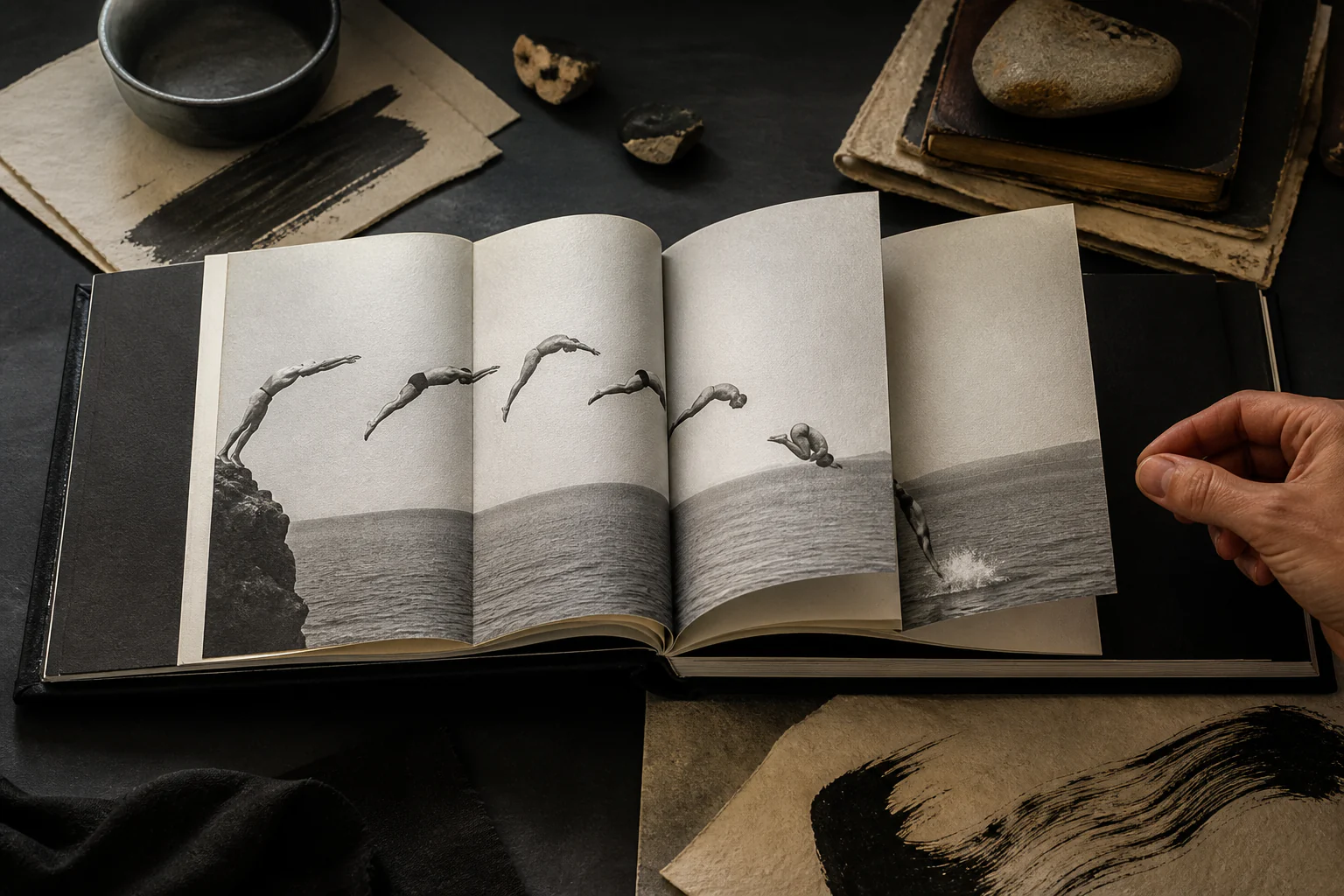
A photobook is a publication in which photographic meaning is constructed through image sequence and the material form of the book. The individual frame is subordinated to montage, rhythm and relations with neighboring pages. The photobook gives duration back to the image: the reader controls speed, while the author controls transitions, repetitions and pauses.
Editorial thesis
A photobook is a publication in which photographic meaning is constructed through image sequence and the material form of the book. The individual frame is subordinated to montage, rhythm and relations with neighboring pages. The photobook gives duration back to the image: the reader controls speed, while the author controls transitions, repetitions and pauses.
Reader question
What actually makes an image convincing: the moment of capture, or the system of decisions before and after it?
Short answer
Author/editor creates the edit, sequence and image groups; designer defines format, paper, typography, binding and pace; printed proofs test how photographs behave as a physical object. series → edit → sequence → layout → print → binding → reading
1. Definition and boundaries
A photobook is a publication in which photographic meaning is constructed through image sequence and the material form of the book. The individual frame is subordinated to montage, rhythm and relations with neighboring pages.
2. Origins and prehistory
Photographers have assembled images in books since photography’s early history; in the twentieth century the photobook became an independent authorial medium, and in the twenty-first a major field of collecting and curating.
3. Why the system emerged when it did
The subject does not emerge from one invention but from increasing circulation, production speed and the need to coordinate more participants. Photographers have assembled images in books since photography’s early history; in the twentieth century the photobook became an independent authorial medium, and in the twenty-first a major field of collecting and curating.
4. Material, construction and composition
Image material includes carrier, optics or source file, light, reproduction surface and metadata; form depends on the full chain rather than capture alone. Production links files/negatives, color proofing, layout, paper, printing, binding, edition, distribution and archive.
5. Principle of operation or production
Author/editor creates the edit, sequence and image groups; designer defines format, paper, typography, binding and pace; printed proofs test how photographs behave as a physical object.
6. Key technical or cultural turning point
The key turn arrives when a local technique becomes a repeatable process through a standard, interface, profession or software environment. Author/editor creates the edit, sequence and image groups; designer defines format, paper, typography, binding and pace; printed proofs test how photographs behave as a physical object.
7. First anchor example
William Klein’s classic books demonstrate aggressive urban montage.
8. Second anchor example
MoMA recognizes the photobook as a medium in its own right.
9. Third anchor example
contemporary artist-publishing blurs boundaries among author, designer and publisher..
10. Form and geometry
Image geometry is organized through frame, scale, crop, perspective, grid or motion path. A photobook is a publication in which photographic meaning is constructed through image sequence and the material form of the book. The individual frame is subordinated to montage, rhythm and relations with neighboring pages.
11. Surface, light and color
Light and color are not decoration but structures of legibility: they determine depth, hierarchy, materiality and psychological distance. Production links files/negatives, color proofing, layout, paper, printing, binding, edition, distribution and archive.
12. Tactility, sound and movement
Even a still image contains a bodily rhythm of looking; sequence and motion add time, sound and state change. Author/editor creates the edit, sequence and image groups; designer defines format, paper, typography, binding and pace; printed proofs test how photographs behave as a physical object.
13. Production system
Production links files/negatives, color proofing, layout, paper, printing, binding, edition, distribution and archive.
14. Tools and infrastructure
Infrastructure includes equipment, software, storage, version management, team communication, rights data and review systems. Production links files/negatives, color proofing, layout, paper, printing, binding, edition, distribution and archive.
15. Mass diffusion
Mass diffusion begins when a technique can be repeated in an editorial office, studio, agency, print workflow or digital platform without losing its main function. The photobook gives duration back to the image: the reader controls speed, while the author controls transitions, repetitions and pauses.
16. Professional practice
Professional practice is distributed authorship: photographer, art director, editor, designer and post-production own different layers of one result. Author/editor creates the edit, sequence and image groups; designer defines format, paper, typography, binding and pace; printed proofs test how photographs behave as a physical object.
17. Connection to architecture
The connection to architecture appears through space, viewpoint, scale and routes of attention. series → edit → sequence → layout → print → binding → reading
18. Connection to product design
The connection to product design appears in interfaces, tools, carriers and material objects through which images are made and consumed. series → edit → sequence → layout → print → binding → reading
19. Connection to fashion
The connection to fashion appears through body, clothing, seasonality, magazine, campaign and public systems of presentation. The photobook gives duration back to the image: the reader controls speed, while the author controls transitions, repetitions and pauses.
20. Connection to image
The photobook gives duration back to the image: the reader controls speed, while the author controls transitions, repetitions and pauses.
21. Connection to technology
Technology changes not only production speed but the set of decisions available before, during and after image making. Today photobooks range from small-edition artist books to major museum publications; digital printing and independent publishing have expanded access, while material decisions remain part of meaning.
22. Connection to materials
Image materiality does not disappear digitally: sensor, screen, paper, print, codec and archival format constrain results differently. Production links files/negatives, color proofing, layout, paper, printing, binding, edition, distribution and archive.
23. Institutions and canon
Museums, archives, professional societies and schools form the canon by preserving final images as well as production documents. Photographers have assembled images in books since photography’s early history; in the twentieth century the photobook became an independent authorial medium, and in the twenty-first a major field of collecting and curating.
24. Market and commercial logic
Commercial logic sets deadline, format, version count, rights, team cost and distribution channels; these parameters directly shape visual form. The photobook gives duration back to the image: the reader controls speed, while the author controls transitions, repetitions and pauses.
25. Critique and limitations
A common mistake is treating the book as a portfolio of best images. A strong sequence may need a less spectacular single picture if it serves a transition.
26. Errors and myths
A common error is judging only the final image while ignoring how it was selected, altered, approved and published. A common mistake is treating the book as a portfolio of best images. A strong sequence may need a less spectacular single picture if it serves a transition.
27. Sustainability, durability and maintenance
Sustainability here includes archive durability, file portability, reproducible outputs, clear rights and avoiding unnecessary production when existing assets can solve the problem. Today photobooks range from small-edition artist books to major museum publications; digital printing and independent publishing have expanded access, while material decisions remain part of meaning.
28. Contemporary condition
Today photobooks range from small-edition artist books to major museum publications; digital printing and independent publishing have expanded access, while material decisions remain part of meaning.
29. What the subject changed in the discipline
The major disciplinary change is the transformation of the image from a single frame into a managed system of decisions, versions, media and relations. series → edit → sequence → layout → print → binding → reading
30. How to read the subject today
Today the subject should be read as a chain: series → edit → sequence → layout → print → binding → reading. The final image is the visible surface of a much larger production process.
See also
- Contact Sheet — Photography as a Process of Selection — A series becomes a story when frames can be seen together and exclusion begins.
- Editorial Photography — An image exists inside a topic, text, sequence and publication position.
- Magazine Spread — The Space Between Two Pages — A magazine is read not as isolated pages but through collisions and pauses between left and right fields.