encyclopedia
Superleggera
Minimum mass as a design problem: craft and industry
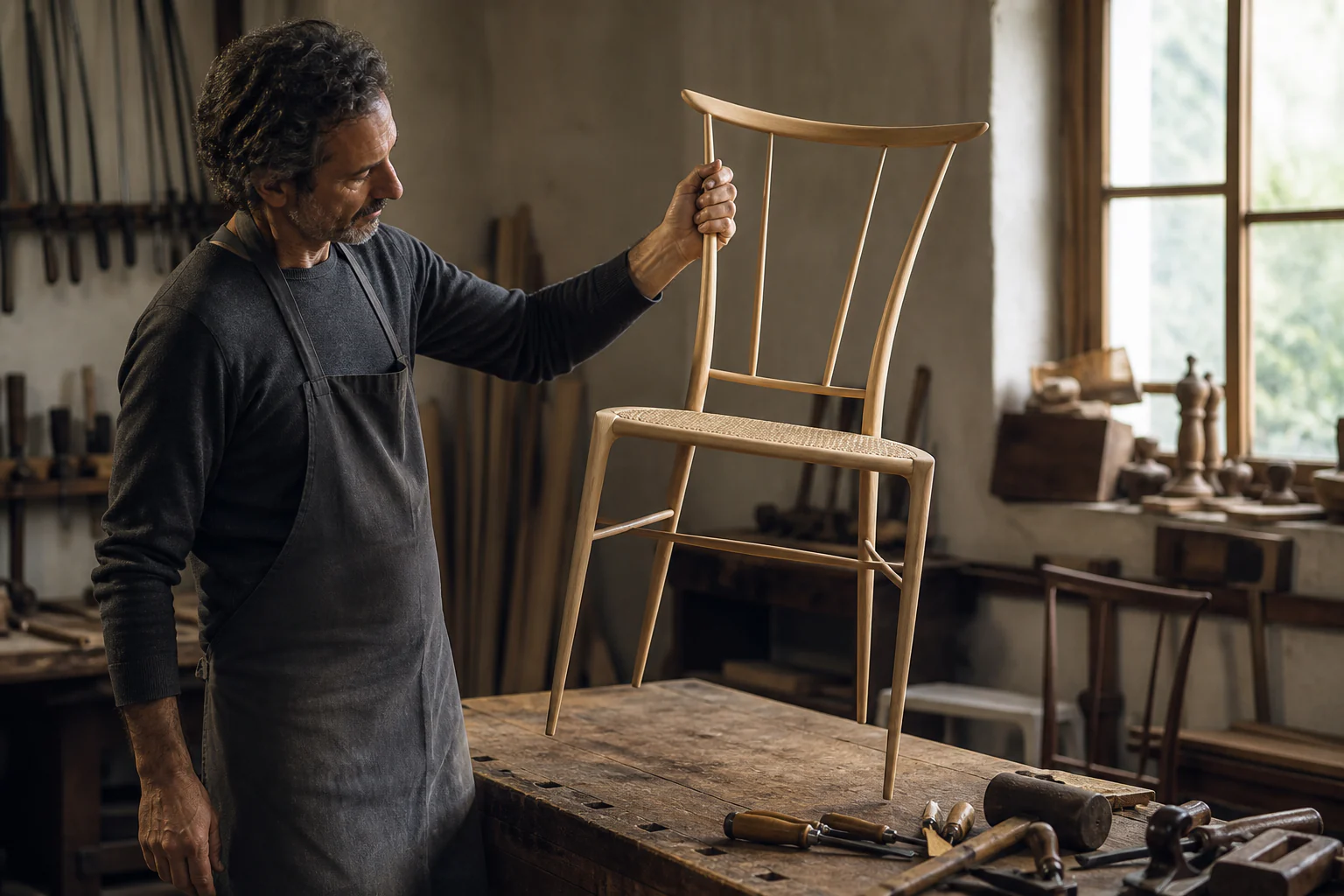
Superleggera matters to VANSMITHLAB not because it is called an icon, but because one object reveals the chain author → material → production → space → image → canon. Minimum mass as a design problem: craft and industry.
Editorial thesis
Superleggera matters to VANSMITHLAB not because it is called an icon, but because one object reveals the chain author → material → production → space → image → canon. Minimum mass as a design problem: craft and industry.
Reader question
Why did Superleggera become important to design history if it is only one piece of furniture?
Short answer
Because Superleggera makes a new relationship between form, body, material and production visible. Its historical role lies in the design problem it formulated and the way that formulation outlived its original moment.
1. Definition and boundaries of the object
The 699 Superleggera is a wooden chair by Gio Ponti, produced by Cassina since 1957. Its premise is clear: reduce mass and section until lightness becomes a measurable engineering quality rather than a visual gesture.
2. Origins and prehistory
Ponti drew on the tradition of the lightweight Ligurian Chiavari chair and refined it with Cassina over several years. Superleggera emerged through progressive structural reduction and the translation of a craft archetype into controlled industrial production.
3. Why the object emerged when it did
Ponti drew on the tradition of the lightweight Ligurian Chiavari chair and refined it with Cassina over several years. Superleggera emerged through progressive structural reduction and the translation of a craft archetype into controlled industrial production. The date 1957 matters not as an isolated timestamp but as the point where material, production and cultural programme converged in one object.
4. Material, construction and composition
The frame is solid ash; the legs use a slender triangular section and the seat may be woven or upholstered. Cassina gives a minimum weight of about 1.7 kg and leg sections of roughly 18 mm, turning the name superlight into a technical proposition.
5. Principle of use and operation
The frame is solid ash; the legs use a slender triangular section and the seat may be woven or upholstered. Cassina gives a minimum weight of about 1.7 kg and leg sections of roughly 18 mm, turning the name superlight into a technical proposition. Use cannot be separated from construction: how a person sits, moves, carries or reconfigures the object is part of the structural idea.
6. Key technical or cultural turning point
Manufacturing combines machine precision in timber processing with hand assembly, finishing and, in woven versions, craft seat-making. Industry organises craftsmanship rather than eliminating it. The turning point is the translation of experiment into a reproducible system, making Superleggera a node in design history rather than only an authorial gesture.
7. First reference context
Ponti drew on the tradition of the lightweight Ligurian Chiavari chair and refined it with Cassina over several years. Superleggera emerged through progressive structural reduction and the translation of a craft archetype into controlled industrial production. The first reference context explains the original problem addressed by Gio Ponti and why the familiar typology proved insufficient.
8. Second reference context
Manufacturing combines machine precision in timber processing with hand assembly, finishing and, in woven versions, craft seat-making. Industry organises craftsmanship rather than eliminating it. The second context is production and licensing, showing which properties survived repetition and which depended on period technology.
9. Third reference context
Cassina continues to produce the 699 Superleggera in multiple finishes. The chair sits in museum collections and remains a lesson in how almost invisible changes of section and mass can become a major design statement. The third context is museum and contemporary life. Canonisation enables comparison between original purpose and later readings.
10. Form and geometry
The frame is solid ash; the legs use a slender triangular section and the seat may be woven or upholstered. Cassina gives a minimum weight of about 1.7 kg and leg sections of roughly 18 mm, turning the name superlight into a technical proposition. The geometry of Superleggera is not an outer shell placed over function; it distributes load, organises the body and makes construction legible.
11. Surface, light and colour
In photography the chair is often best read through emptiness: its thin frame nearly disappears, so the spaces between members and their shadows become part of the image of lightness. Surface and colour reinforce geometry: material communicates age, technology and making before the viewer reads a caption.
12. Tactility, movement and bodily posture
The 699 Superleggera is a wooden chair by Gio Ponti, produced by Cassina since 1957. Its premise is clear: reduce mass and section until lightness becomes a measurable engineering quality rather than a visual gesture. Tactility emerges where body meets material, while movement appears through posture, carrying or reconfiguration. This bodily sequence remains part of the project.
13. Production system
Manufacturing combines machine precision in timber processing with hand assembly, finishing and, in woven versions, craft seat-making. Industry organises craftsmanship rather than eliminating it.
14. Tools and infrastructure
The production infrastructure of Superleggera includes drawings, tooling, machines, hand operations, tolerances, supply and quality control. Manufacturing combines machine precision in timber processing with hand assembly, finishing and, in woven versions, craft seat-making. Industry organises craftsmanship rather than eliminating it.
15. Diffusion and canonisation
Cassina continues to produce the 699 Superleggera in multiple finishes. The chair sits in museum collections and remains a lesson in how almost invisible changes of section and mass can become a major design statement. Diffusion occurred not only through sales: exhibitions, museums, magazines, catalogues and photographs turned a thing into a recognisable type and teaching example.
16. Professional practice
For professional designers, Superleggera is useful as a methodological case. Superleggera represents another modernist path: not a new material or spectacular form but radical economy of matter. As timber is reduced, grain direction, joints and execution become more consequential. The practical value lies in seeing where form follows material and production and where it becomes cultural statement.
17. Relationship to architecture
The chair is close to architecture’s problem of structural optimisation: remove what is unnecessary while retaining stability. Its slender members behave like a miniature frame in which every section is justified by load.
18. Relationship to product design
Superleggera represents another modernist path: not a new material or spectacular form but radical economy of matter. As timber is reduced, grain direction, joints and execution become more consequential. The object changes not only furniture appearance but the design question itself: what counts as structure, comfort, system, material or authorship.
19. Relationship to fashion
Within Italian design culture, Superleggera became evidence that craft knowledge and modern industry can coexist — an alternative to the idea that modernisation must mean plastic or metal.
20. Relationship to image-making
In photography the chair is often best read through emptiness: its thin frame nearly disappears, so the spaces between members and their shadows become part of the image of lightness.
21. Relationship to technology
Manufacturing combines machine precision in timber processing with hand assembly, finishing and, in woven versions, craft seat-making. Industry organises craftsmanship rather than eliminating it. Technology is a co-author of form: change material, tool or process and the field of possible geometry changes too.
22. Relationship to materials
The frame is solid ash; the legs use a slender triangular section and the seat may be woven or upholstered. Cassina gives a minimum weight of about 1.7 kg and leg sections of roughly 18 mm, turning the name superlight into a technical proposition. Material must therefore be read through thickness, direction, joints, ageing, repair and component interaction, not by substance name alone.
23. Institutions and the canon
Cassina continues to produce the 699 Superleggera in multiple finishes. The chair sits in museum collections and remains a lesson in how almost invisible changes of section and mass can become a major design statement. Canonisation through museums and archives preserves documentation and early versions, but also turns domestic furniture into cultural signs. Both roles matter.
24. Market and commercial logic
The market value of Superleggera reflects production, licensing, brand, historical status and demand rather than raw-material price alone. Lightness alone does not guarantee comfort or universality; the delicate-looking frame requires excellent timber and precise production. The object can be romanticised as pure Italian craft if the industrial company and engineering discipline are ignored. High cost by itself proves nothing about design quality.
25. Criticism and limitations
Lightness alone does not guarantee comfort or universality; the delicate-looking frame requires excellent timber and precise production. The object can be romanticised as pure Italian craft if the industrial company and engineering discipline are ignored.
26. Mistakes and myths
Famous strength demonstrations belong to the chair’s mythology, but they should not replace verifiable construction data. Its importance rests on a durable production solution rather than on a single anecdote.
27. Sustainability, longevity and maintenance
Material economy and a long production life provide a strong basis for sustainability discussion, especially with a repairable timber frame. The outcome depends on timber sourcing, adhesives, finishes and continued use.
28. Contemporary status
Cassina continues to produce the 699 Superleggera in multiple finishes. The chair sits in museum collections and remains a lesson in how almost invisible changes of section and mass can become a major design statement.
29. What the object changed in the discipline
Superleggera represents another modernist path: not a new material or spectacular form but radical economy of matter. As timber is reduced, grain direction, joints and execution become more consequential. The primary contribution is a changed design question: the object offers a new example of linking body, material, production and cultural meaning.
30. How to read the object today
Today Superleggera should be read at three scales: as a thing for the body, as a production system and as an image loaded with history. Lightness alone does not guarantee comfort or universality; the delicate-looking frame requires excellent timber and precise production. The object can be romanticised as pure Italian craft if the industrial company and engineering discipline are ignored. This makes iconic status testable and meaningful.
See also
- Eames Lounge Chair — Moulded plywood, comfort and postwar luxury.
- Panton Chair — One material, continuous form and a new plastics industry.
- Ulm Stool — An object as a tool: furniture, education and systems thinking.