encyclopedia
Ulm Stool
An object as a tool: furniture, education and systems thinking
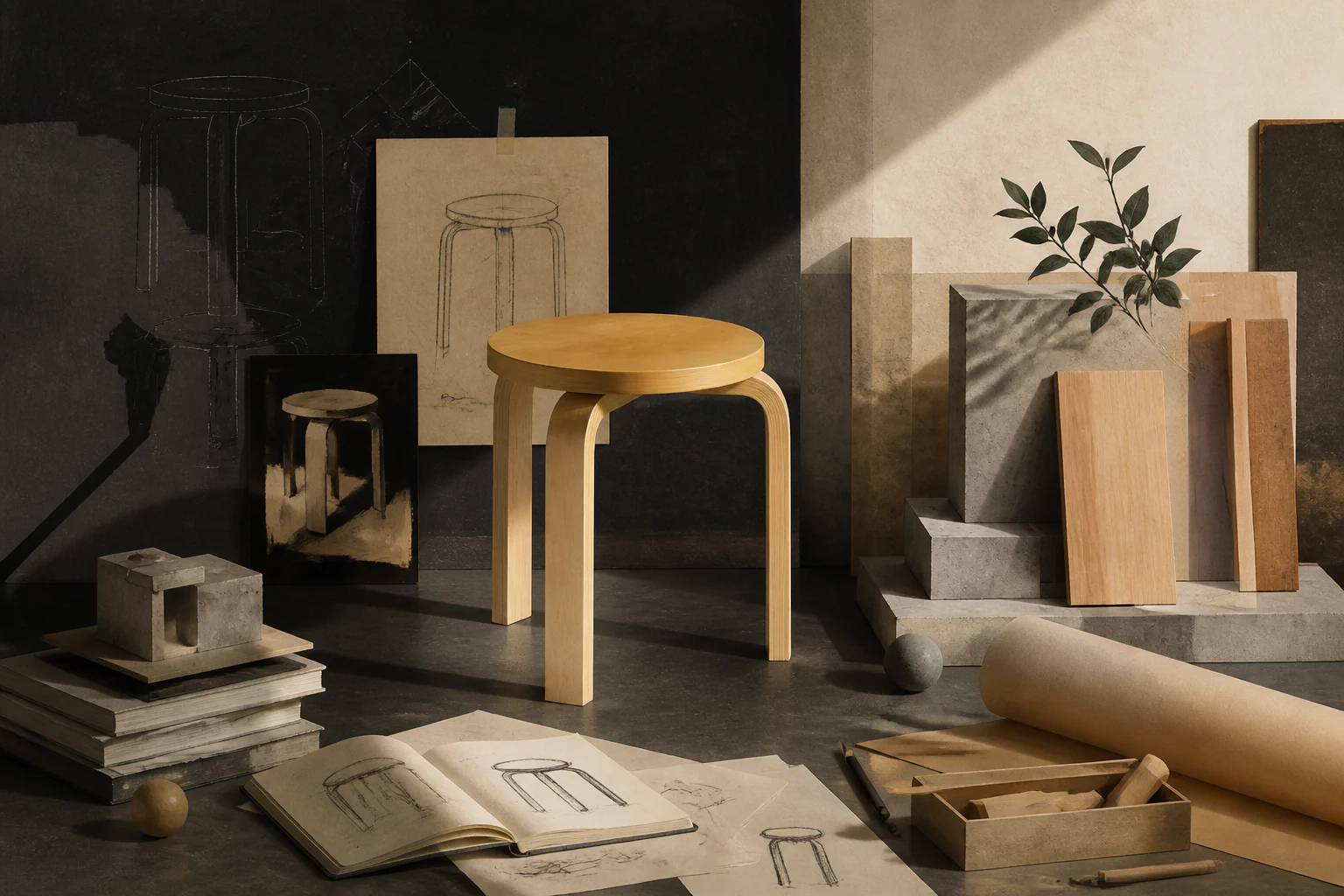
Ulm Stool matters to VANSMITHLAB not because it is called an icon, but because one object reveals the chain author → material → production → space → image → canon. An object as a tool: furniture, education and systems thinking.
Editorial thesis
Ulm Stool matters to VANSMITHLAB not because it is called an icon, but because one object reveals the chain author → material → production → space → image → canon. An object as a tool: furniture, education and systems thinking.
Reader question
Why did Ulm Stool become important to design history if it is only one piece of furniture?
Short answer
Because Ulm Stool makes a new relationship between form, body, material and production visible. Its historical role lies in the design problem it formulated and the way that formulation outlived its original moment.
1. Definition and boundaries of the object
The Ulm Stool is a compact wooden stool designed by Max Bill, Hans Gugelot and Paul Hildinger for the Ulm School of Design in 1954. It can act as a seat, low table, support, portable container or storage element.
2. Origins and prehistory
The object grew out of the young school’s economic and pedagogical conditions, including chronic underfunding. A cheap, light and multifunctional object was needed for students and teachers moving between classrooms, accommodation, refectory and terrace.
3. Why the object emerged when it did
The object grew out of the young school’s economic and pedagogical conditions, including chronic underfunding. A cheap, light and multifunctional object was needed for students and teachers moving between classrooms, accommodation, refectory and terrace. The date 1954 matters not as an isolated timestamp but as the point where material, production and cultural programme converged in one object.
4. Material, construction and composition
The minimal construction uses flat wooden panels joined into a rigid U-shaped shell; a cross-member stiffens the structure while also functioning as a handle. Its value lies in clear assembly and the ability to change function by turning the object.
5. Principle of use and operation
The minimal construction uses flat wooden panels joined into a rigid U-shaped shell; a cross-member stiffens the structure while also functioning as a handle. Its value lies in clear assembly and the ability to change function by turning the object. Use cannot be separated from construction: how a person sits, moves, carries or reconfigures the object is part of the structural idea.
6. Key technical or cultural turning point
The stool is compatible with straightforward woodworking and a small number of parts. Its historical importance comes from treating production economy, pedagogy and patterns of use as one design problem. The turning point is the translation of experiment into a reproducible system, making Ulm Stool a node in design history rather than only an authorial gesture.
7. First reference context
The object grew out of the young school’s economic and pedagogical conditions, including chronic underfunding. A cheap, light and multifunctional object was needed for students and teachers moving between classrooms, accommodation, refectory and terrace. The first reference context explains the original problem addressed by Max Bill; Hans Gugelot; Paul Hildinger and why the familiar typology proved insufficient.
8. Second reference context
The stool is compatible with straightforward woodworking and a small number of parts. Its historical importance comes from treating production economy, pedagogy and patterns of use as one design problem. The second context is production and licensing, showing which properties survived repetition and which depended on period technology.
9. Third reference context
The Ulm Stool remains a museum and educational object, repeatedly reproduced and interpreted. Its contemporary relevance comes from the idea one thing, several jobs rather than stylistic nostalgia. The third context is museum and contemporary life. Canonisation enables comparison between original purpose and later readings.
10. Form and geometry
The minimal construction uses flat wooden panels joined into a rigid U-shaped shell; a cross-member stiffens the structure while also functioning as a handle. Its value lies in clear assembly and the ability to change function by turning the object. The geometry of Ulm Stool is not an outer shell placed over function; it distributes load, organises the body and makes construction legible.
11. Surface, light and colour
In photographs it can look almost authorless — a simple rectangular frame. Its meaning becomes clear when a person or object reveals that the same geometry supports multiple orientations and uses. Surface and colour reinforce geometry: material communicates age, technology and making before the viewer reads a caption.
12. Tactility, movement and bodily posture
The Ulm Stool is a compact wooden stool designed by Max Bill, Hans Gugelot and Paul Hildinger for the Ulm School of Design in 1954. It can act as a seat, low table, support, portable container or storage element. Tactility emerges where body meets material, while movement appears through posture, carrying or reconfiguration. This bodily sequence remains part of the project.
13. Production system
The stool is compatible with straightforward woodworking and a small number of parts. Its historical importance comes from treating production economy, pedagogy and patterns of use as one design problem.
14. Tools and infrastructure
The production infrastructure of Ulm Stool includes drawings, tooling, machines, hand operations, tolerances, supply and quality control. The stool is compatible with straightforward woodworking and a small number of parts. Its historical importance comes from treating production economy, pedagogy and patterns of use as one design problem.
15. Diffusion and canonisation
The Ulm Stool remains a museum and educational object, repeatedly reproduced and interpreted. Its contemporary relevance comes from the idea one thing, several jobs rather than stylistic nostalgia. Diffusion occurred not only through sales: exhibitions, museums, magazines, catalogues and photographs turned a thing into a recognisable type and teaching example.
16. Professional practice
For professional designers, Ulm Stool is useful as a methodological case. The Ulm Stool is almost a teaching aid for systems design. It shows that universality can emerge not from a complex mechanism but from precise geometry and refusal to assign one fixed function. The practical value lies in seeing where form follows material and production and where it becomes cultural statement.
17. Relationship to architecture
The stool grew out of the building and everyday life of the school and was carried throughout HfG. It acts as a mobile architectural element that changes spatial use without rebuilding the room.
18. Relationship to product design
The Ulm Stool is almost a teaching aid for systems design. It shows that universality can emerge not from a complex mechanism but from precise geometry and refusal to assign one fixed function. The object changes not only furniture appearance but the design question itself: what counts as structure, comfort, system, material or authorship.
19. Relationship to fashion
Its image became part of the mythology of Ulm as a school of rational systems. Archive material restores everyday specificity: students really sat on it, carried things in it and used it as a table.
20. Relationship to image-making
In photographs it can look almost authorless — a simple rectangular frame. Its meaning becomes clear when a person or object reveals that the same geometry supports multiple orientations and uses.
21. Relationship to technology
The stool is compatible with straightforward woodworking and a small number of parts. Its historical importance comes from treating production economy, pedagogy and patterns of use as one design problem. Technology is a co-author of form: change material, tool or process and the field of possible geometry changes too.
22. Relationship to materials
The minimal construction uses flat wooden panels joined into a rigid U-shaped shell; a cross-member stiffens the structure while also functioning as a handle. Its value lies in clear assembly and the ability to change function by turning the object. Material must therefore be read through thickness, direction, joints, ageing, repair and component interaction, not by substance name alone.
23. Institutions and the canon
The Ulm Stool remains a museum and educational object, repeatedly reproduced and interpreted. Its contemporary relevance comes from the idea one thing, several jobs rather than stylistic nostalgia. Canonisation through museums and archives preserves documentation and early versions, but also turns domestic furniture into cultural signs. Both roles matter.
24. Market and commercial logic
The market value of Ulm Stool reflects production, licensing, brand, historical status and demand rather than raw-material price alone. Extreme simplicity led to numerous copies and variants, blurring the boundary of the original. The HfG-Archiv exhibition specifically examined which features make a stool recognisably Ulm. High cost by itself proves nothing about design quality.
25. Criticism and limitations
Extreme simplicity led to numerous copies and variants, blurring the boundary of the original. The HfG-Archiv exhibition specifically examined which features make a stool recognisably Ulm.
26. Mistakes and myths
The object is sometimes reduced to Max Bill’s authorship, while the HfG archive emphasises the contribution of Bill, Gugelot and Hildinger. The shortened attribution obscures the project’s collaborative and institutional nature.
27. Sustainability, longevity and maintenance
Low material use, little finishing, multifunctionality and a repairable timber construction create a strong life-cycle proposition. Sustainability still depends on timber, joints and the duration of actual use.
28. Contemporary status
The Ulm Stool remains a museum and educational object, repeatedly reproduced and interpreted. Its contemporary relevance comes from the idea one thing, several jobs rather than stylistic nostalgia.
29. What the object changed in the discipline
The Ulm Stool is almost a teaching aid for systems design. It shows that universality can emerge not from a complex mechanism but from precise geometry and refusal to assign one fixed function. The primary contribution is a changed design question: the object offers a new example of linking body, material, production and cultural meaning.
30. How to read the object today
Today Ulm Stool should be read at three scales: as a thing for the body, as a production system and as an image loaded with history. Extreme simplicity led to numerous copies and variants, blurring the boundary of the original. The HfG-Archiv exhibition specifically examined which features make a stool recognisably Ulm. This makes iconic status testable and meaningful.
See also
- Superleggera — Minimum mass as a design problem: craft and industry.
- Mezzadro — A found industrial element transformed into a domestic object.
- 606 Universal Shelving System — Modularity, repairability and the long life of an object.