encyclopedia
UP5/UP6
Body, politics, polyurethane foam and radical design
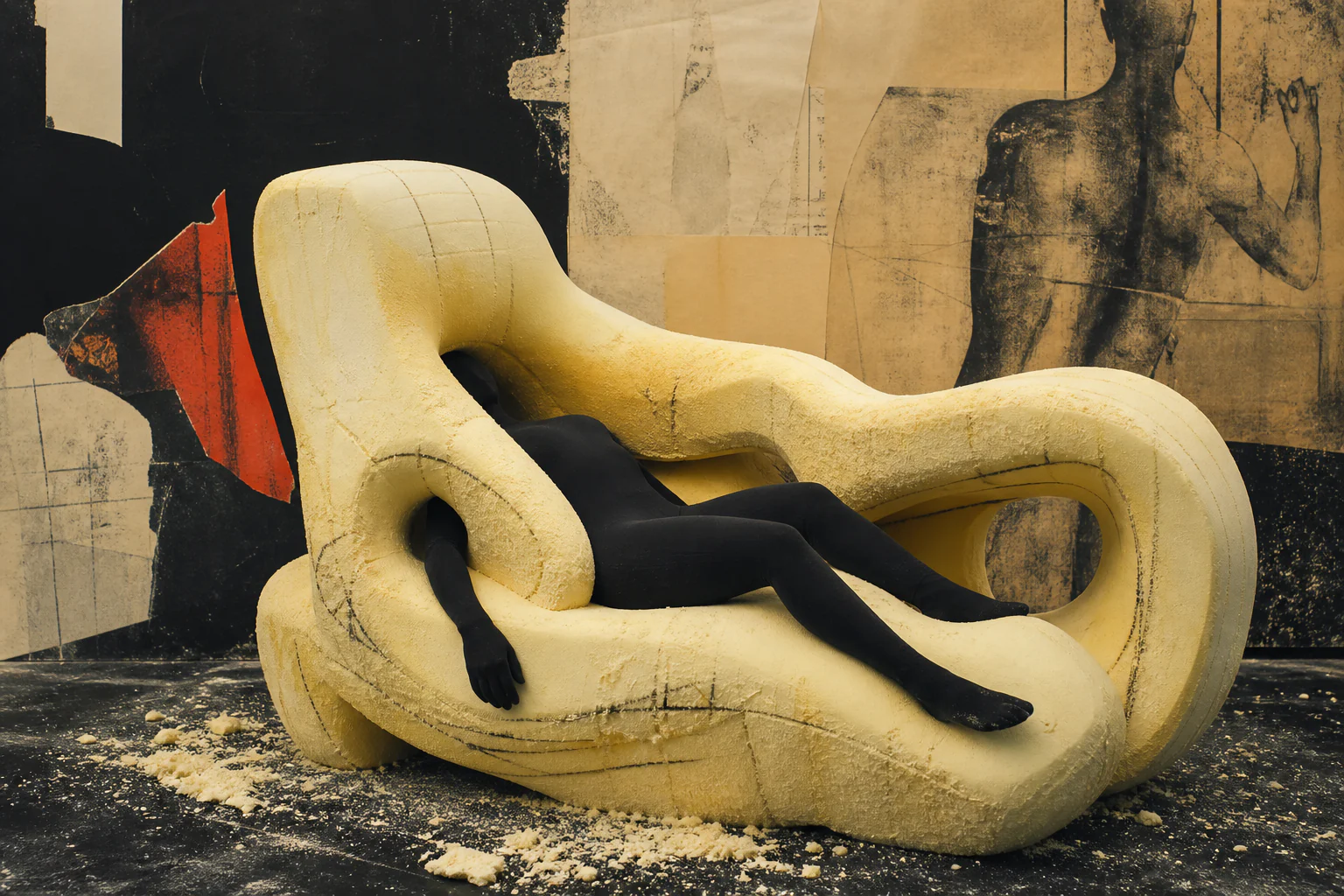
UP5/UP6 matters to VANSMITHLAB not because it is called an icon, but because one object reveals the chain author → material → production → space → image → canon. Body, politics, polyurethane foam and radical design.
Editorial thesis
UP5/UP6 matters to VANSMITHLAB not because it is called an icon, but because one object reveals the chain author → material → production → space → image → canon. Body, politics, polyurethane foam and radical design.
Reader question
Why did UP5/UP6 become important to design history if it is only one piece of furniture?
Short answer
Because UP5/UP6 makes a new relationship between form, body, material and production visible. Its historical role lies in the design problem it formulated and the way that formulation outlived its original moment.
1. Definition and boundaries of the object
UP5/UP6 is an armchair and tethered spherical ottoman from Gaetano Pesce’s 1969 UP series. The anthropomorphic chair uses moulded polyurethane foam and stretch upholstery, while the ball on a cord turns the set into a figurative image of body and constraint.
2. Origins and prehistory
The project emerged at the intersection of new foam chemistry, experimental furniture industry and radical culture at the end of the 1960s. The original series became famous for compression technology: a soft object could be packed at greatly reduced volume and recover its shape after opening.
3. Why the object emerged when it did
The project emerged at the intersection of new foam chemistry, experimental furniture industry and radical culture at the end of the 1960s. The original series became famous for compression technology: a soft object could be packed at greatly reduced volume and recover its shape after opening. The date 1969 matters not as an isolated timestamp but as the point where material, production and cultural programme converged in one object.
4. Material, construction and composition
UP5 is almost monolithic: flexible polyurethane foam creates seat, back and sides without a visible rigid frame. The separate spherical UP6 is tied by a cord and works simultaneously as ottoman and semantic element.
5. Principle of use and operation
UP5 is almost monolithic: flexible polyurethane foam creates seat, back and sides without a visible rigid frame. The separate spherical UP6 is tied by a cord and works simultaneously as ottoman and semantic element. Use cannot be separated from construction: how a person sits, moves, carries or reconfigures the object is part of the structural idea.
6. Key technical or cultural turning point
The historical version made foaming and vacuum compression part of the product and its logistics. With the 2000 re-edition, B&B Italia retained the image but changed the production method: current pieces arrive in final shape rather than travelling vacuum-compressed. The turning point is the translation of experiment into a reproducible system, making UP5/UP6 a node in design history rather than only an authorial gesture.
7. First reference context
The project emerged at the intersection of new foam chemistry, experimental furniture industry and radical culture at the end of the 1960s. The original series became famous for compression technology: a soft object could be packed at greatly reduced volume and recover its shape after opening. The first reference context explains the original problem addressed by Gaetano Pesce and why the familiar typology proved insufficient.
8. Second reference context
The historical version made foaming and vacuum compression part of the product and its logistics. With the 2000 re-edition, B&B Italia retained the image but changed the production method: current pieces arrive in final shape rather than travelling vacuum-compressed. The second context is production and licensing, showing which properties survived repetition and which depended on period technology.
9. Third reference context
B&B Italia continues to produce Serie UP; UP5/UP6 remains an international icon. In 2022 the series received the ADI Compasso d’Oro Product Career Award. The third context is museum and contemporary life. Canonisation enables comparison between original purpose and later readings.
10. Form and geometry
UP5 is almost monolithic: flexible polyurethane foam creates seat, back and sides without a visible rigid frame. The separate spherical UP6 is tied by a cord and works simultaneously as ottoman and semantic element. The geometry of UP5/UP6 is not an outer shell placed over function; it distributes load, organises the body and makes construction legible.
11. Surface, light and colour
A frontal image quickly reveals the figurative reading: broad back and spherical ottoman become body and attached weight. From the side, the technological continuity of the foam form becomes more evident. Surface and colour reinforce geometry: material communicates age, technology and making before the viewer reads a caption.
12. Tactility, movement and bodily posture
UP5/UP6 is an armchair and tethered spherical ottoman from Gaetano Pesce’s 1969 UP series. The anthropomorphic chair uses moulded polyurethane foam and stretch upholstery, while the ball on a cord turns the set into a figurative image of body and constraint. Tactility emerges where body meets material, while movement appears through posture, carrying or reconfiguration. This bodily sequence remains part of the project.
13. Production system
The historical version made foaming and vacuum compression part of the product and its logistics. With the 2000 re-edition, B&B Italia retained the image but changed the production method: current pieces arrive in final shape rather than travelling vacuum-compressed.
14. Tools and infrastructure
The production infrastructure of UP5/UP6 includes drawings, tooling, machines, hand operations, tolerances, supply and quality control. The historical version made foaming and vacuum compression part of the product and its logistics. With the 2000 re-edition, B&B Italia retained the image but changed the production method: current pieces arrive in final shape rather than travelling vacuum-compressed.
15. Diffusion and canonisation
B&B Italia continues to produce Serie UP; UP5/UP6 remains an international icon. In 2022 the series received the ADI Compasso d’Oro Product Career Award. Diffusion occurred not only through sales: exhibitions, museums, magazines, catalogues and photographs turned a thing into a recognisable type and teaching example.
16. Professional practice
For professional designers, UP5/UP6 is useful as a methodological case. Pesce joins comfort to political metaphor. In the designer’s explanation, the feminine chair form and tethered ball refer to the condition of women as bodies that may be protected yet constrained. The practical value lies in seeing where form follows material and production and where it becomes cultural statement.
17. Relationship to architecture
The chair behaves like a soft mass, almost a small room for one body. The absence of visible frame makes volume and void read as architectural modelling.
18. Relationship to product design
Pesce joins comfort to political metaphor. In the designer’s explanation, the feminine chair form and tethered ball refer to the condition of women as bodies that may be protected yet constrained. The object changes not only furniture appearance but the design question itself: what counts as structure, comfort, system, material or authorship.
19. Relationship to fashion
The object lives between design, pop culture and political imagery. Advertising, vivid textiles and anthropomorphism made the chair a media character rather than furniture alone.
20. Relationship to image-making
A frontal image quickly reveals the figurative reading: broad back and spherical ottoman become body and attached weight. From the side, the technological continuity of the foam form becomes more evident.
21. Relationship to technology
The historical version made foaming and vacuum compression part of the product and its logistics. With the 2000 re-edition, B&B Italia retained the image but changed the production method: current pieces arrive in final shape rather than travelling vacuum-compressed. Technology is a co-author of form: change material, tool or process and the field of possible geometry changes too.
22. Relationship to materials
UP5 is almost monolithic: flexible polyurethane foam creates seat, back and sides without a visible rigid frame. The separate spherical UP6 is tied by a cord and works simultaneously as ottoman and semantic element. Material must therefore be read through thickness, direction, joints, ageing, repair and component interaction, not by substance name alone.
23. Institutions and the canon
B&B Italia continues to produce Serie UP; UP5/UP6 remains an international icon. In 2022 the series received the ADI Compasso d’Oro Product Career Award. Canonisation through museums and archives preserves documentation and early versions, but also turns domestic furniture into cultural signs. Both roles matter.
24. Market and commercial logic
The market value of UP5/UP6 reflects production, licensing, brand, historical status and demand rather than raw-material price alone. The metaphor remains contested: it can be read as feminist statement, male projection onto the female body, or marketing dramatisation. The designer’s explanation should not be treated as the only possible interpretation. High cost by itself proves nothing about design quality.
25. Criticism and limitations
The metaphor remains contested: it can be read as feminist statement, male projection onto the female body, or marketing dramatisation. The designer’s explanation should not be treated as the only possible interpretation.
26. Mistakes and myths
Today’s Serie UP visually continues the 1969 object, but its technology is not identical to the original. The history should not imply that current chairs still ship flat in vacuum packaging.
27. Sustainability, longevity and maintenance
Original compression greatly reduced shipping volume, while polyurethane foam and multi-material upholstery create their own environmental difficulties. Logistics is only one part of a life-cycle assessment.
28. Contemporary status
B&B Italia continues to produce Serie UP; UP5/UP6 remains an international icon. In 2022 the series received the ADI Compasso d’Oro Product Career Award.
29. What the object changed in the discipline
Pesce joins comfort to political metaphor. In the designer’s explanation, the feminine chair form and tethered ball refer to the condition of women as bodies that may be protected yet constrained. The primary contribution is a changed design question: the object offers a new example of linking body, material, production and cultural meaning.
30. How to read the object today
Today UP5/UP6 should be read at three scales: as a thing for the body, as a production system and as an image loaded with history. The metaphor remains contested: it can be read as feminist statement, male projection onto the female body, or marketing dramatisation. The designer’s explanation should not be treated as the only possible interpretation. This makes iconic status testable and meaningful.
See also
- Sacco — The anti-chair: free posture and unfixed form.
- Panton Chair — One material, continuous form and a new plastics industry.
- Wiggle Side Chair — Cardboard as structural material and a critique of familiar value.