encyclopedia
Wiggle Side Chair
Cardboard as structural material and a critique of familiar value
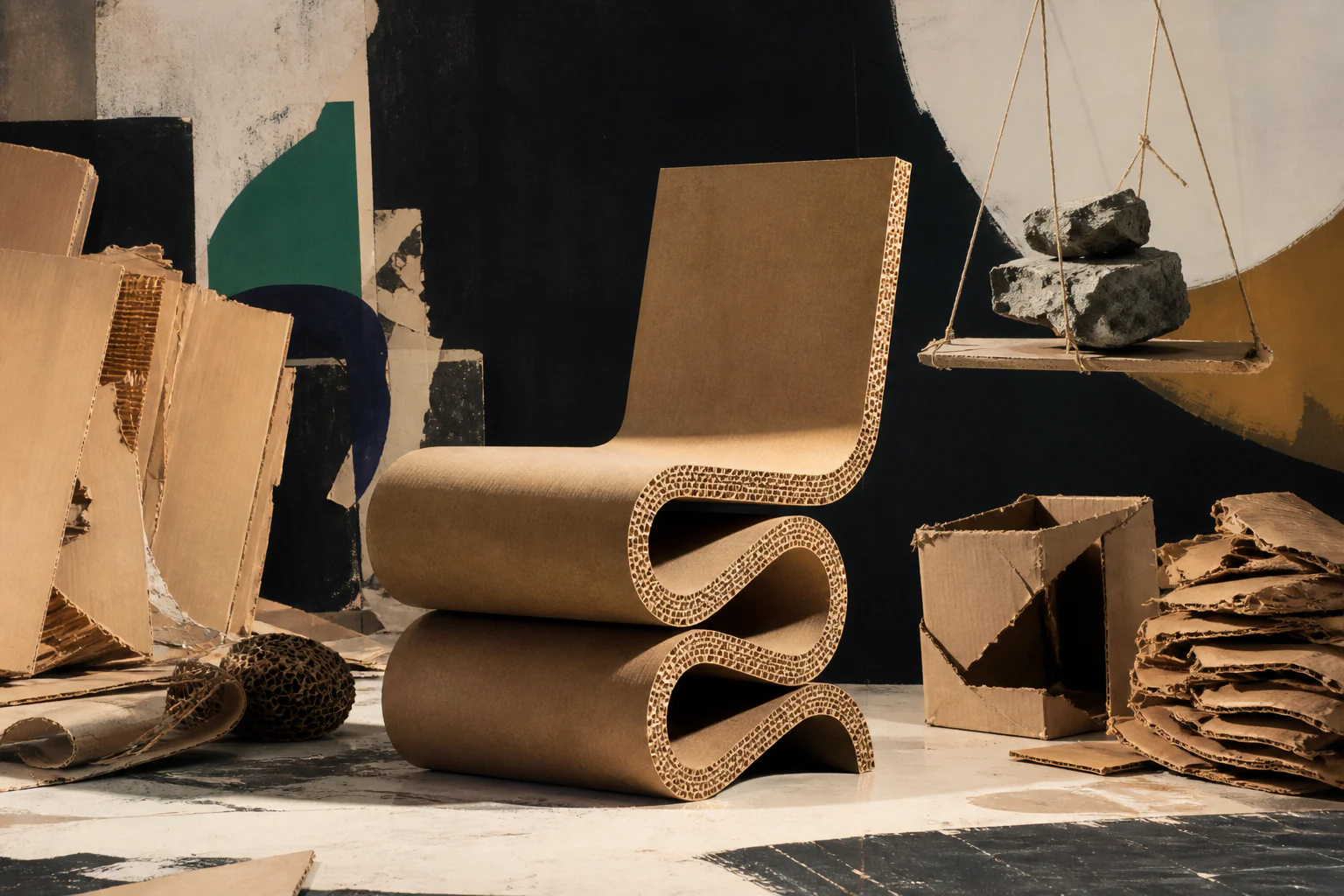
Wiggle Side Chair matters to VANSMITHLAB not because it is called an icon, but because one object reveals the chain author → material → production → space → image → canon. Cardboard as structural material and a critique of familiar value.
Editorial thesis
Wiggle Side Chair matters to VANSMITHLAB not because it is called an icon, but because one object reveals the chain author → material → production → space → image → canon. Cardboard as structural material and a critique of familiar value.
Reader question
Why did Wiggle Side Chair become important to design history if it is only one piece of furniture?
Short answer
Because Wiggle Side Chair makes a new relationship between form, body, material and production visible. Its historical role lies in the design problem it formulated and the way that formulation outlived its original moment.
1. Definition and boundaries of the object
The Wiggle Side Chair is Frank Gehry’s 1972 Easy Edges chair built from laminated corrugated cardboard with hard edge panels. Its undulating profile turns packaging material into load-bearing structure and an expressive furniture silhouette.
2. Origins and prehistory
Gehry experimented with ordinary cardboard and found that laminating layers with controlled corrugation direction produced unexpected strength. Easy Edges translated this effect into objects that were materially cheap yet formally complex.
3. Why the object emerged when it did
Gehry experimented with ordinary cardboard and found that laminating layers with controlled corrugation direction produced unexpected strength. Easy Edges translated this effect into objects that were materially cheap yet formally complex. The date 1972 matters not as an isolated timestamp but as the point where material, production and cultural programme converged in one object.
4. Material, construction and composition
Structural mass comes not from one thick sheet but from a pack of thin corrugated layers. The cut edges become the main visible surface, exposing material structure as pattern; hard side panels protect edges and stabilise the form.
5. Principle of use and operation
Structural mass comes not from one thick sheet but from a pack of thin corrugated layers. The cut edges become the main visible surface, exposing material structure as pattern; hard side panels protect edges and stabilise the form. Use cannot be separated from construction: how a person sits, moves, carries or reconfigures the object is part of the structural idea.
6. Key technical or cultural turning point
Manufacturing requires cutting and accurately laminating many cardboard layers. Cheap raw material therefore does not produce a cheap object: cost shifts from material into labour, processing and geometric control. The turning point is the translation of experiment into a reproducible system, making Wiggle Side Chair a node in design history rather than only an authorial gesture.
7. First reference context
Gehry experimented with ordinary cardboard and found that laminating layers with controlled corrugation direction produced unexpected strength. Easy Edges translated this effect into objects that were materially cheap yet formally complex. The first reference context explains the original problem addressed by Frank Gehry and why the familiar typology proved insufficient.
8. Second reference context
Manufacturing requires cutting and accurately laminating many cardboard layers. Cheap raw material therefore does not produce a cheap object: cost shifts from material into labour, processing and geometric control. The second context is production and licensing, showing which properties survived repetition and which depended on period technology.
9. Third reference context
Vitra continues to produce the Wiggle Side Chair and early Easy Edges objects belong to museum collections. It remains one of the clearest examples of material dictating furniture geometry. The third context is museum and contemporary life. Canonisation enables comparison between original purpose and later readings.
10. Form and geometry
Structural mass comes not from one thick sheet but from a pack of thin corrugated layers. The cut edges become the main visible surface, exposing material structure as pattern; hard side panels protect edges and stabilise the form. The geometry of Wiggle Side Chair is not an outer shell placed over function; it distributes load, organises the body and makes construction legible.
11. Surface, light and colour
A side view reveals the wiggle, while a frontal view shows the dense striped structure of layers. In a strong image the viewer sees sculptural profile first and only later realises that the surface is ordinary cardboard. Surface and colour reinforce geometry: material communicates age, technology and making before the viewer reads a caption.
12. Tactility, movement and bodily posture
The Wiggle Side Chair is Frank Gehry’s 1972 Easy Edges chair built from laminated corrugated cardboard with hard edge panels. Its undulating profile turns packaging material into load-bearing structure and an expressive furniture silhouette. Tactility emerges where body meets material, while movement appears through posture, carrying or reconfiguration. This bodily sequence remains part of the project.
13. Production system
Manufacturing requires cutting and accurately laminating many cardboard layers. Cheap raw material therefore does not produce a cheap object: cost shifts from material into labour, processing and geometric control.
14. Tools and infrastructure
The production infrastructure of Wiggle Side Chair includes drawings, tooling, machines, hand operations, tolerances, supply and quality control. Manufacturing requires cutting and accurately laminating many cardboard layers. Cheap raw material therefore does not produce a cheap object: cost shifts from material into labour, processing and geometric control.
15. Diffusion and canonisation
Vitra continues to produce the Wiggle Side Chair and early Easy Edges objects belong to museum collections. It remains one of the clearest examples of material dictating furniture geometry. Diffusion occurred not only through sales: exhibitions, museums, magazines, catalogues and photographs turned a thing into a recognisable type and teaching example.
16. Professional practice
For professional designers, Wiggle Side Chair is useful as a methodological case. The Wiggle Side Chair reverses a familiar hierarchy of value. A material normally discarded with packaging acquires structural purpose, museum status and high cultural value. The practical value lies in seeing where form follows material and production and where it becomes cultural statement.
17. Relationship to architecture
Serial cardboard layers behave like ribs or laminations in architecture. The profile provides base, seat and back while the material exposes its own structure without cladding.
18. Relationship to product design
The Wiggle Side Chair reverses a familiar hierarchy of value. A material normally discarded with packaging acquires structural purpose, museum status and high cultural value. The object changes not only furniture appearance but the design question itself: what counts as structure, comfort, system, material or authorship.
19. Relationship to fashion
The chair connected Gehry’s architectural interest in complex contour to an everyday low-status material. The gesture later resonated with wider experimentation in recycled, temporary and paper-based materials.
20. Relationship to image-making
A side view reveals the wiggle, while a frontal view shows the dense striped structure of layers. In a strong image the viewer sees sculptural profile first and only later realises that the surface is ordinary cardboard.
21. Relationship to technology
Manufacturing requires cutting and accurately laminating many cardboard layers. Cheap raw material therefore does not produce a cheap object: cost shifts from material into labour, processing and geometric control. Technology is a co-author of form: change material, tool or process and the field of possible geometry changes too.
22. Relationship to materials
Structural mass comes not from one thick sheet but from a pack of thin corrugated layers. The cut edges become the main visible surface, exposing material structure as pattern; hard side panels protect edges and stabilise the form. Material must therefore be read through thickness, direction, joints, ageing, repair and component interaction, not by substance name alone.
23. Institutions and the canon
Vitra continues to produce the Wiggle Side Chair and early Easy Edges objects belong to museum collections. It remains one of the clearest examples of material dictating furniture geometry. Canonisation through museums and archives preserves documentation and early versions, but also turns domestic furniture into cultural signs. Both roles matter.
24. Market and commercial logic
The market value of Wiggle Side Chair reflects production, licensing, brand, historical status and demand rather than raw-material price alone. Cardboard is vulnerable to water, dirt and edge damage, so the image of a simple cheap material collides with careful-use requirements. Multi-layer gluing can also complicate recycling compared with plain packaging board. High cost by itself proves nothing about design quality.
25. Criticism and limitations
Cardboard is vulnerable to water, dirt and edge damage, so the image of a simple cheap material collides with careful-use requirements. Multi-layer gluing can also complicate recycling compared with plain packaging board.
26. Mistakes and myths
The chair is not simply a stack of cardboard. Stability depends on layer orientation, profile geometry, adhesive quality and hard edge elements — in other words, on engineering a composite material.
27. Sustainability, longevity and maintenance
Vitra describes cardboard as a material used only in a limited part of its range. Environmental assessment must consider fibre sourcing, adhesives, service life and recycling; the cultural idea of a low-status material does not replace life-cycle evidence.
28. Contemporary status
Vitra continues to produce the Wiggle Side Chair and early Easy Edges objects belong to museum collections. It remains one of the clearest examples of material dictating furniture geometry.
29. What the object changed in the discipline
The Wiggle Side Chair reverses a familiar hierarchy of value. A material normally discarded with packaging acquires structural purpose, museum status and high cultural value. The primary contribution is a changed design question: the object offers a new example of linking body, material, production and cultural meaning.
30. How to read the object today
Today Wiggle Side Chair should be read at three scales: as a thing for the body, as a production system and as an image loaded with history. Cardboard is vulnerable to water, dirt and edge damage, so the image of a simple cheap material collides with careful-use requirements. Multi-layer gluing can also complicate recycling compared with plain packaging board. This makes iconic status testable and meaningful.
See also
- Panton Chair — One material, continuous form and a new plastics industry.
- Eames Lounge Chair — Moulded plywood, comfort and postwar luxury.
- UP5/UP6 — Body, politics, polyurethane foam and radical design.
- Carlton — Memphis: furniture as sign, colour and refusal of neutrality.