industrial designer profile
Marc Newson
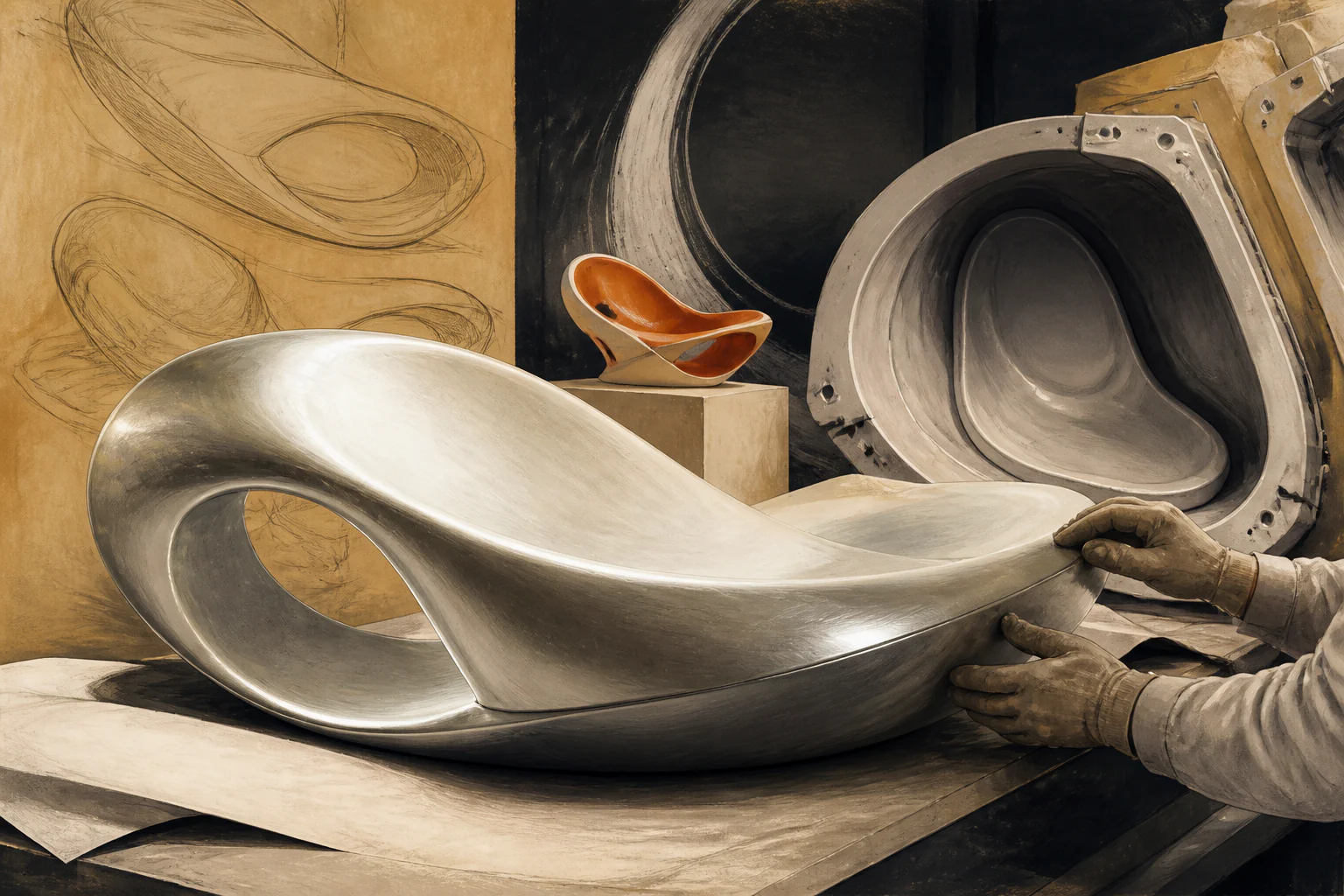
A continuous surface without visible joints, at once a form and a manufacturing requirement.

Editorial thesis
Newson matters for taking the demand for seamlessness to its limit: his objects read as cast whole, and that demand determines the technology rather than the reverse.
Reader question
What does an object cost when not a single joint is visible?
Short answer
It costs hand finishing, expensive tooling, and a short run: seamlessness is almost always the consequence of rejecting an economical way of making.
1. Position
Newson works as an industrial designer across a range from furniture to transport and watches. Common to every category is the requirement of a continuous shell.
2. An early work as manifesto
His best-known early object is a chaise of the late 1980s clad in aluminium sheets fitted by hand with rivets from inside. Externally the surface appears continuous.
3. The making method
The form was built by hand in fibreglass and clad in metal. It is a craft technology imitating an industrial one: the result looks stamped while being made piece by piece.
4. The gap between look and method
Here lies the central contradiction of his practice: objects look like the product of a high-technology series while being made as unique pieces. Appearance promises industry; origin speaks of a workshop.
5. Auction status
His early objects reached the top of the design auction market. This confirms their status as collectable objects rather than as industrial products.
6. An aerospace vocabulary
His formal language is borrowed from aviation: streamlining, the rivet, the rounded corner, instrument logic. This is not a reference to the past but the transfer of a working engineering aesthetic.
7. The fillet as signature
A constant feature of his objects is a large blend radius in which the edge disappears. The radius here does the work a detail does for other authors: it is recognisable.
8. Transport projects
He has worked on aircraft interiors and a concept car. In these categories the demand for continuous surface coincides with the engineering requirement rather than contradicting it.
9. The aircraft cabin as a task
Designing an aircraft interior is constrained by certification, weight, and material flammability. It is the most regulated of his fields and therefore the most verifiable.
10. Watches and precision
Working with watches translates his language into a very small scale, where tolerances are measured in fractions of a millimetre. Seamlessness here becomes a question of machining.
11. A move into corporate practice
In the mid-2010s he joined the design group of a major technology company. This moved his work from an authorial regime into a corporate one, where the name is not displayed.
12. A convergence of languages
The move was logical: the demand for a whole enclosure with concealed joints is shared by both sides. Two practices that arrived independently at the same technical ideal met here.
13. The price of seamlessness
The absence of a visible joint impedes disassembly and repair. This follows directly from the formal requirement and conflicts with repairability.
14. What transfers
The discipline of surface transfers: curvature continuity, consistent radii, absence of accidental edges. These are verifiable geometric criteria.
15. What does not transfer
The economics of the early work do not transfer. Hand cladding in a single example is not a production model and never was.
16. Critique
A justified objection: a streamlined language is universal and therefore neutral to purpose. The same formal device is applied to a chaise, a car, and a watch, and the object loses the specificity of its category.
17. A second objection
Smoothness resists ageing: a chip in a continuous surface reads as breakage, whereas on an articulated one it remains a trace of use.
18. Historical position
He represents a line in which an industrial appearance is an aesthetic goal rather than a production fact. This is a substantial shift from the modernist tradition of honesty in making.
19. Link to the knowledge base
The material connects to the entries on composites, aluminium, industrial design as company interface, and the logistics of form.
20. How to read this today
Ask about the making method rather than the appearance. An object that looks stamped may be made by hand, and that difference determines its price and status entirely.