industrial designer profile
Naoto Fukasawa
Design that begins from observing unconscious behaviour rather than from the form of an object.
Editorial thesis
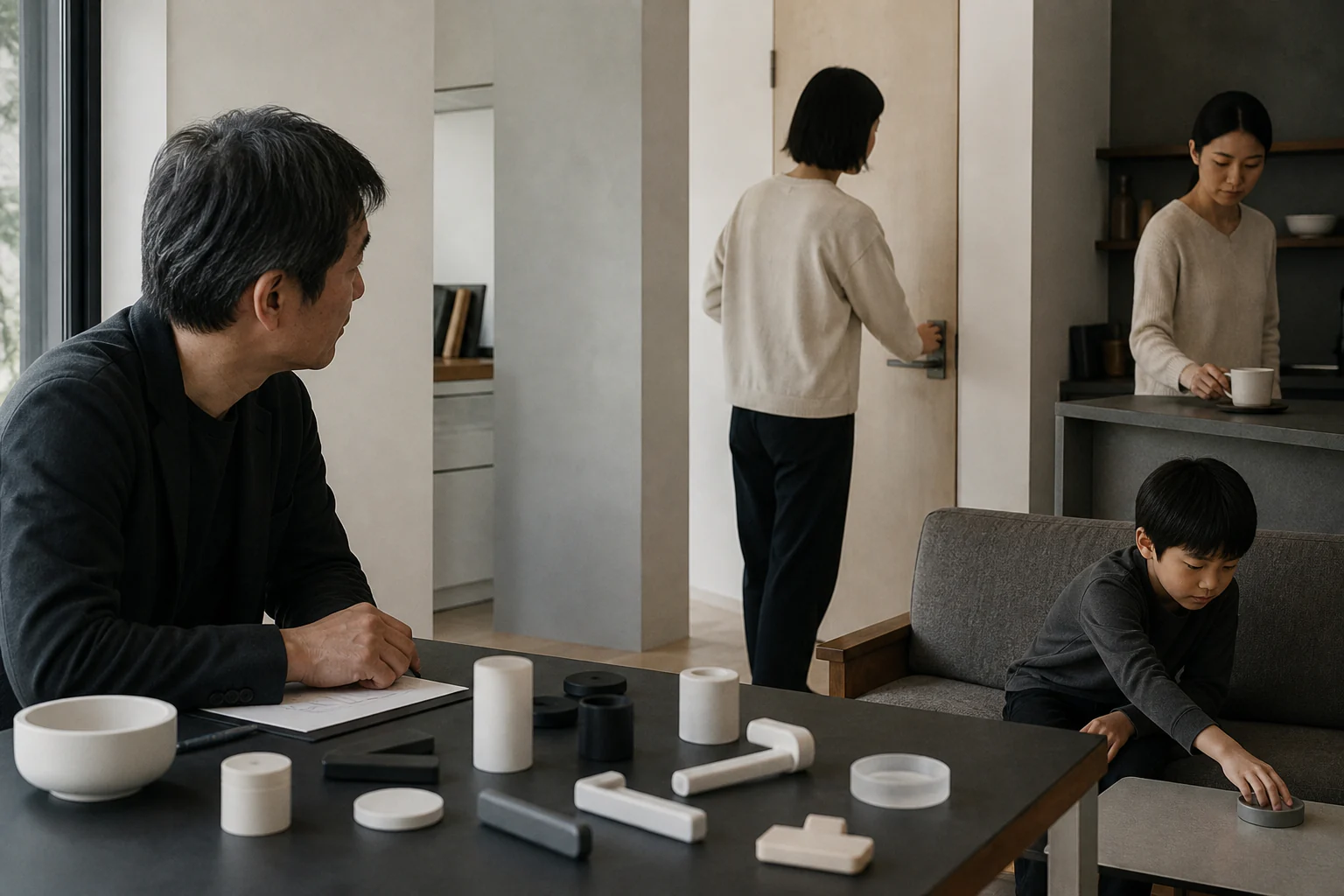
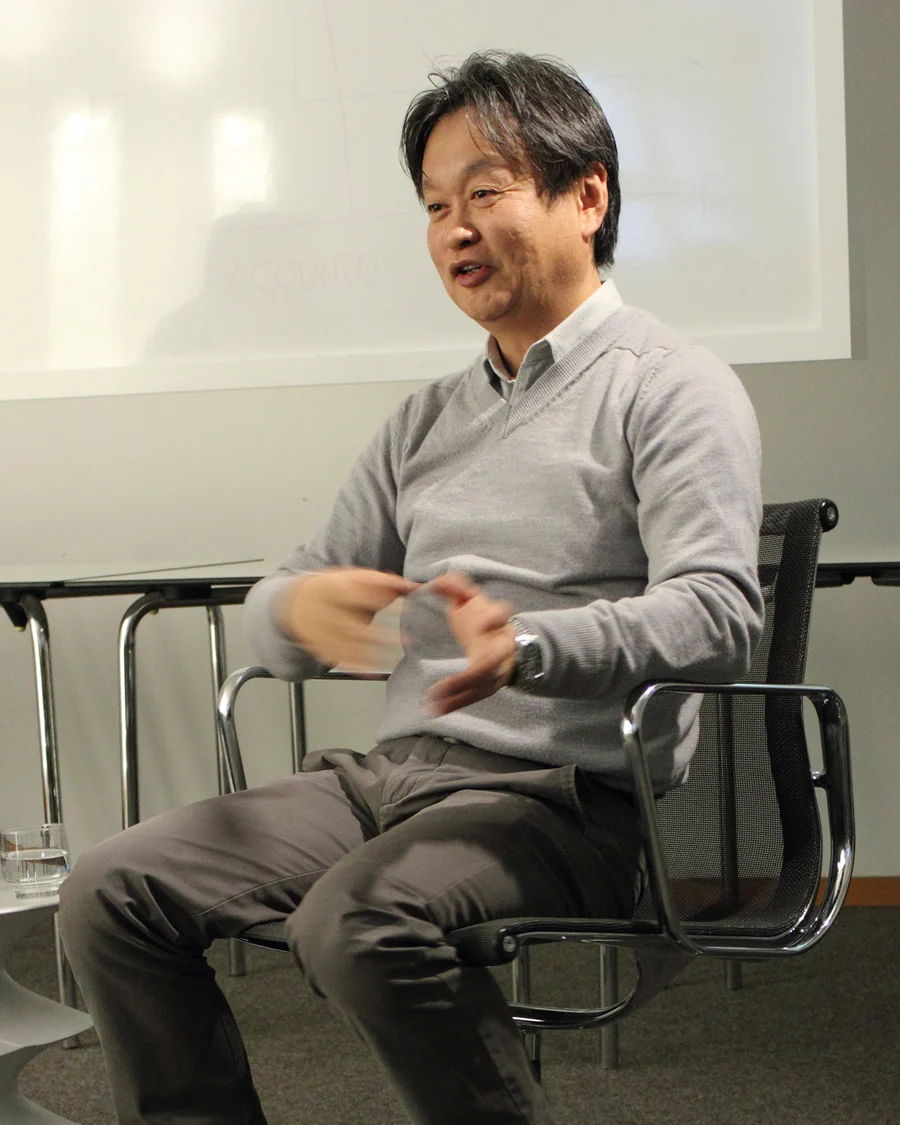
Fukasawa matters as the author of a method in which an object is derived from habit: what a person does without thinking is recorded first, and only then does a form appear to serve that action.
Reader question
How can an object be designed when a user cannot say what they want?
Short answer
By observing what they already do automatically. Unconscious action is a more reliable source of requirements than stated preference.
1. Position
Fukasawa works as a product designer and is known for an approach in which an object should dissolve into an action. His interest is not the expressiveness of a thing but how imperceptibly it fits an already existing habit.
2. Thinking without thought
The central notion of his practice is action performed without deliberation. A person puts keys in the same place without making a decision; such automatisms serve as the project’s raw material.
3. Observation as method
The approach rests on recording small domestic scenes: how things are held, where they are set down, what people lean on. The material is not a user’s opinion but their recorded behaviour.
4. Why surveys fail
Stated preference describes how a person sees themselves rather than how they act. The divergence between these two pictures is the method’s working zone.
5. The object as continuation of the environment
A thing is designed to seem as if it had always been there. Hence formal restraint: conspicuousness prevents an object from becoming part of the everyday background.
6. The wall-mounted player
His best-known object is a wall-mounted compact disc player with a pull cord, released by MUJI at the turn of the century. It quotes a ventilation fan: the gesture of pulling a cord is already known to the body.
7. Why that object is representative
It does not invent a new action but borrows an existing one. A user understands the device before reading instructions, because the gesture is carried over from another, familiar category.
8. Work with MUJI
His practice is closely tied to a brand built on refusing visible branding. The coincidence is not accidental: a method seeking an object’s invisibility requires a client that does not demand a visible brand.
9. Super Normal
Together with Jasper Morrison he formulated the notion of the super normal — a quality possessed by things that make no claim to novelty yet withstand daily use for decades.
10. The exhibition as argument
The super normal project was presented as an exhibition of selected objects, most without a known author. Selection here worked as a statement: what was shown had already passed the test of use.
11. The difference from minimalism
The restraint of his objects is not stylistic minimalism. Form is simplified not for appearance but until it stops obstructing action; the criterion is functional rather than aesthetic.
12. An own brand
He took part in founding a domestic appliance brand whose very name refers to the idea of zero deviation. The position is stated in the name: an object should add nothing superfluous to its surroundings.
13. Tactility as criterion
A substantial part of his decisions concerns feel in the hand: weight, material temperature, button resistance. These qualities are not conveyed by images and are therefore rarely discussed in publications.
14. Attitude to technology
Technology in his objects is deliberately concealed. Complexity is served by an interface reduced to one obvious action, which is the opposite of a logic of demonstrating capability.
15. What in the method transfers
The procedure transfers: observe, record automatism, find an already existing gesture, design for it. This is a describable sequence rather than a position of taste.
16. What does not transfer
Selection does not transfer: deciding which observation matters remains authorial. The method narrows the field but does not decide for the designer.
17. Critique
A justified objection is that the approach works well for domestic objects with an established scenario and poorly where no scenario yet exists. There is nothing to observe if an action does not exist.
18. A second objection
Inconspicuousness sells badly. An object designed not to attract attention loses in a channel where decisions are made from a photograph.
19. Link to the knowledge base
The material connects to the entries on minimalism, on MUJI, on product design as a system, and on prototyping as hypothesis testing.
20. How to read this today
Test objects of this circle by hand and by repetition rather than by looking. Quality here appears at the hundredth use, not in the first photograph.