analysis
From craft to digital craft — where mastery begins
Digital craft begins where an author governs the constraints of a tool as finely as a maker governs material.
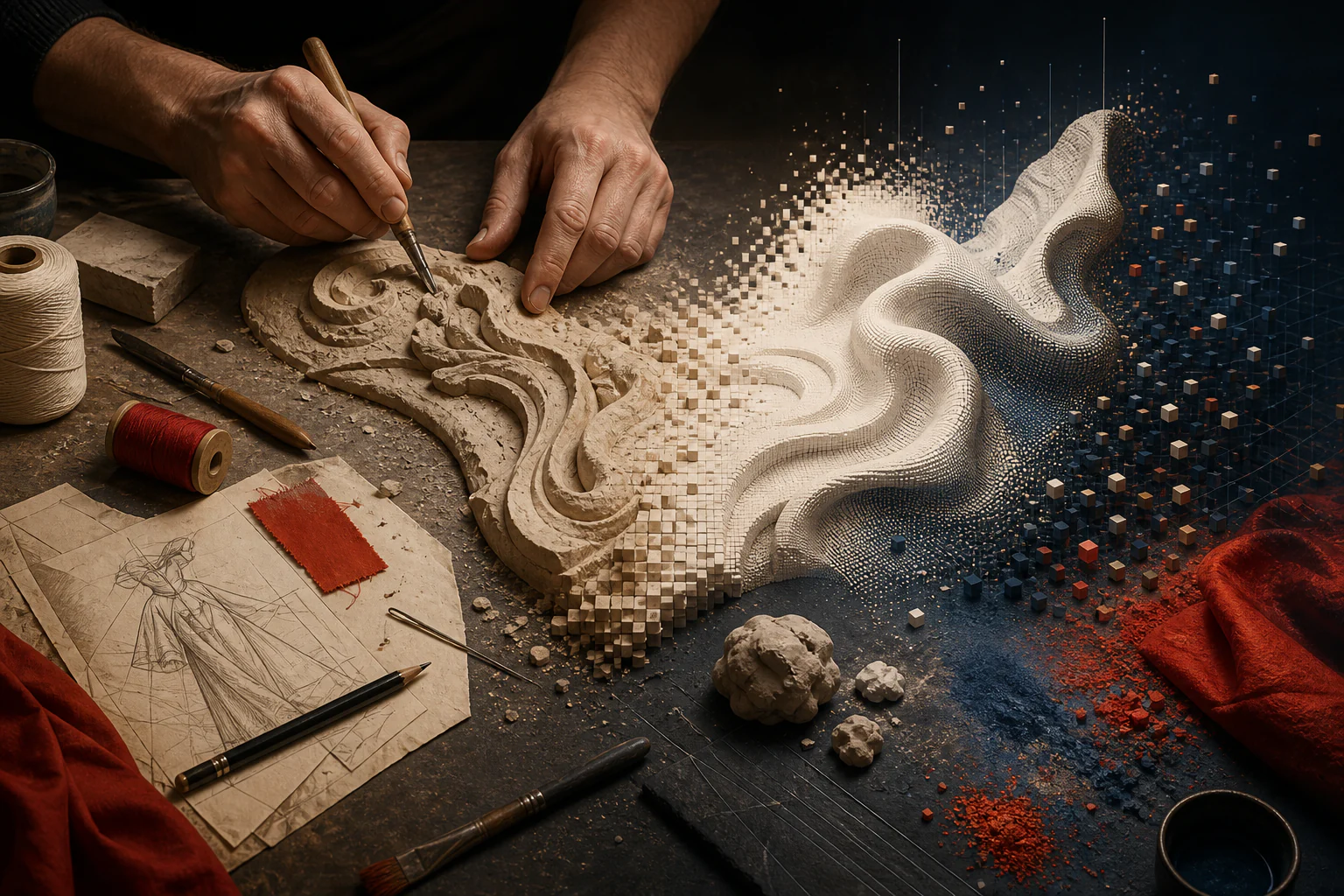
Digital craft begins where an author governs the constraints of a tool as finely as a maker governs material.
Editorial question
How should we read this problem: digital craft begins where an author governs the constraints of a tool as finely as a maker governs material.
Short answer
Digital craft begins where an author governs the constraints of a tool as finely as a maker governs material.
Thesis
Mastery lies not in the cleanness of a result but in how an author works with the resistance of material. Wood has grain, clay has shrinkage, a file has bit depth and an algorithm. Craft begins where resistance is known and used.
Digital craft begins where an author governs the constraints of a tool as finely as a maker governs material.
Evidence and cases
Thesis: craft is a relationship with resistance
Mastery lies not in the cleanness of a result but in how an author works with the resistance of material. Wood has grain, clay has shrinkage, a file has bit depth and an algorithm. Craft begins where resistance is known and used.
What resists in the digital
A digital tool has its own physics: bit depth, colour gamut, compression, resolution, order of operations. These properties are not metaphorical — they produce visible artefacts and limit permissible actions.
Non-destructive editing as a skill
The layer, the mask, and the adjustment layer in Photoshop created a craft discipline: do not damage the original, preserve reversibility, leave a trace of the decision. This is exactly the working order that separates a master from an amateur in any material.
Order of operations matters
As in joinery you do not sand before assembly, in digital work you do not grade before the final edit or retouch on a compressed file. Breaking the order produces a defect that cannot be corrected later.
Calibration is sharpening the tool
Colour management and monitor calibration play the same role as sharpening a chisel: without them any judgement about the result is unreliable. A professional spends time on the tool before starting work.
The proof sheet and the proof frame
The contact sheet was a craft instrument of selection: it showed all the material at once and made the process visible. Digital equivalents — series review, versions, history — serve the same function.
The mastery of selection
In both regimes the key skill is choosing. A craftsman rejects a blank, a photographer selects a frame, an editor selects a take. Selection takes more time than creation and is least visible in the result.
Repeatability as the mark of craft
A master is distinguished by the ability to repeat a result. In digital work this means a reproducible process: saved settings, documented steps, versioning. A lucky accident is not craft in any material.
A preset is not mastery
A ready preset corresponds to a jig in craft: it speeds up routine work and creates no skill. The problem begins where a preset is applied to material it was not designed for and the author cannot see the mismatch.
Digital fabrication returned the material
Milling, laser cutting, and printing returned physical consequences to the digital file. Here craft skill is obvious: you must know material behaviour for a file to become an object at all.
Moulded plywood as precedent
The history of moulded plywood shows that technological mediation does not abolish craft. Between drawing and chair there remain a mould, a press, a curing time, and experience — exactly what remains between file and printed object.
The tool sets the vocabulary
Every tool makes some decisions easy and others difficult. A corner radius, a Bézier curve, and a layout grid shape what even comes to mind. Craft includes knowing this bias.
Working against the tool
The highest level is producing a result the tool does not push you toward. This requires understanding a program’s mechanics at a level where obvious paths are consciously refused.
Time as a resource has shifted
The digital shortened execution time but not judgement time. The freed hours go into the number of variants, and this changes the character of fatigue: you tire not from the hand but from choosing.
Learning has changed
Craft was transmitted through apprenticeship and repetition. Digital craft is transmitted through project files, dissecting someone else’s layers, and documentation — but the principle of learning from another’s process survives.
First turn: the tool became common
Identical software is available to everyone, and difference stopped being determined by access to equipment. This raised the value of judgement and lowered the value of technical rarity.
Second turn: process became invisible
A finished file does not show how much labour is in it. In craft, traces of working were legible on the surface; in digital work they must be documented separately, or the process does not exist for the viewer.
Third turn: part of the work is delegated to a model
Generative tools handed part of execution to a system. This is not the first such shift — the machine tool and the lens did the same — but it touches the generation of variants rather than execution.
What is usually misunderstood
The error is to tie craft to hand labour. Craft is defined by knowledge of constraints and repeatability of result, not by whether a hand touched the material.
Counterargument: no hand, no craft
The objection carries weight: bodily knowledge of material, acquired over years, has no digital equivalent. Removing effort also removes part of understanding.
Where the counterargument holds
It holds for materials where feedback runs through the body: ceramics, tailoring, joinery. Here the hand’s experience cannot be replaced by description, and a digital model does not cover it.
Where it fails
It fails as a general rule. Colour grading, compositing, and typography require years of accumulated judgement and produce a measurable difference between novice and master — that is craft by any working definition.
A test: ask for a repeat
The practical test of mastery is the same in both regimes: ask for it again, on different material, with each step explained. Craft survives that request.
Link to image grammar
The entries on retouching, colour grading, compositing, and Photoshop analyse the specific digital operations on which this argument rests.
Link to the materials
The entries on plywood, fibreglass, carbon fibre, and ceramics show how the physical resistance behaves against which the digital is measured.
What this changes in practice
Treat the tool as material: study its limits, record the process, achieve repeatability. This is the only way to distinguish your work from the output of default settings.
What stays bodily
Part of the skill does not transfer: the sense of weight, fit, temperature, and smell of material. A designer working only with a screen loses feedback that no render can restore.
The current state
The line today runs not between hand and machine, but between those who understand their tool’s constraints and those who mistake its defaults for their own decision.
Editorial conclusion
Mastery begins where resistance is known and the result is reproducible. This definition works identically for a chisel, a lens, and a model — the material changes, the criterion does not.
How to read the subject today
Ask not "was this made by hand" but "does the author know why it came out this way". The second question separates craft from coincidence in any tool.
Visual analysis
The article's visual logic can be tested through «Thesis: craft is a relationship with resistance», «What resists in the digital», «Non-destructive editing as a skill», «Order of operations matters», «Calibration is sharpening the tool», «The proof sheet and the proof frame». Compare these signs within one object or sequence rather than judging them as an isolated style.
Practical implication
Practical use begins by testing the thesis against a specific object, frame, or production decision. For this subject, the working criterion is: Digital craft begins where an author governs the constraints of a tool as finely as a maker governs material.
Limitations
“From craft to digital craft — where mastery begins” is limited to its stated subject: digital craft begins where an author governs the constraints of a tool as finely as a maker governs material. The analysis does not replace examination of a specific original, project, or production context.
Sources
- Adobe — Nondestructive editing in Photoshop
- Adobe — Add layer masks
- Adobe — Understanding colour management
- Computer History Museum — Make Software: Photoshop
- Computer History Museum — Adobe Photoshop source code
- Vitra Design Museum — Online Collection
- VANSMITHLAB AI Master Content Plan — project master plan