analysis
Who authors the image in the age of generative AI
Authorship has shifted from a single press to a distributed system: data, model, prompt, selection, assembly, and publication.
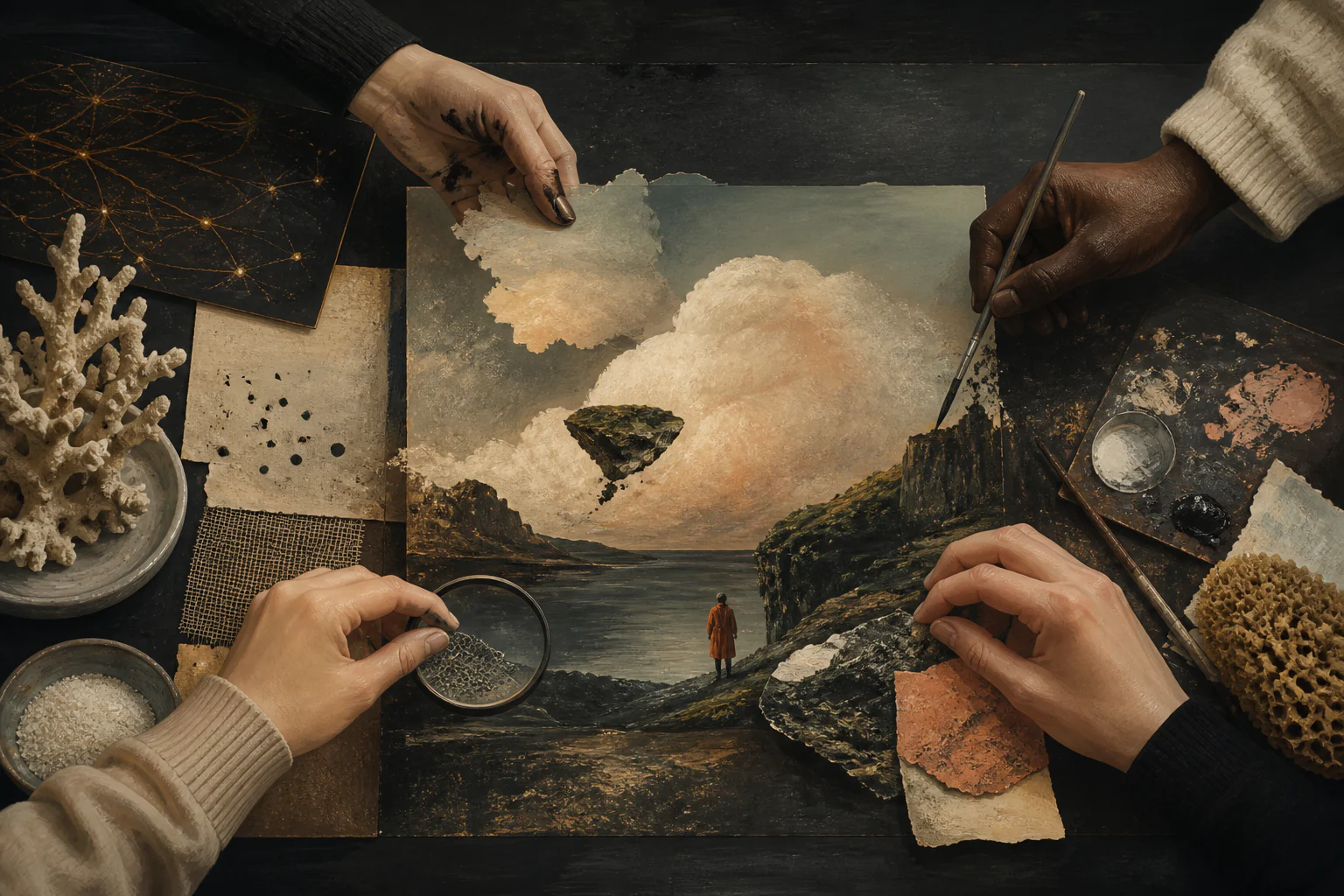
Authorship of an image is shifting from a single press of a button to a distributed system: dataset, model, prompt, selection, assembly, and publication.
Authorship has shifted from a single press to a distributed system: data, model, prompt, selection, assembly, and publication.
Editorial question
How should we read this problem: authorship has shifted from a single press to a distributed system: data, model, prompt, selection, assembly, and publication.
Short answer
Authorship has shifted from a single press to a distributed system: data, model, prompt, selection, assembly, and publication.
Thesis
The question of authorship seems new, but it is not. Film stock, lens, laboratory, and editor always participated in the result. A generative model did not create distribution — it made distribution impossible to ignore.
Authorship has shifted from a single press to a distributed system: data, model, prompt, selection, assembly, and publication.
Evidence and cases
Thesis: authorship was always distributed
The question of authorship seems new, but it is not. Film stock, lens, laboratory, and editor always participated in the result. A generative model did not create distribution — it made distribution impossible to ignore.
Six positions in the chain
It helps to break production into positions: who assembled the data, who trained the model, who formulated the prompt, who selected the result, who assembled it, and who published it. Each position carries its share of decision and of responsibility.
The prompt is the most overrated position
The prompt is conspicuous because it is textual and easy to display. But in contribution to the result it usually ranks below selection: one prompt produces hundreds of variants, and the work begins after they appear.
Selection is the underrated position
The same skill that made an editor and a picture editor authors works here too. Choosing one frame out of three hundred is an authorial judgement that cannot be automated without losing the position.
Data is the invisible position
A dataset determines the space of the possible: what a model can show at all, which subjects it treats as typical, what is absent from it. This is an editorial decision taken before any author appears.
Sampling bias is visible in the output
Dataset biases appear in results as persistent preferences of composition, lighting, casting, and setting. An author’s work often consists in resisting this average rather than following it.
Assembly returned the craft
In practice a professional result is almost never a single generation. It is assembled: parts are joined, light is reconciled, colour is graded. This is compositing, and it remains a craft operation with known rules.
The photographic precedent
The argument over photographic authorship ran for more than a century and settled thus: the author is the one who makes substantive decisions about the frame, not the one who owns the apparatus. The formula transfers unchanged.
The precedent of film production
Cinema has long lived with distributed authorship: cinematographer, designer, editor, and director share the decision, and credits record the shares. A ready model for dividing responsibility already exists.
Credits as a solution
The most practical answer to the authorship question is to bring back credits. Listing positions is more honest than arguing over a single author, and it already works in disciplines with complex production.
Provenance became a technical problem
Industry provenance schemes write into a file a record of how an image was created and altered. This does not answer the authorship question, but it makes a claim verifiable.
Labelling is not authorship
A mark saying "made with AI" reports a method of production, not who is responsible for the statement. These two questions are regularly conflated, and the confusion suits whoever prefers not to answer.
Responsibility matters more than credit
In editorial work the main question is not who gets the byline but who answers if the image misleads. Responsibility cannot be distributed onto a model: it stays with the publisher.
Documentary status under pressure
The main damage concerns evidence rather than art. When a plausible image can be produced without an event, trust in the image as document must be rebuilt by external means.
Separating the genres
The practical way out is a strict separation of regimes: illustration, reconstruction, and document. Mixing these regimes within one publication does more harm than the use of a model itself.
First turn: production separated from shooting
Digital processing had already broken the link between frame and event: retouching, compositing, and grading changed content long before generative models. The new stage continued an old line.
Second turn: the original disappeared
The key difference at the current stage is the absence of a negative. Previously one could return to an original and compare; now there is no original in the former sense, and verification requires a record of process.
Third turn: volume became unlimited
The cost of a variant fell to nearly zero, and attention became the bottleneck. Under these conditions the author is whoever can reject; anyone can produce.
What is usually misunderstood
The common error is to look for a single author. The question is badly posed: it is more productive to ask which decisions were taken and by whom, because authorship is composed of decisions rather than of presses.
Counterargument: the author is whoever pressed
The objection is simple and legally convenient: the author is the person who initiated the generation and accepted the result. Everything else is a tool, like a lens or a brush.
Where the counterargument holds
It holds as a working rule of responsibility. Someone must answer for a publication, and distribution cannot become grounds for nobody answering.
Where it fails
It fails as a description of contribution. If a result is nine-tenths determined by a dataset and default settings, naming the person who typed a line of text as sole author misrepresents the process.
A test: describe the process
The working test is to ask for a description of process. An author who made decisions can explain what they rejected and why. Someone who accepted the first output cannot.
Link to image grammar
The entries on compositing, retouching, colour grading, and visual effects show that operations for assembling an image existed long before generative models.
Link to media and publishing
The entries on art direction, the magazine cover, and editorial photography explain exactly where in the publishing chain the decisions that constitute authorship are made.
What this changes in practice
The practice is simple: keep a record of process and publish a list of positions. This protects both against inflated claims and against accusations — and makes the work reproducible.
What stays human
Responsibility and intention do not transfer. A model cannot answer for the consequences of a statement and cannot want to make one; both positions remain with people.
The current state
Practice currently runs ahead of norms: tools spread faster than attribution rules formed. The gap is being closed by technical provenance schemes and editorial policies rather than by general declarations.
Editorial conclusion
The author of an image is whoever makes substantive decisions and answers for publication. A model changes the distribution of labour inside the chain but does not move responsibility outside it.
How to read the subject today
Look not at the byline but at the list: are the positions named, is the method of production stated, is there a record of process. The absence of a list is itself the answer about authorship.
Visual analysis
The article's visual logic can be tested through «Thesis: authorship was always distributed», «Six positions in the chain», «The prompt is the most overrated position», «Selection is the underrated position», «Data is the invisible position», «Sampling bias is visible in the output». Compare these signs within one object or sequence rather than judging them as an isolated style.
Practical implication
Practical use begins by testing the thesis against a specific object, frame, or production decision. For this subject, the working criterion is: Authorship has shifted from a single press to a distributed system: data, model, prompt, selection, assembly, and publication.
Limitations
“Who authors the image in the age of generative AI” is limited to its stated subject: authorship has shifted from a single press to a distributed system: data, model, prompt, selection, assembly, and publication. The analysis does not replace examination of a specific original, project, or production context.
Sources
- OpenAI — Advancing content provenance
- OpenAI Help Center — C2PA and SynthID in generated images
- Adobe — Nondestructive editing in Photoshop
- Adobe — Auto-Blend Layers overview
- Computer History Museum — Make Software: Photoshop
- V&A — 100 years of fashion photography
- VANSMITHLAB AI Master Content Plan — project master plan