analysis
The Music Video as Myth Factory
How music video turns a song into a face, body, costume, gesture and cultural memory
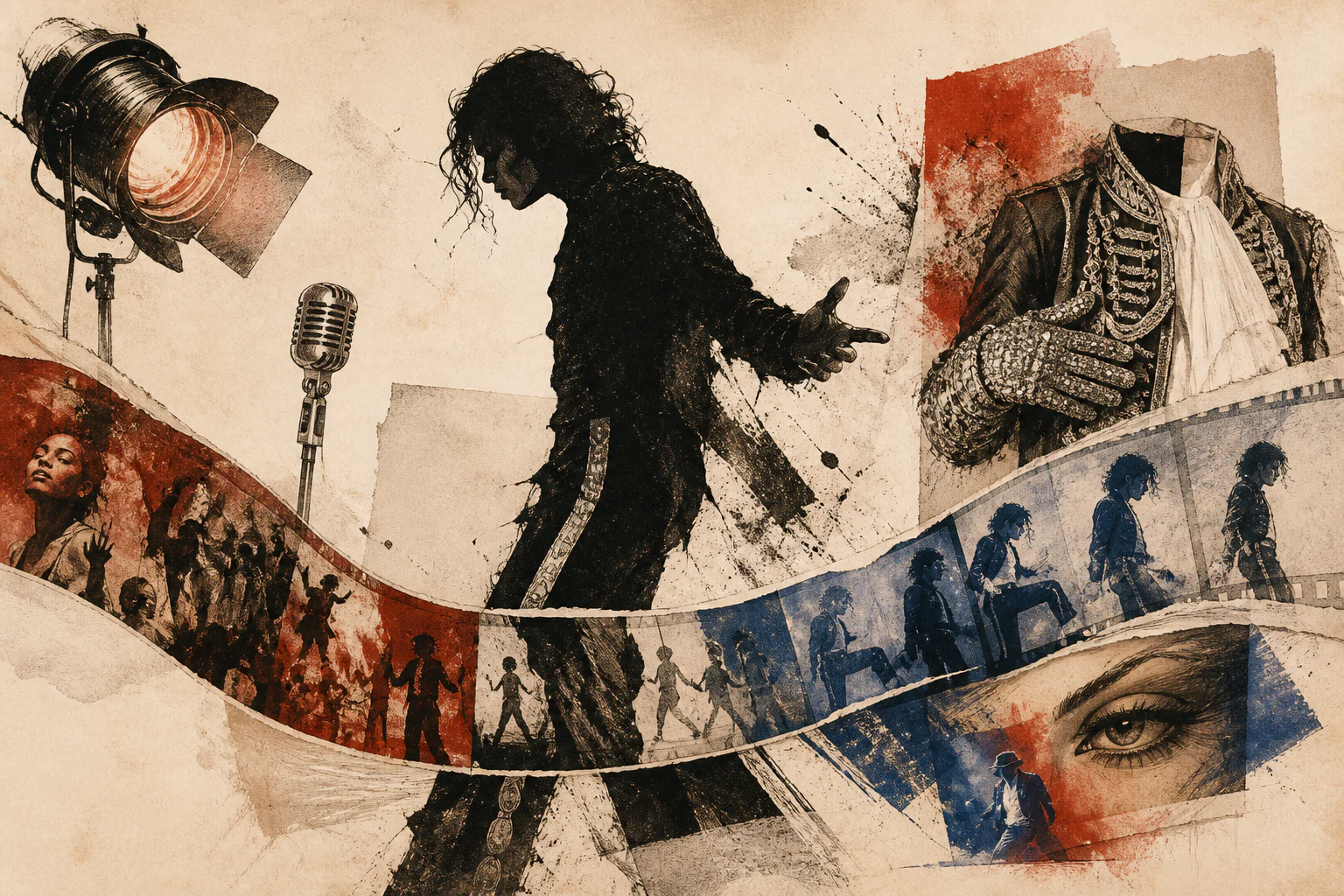
A song unfolds in time. A music video gives it an image that can be recognised in a second—sometimes even without sound.
Editorial question
Why are some songs not only heard, but instantly seen?
Short answer
Because music video can turn sound into compact visual memory. MTV made screen visibility a regular condition of pop culture; Thriller showed that a song could acquire its own cinematic world; Björk and Chris Cunningham showed that a video could invent a new body for an artist; YouTube and TikTok turned images into gestures and fragments that audiences distribute themselves. 4
A powerful video is not necessarily the most expensive or complicated. It creates a visual sign that becomes difficult to separate from the music. That is why a few seconds of imagery can outlive an entire promotional cycle and become cultural myth.
Thesis
A music video becomes culturally powerful not when it literally illustrates a song, but when it builds a second layer of memory for it: a face, costume, body, space or gesture that begins to live with the sound and can outlast the original release cycle.
In that sense a music video is not an accessory to the song but a machine for visual myth. It assembles the artist through direction, choreography, fashion styling, light, editing and platform logic, then gives that image to a public that recognises, repeats, quotes and remakes it.
A song unfolds in time. A music video gives it an image that can be recognised in a second—sometimes even without sound.
Evidence and cases
When a song starts playing before anyone presses play
Music can be remembered with the eyes. Sometimes a red leather jacket among zombies, two white humanoid robots leaning toward each other, eight treadmills in an empty room, or one absurd arm movement is enough for the song to begin playing in the mind before the first note.
This is the peculiar power of the music video. It does not merely accompany music; it becomes a second memory for the song. It gives sound what sound does not possess on its own: a face, a colour, a walk, a costume, a room, an editing rhythm, a gesture that can be repeated, and an image that can be recognised in silence.
The interesting question, then, is not simply what a music video is. When did being heard stop being enough for a song? And why do some videos vanish with their promotional cycle while others become cultural shorthand—just a few frames through which a generation remembers the music? 4
MTV: when looking became part of sounding
Music had a visual life before MTV: sleeves, posters, televised performances, stage costumes and promotional films. But MTV’s 1981 debut made the music video a continuous environment rather than an occasional event. Smithsonian describes the channel as a youth-oriented mix of performance, video art and advertising, while the Fred/Alan archive documents how deliberately a new aesthetic and a segmented market were constructed around it. 2
The shift changed more than promotion. It changed what was expected of an artist. A voice now needed visual discipline: a recognisable face, a readable silhouette, editing that could hold attention, and costume that could speak faster than an interview. The star increasingly existed as a repeatable system of screen signs.
This does not mean MTV “invented” visual music. It made visibility a regular obligation of pop culture. Songs increasingly entered mass memory already attached to images—and the industry learned that the screen could sell not only a recording, but a persona. [source]
Thriller: the song acquires a world of its own
In 1983 Michael Jackson and director John Landis did something promotion rarely manages: they turned a song campaign into an independent screen event. The Library of Congress describes the 13-minute Thriller as a large-scale production whose impact was strong enough for a 35mm theatrical release; in 2009 it entered the National Film Registry. 4
Historical importance is only half the story. Consider how much memory is compressed into one video: the red jacket, the cinematic night, zombie makeup, mass choreography, transformation, horror as genre, the theatrical face. The song receives not a set of shots but a world with its own rules.
This is where the music video literally begins to operate as a myth factory. It does not explain the lyric; it produces a second reality that becomes so strongly attached to the song that its images return independently—in costumes, dances, parody, seasonal ritual and visual quotation. That is more than promotion. It is cultural memory organised through direction. [source]
Björk: a video can invent a new body for the artist
In All Is Full of Love Chris Cunningham makes an even more radical move. Rather than intensifying Björk’s existing stage persona, the video effectively constructs another body for her. MoMA describes the 1999 work as an echo between the tenderness and mystery of Björk’s voice and Cunningham’s imagery, and presents the video within the director’s work as an independent moving-image object. 6
The white humanoid machines matter not as effects for their own sake, but because they translate voice into material: cold surfaces become intimate, industrial assembly becomes sensual, mechanics become almost bodily. The music receives an image that could not be credibly “captured” as a conventional portrait.
Interpretation
A strong music video does not have to show who an artist “really is.” Sometimes its task is the opposite: to construct a screen creature through which the music becomes visible. In that sense music video operates closer to mythology than portrait photography—it does not simply record identity; it produces a symbolic body.
OK Go: sometimes the myth fits inside a single trick
Not every video needs a cinematic universe. OK Go’s Here It Goes Again proves almost the opposite: one idea can be enough when the viewer understands it instantly. The band’s official site still preserves the video as a discrete object in its videography. 7
The treadmills turn the video into visible proof. We understand the spatial rules, see the physical risk, register the synchronisation and want to know how long the system can avoid collapsing. The trick does not hide its production; it displays production directly in front of us.
That legibility is precisely why the image sticks. The song does not receive an elaborate plot but a visual formula. In the early YouTube era the formula was perfectly transmissible from person to person: “the treadmill video” was often enough description to find it and send it on.
Gangnam Style: the myth becomes a gesture performed by the viewer
Gangnam Style takes the next step. YouTube records that PSY’s video debuted on July 15, 2012 and, on December 21 that year, became the first video on the platform to reach one billion views. In its tenth-anniversary account, YouTube explicitly links the video’s global spread to its distinctive dance moves and the ability of audiences to share it worldwide. 9
But the billion is not the main argument. More important is that the viewer could take an action out of the video. The “horse-riding” gesture existed beyond the original frame: on stages, television shows, parodies, home videos and mass performances. The video ceased to be only an object of viewing and became an instruction for participation.
That changes the structure of myth. Thriller offers a world the viewer enters with the eyes. Gangnam Style offers a gesture the viewer can appropriate with the body. Platforms intensify that portability: an image becomes culturally powerful when it is easy to quote, copy and replay. [source]
Lemonade: when one myth expands into an entire visual world
Beyoncé moves in the opposite direction from viral compression. Rather than reducing a song to one gesture, she expands multiple songs into a larger screen space. GRAMMY.com describes 2016’s Lemonade as an album accompanied by a cohesive visual component made with multiple directors, and situates the work in relation to Black culture, women’s experience, family memory and political context. 12
Costume, Southern architecture, water, interiors, landscape, hair, poetry and bodily gesture no longer operate as service elements for individual songs. They connect the album into a system. A single frame can point not only to one track but to the larger emotional and cultural logic of the work.
This is one limit case of music video: it can grow until the word “video” is too small. The visual album turns the screen from release packaging into another layer of authorship—a way to show how songs belong to one world. [source]
Platforms cut the myth into pieces—and make it live longer
Today the music video no longer exists only as one file watched from beginning to end. YouTube describes Shorts as another route into music, where a short fragment can lead toward the full song, official video and artist; in 2024 the platform added tools for directly remixing music videos into Shorts. 14
TikTok pushes music even further toward participation. In a TikTok/Luminate report based on 2024 data, the platform said that a large share of songs entering the Billboard Global 200 had first gone viral on TikTok; the company explicitly builds its music product around discovery and user reproduction of tracks in personal videos. Those figures are platform-reported and should be read as such, but the directional change is clear: a song now circulates through thousands of other people’s images, not only through one official video. [source]
For directors and artists this creates a new paradox. They must invent a strong whole image while accepting that audiences will cut it into gestures, outfits, transitions, memes, close-ups and ten-second fragments. Myth is no longer fully controllable after publication. It becomes material for other people’s editing.
The music video as myth factory: what remains when the platform changes
The history of music video is often told as a history of technologies: promotional film, MTV, digital editing, YouTube, smartphones, Shorts, TikTok, generative video. Technology explains the channels. It does not explain why some images outlive their platforms while others disappear with the campaign.
A strong video does not maximise visual information; it creates a precise compression of the music. Thriller is a world. All Is Full of Love is a new body. Here It Goes Again is a physical trick. Gangnam Style is a gesture. Lemonade is an entire visual mythology. In every case the screen gives sound a form that can be remembered without sound.
That is why the music video is neither mere song packaging nor a compulsory image for an algorithm. At its best it is a machine for cultural memory. It turns music into face, costume, movement, space and symbol, then sends that symbol out to live a life of its own. Platforms change. Myth survives when it can be recognised at a glance. 7
Visual analysis
The article's visual logic can be tested through «When a song starts playing before anyone presses play», «MTV: when looking became part of sounding», «Thriller: the song acquires a world of its own», «Björk: a video can invent a new body for the artist», «OK Go: sometimes the myth fits inside a single trick», «Gangnam Style: the myth becomes a gesture performed by the viewer». Compare these signs within one object or sequence rather than judging them as an isolated style.
Practical implication
Practical use begins by testing the thesis against a specific object, frame, or production decision. For this subject, the working criterion is: How music video turns a song into a face, body, costume, gesture and cultural memory
Limitations
“The Music Video as Myth Factory” is limited to its stated subject: how music video turns a song into a face, body, costume, gesture and cultural memory. The analysis does not replace examination of a specific original, project, or production context.
Sources
The open sources for “The Music Video as Myth Factory” are listed in the page panel and define the boundary of its verifiable facts.