analysis
Why a design system outlives an individual designer
A system outlives its author when it turns taste into rules, details into an interface, and exceptions into a governed vocabulary.
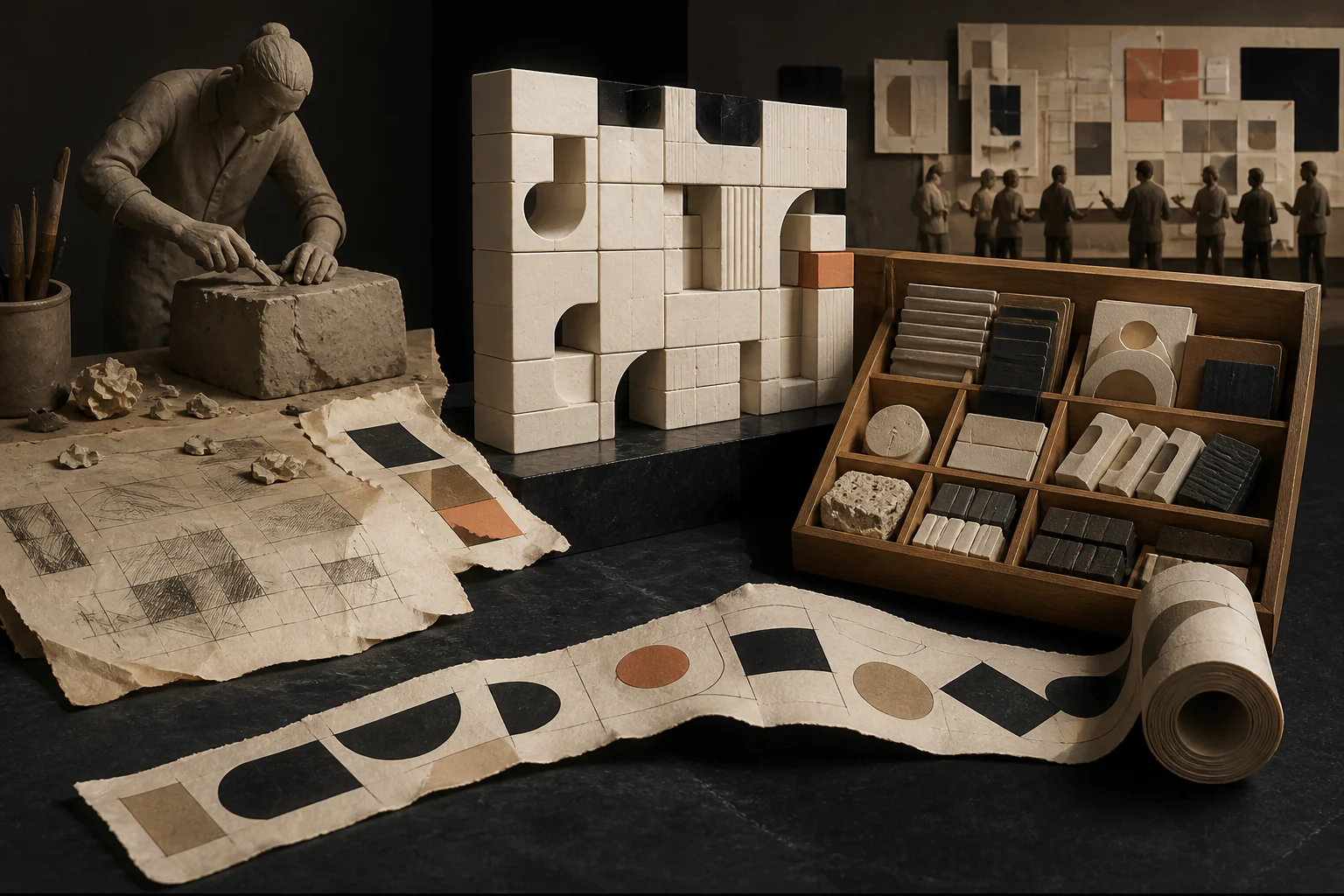
A design system lives longer than its author when it turns taste into rules, details into an interface, and exceptions into a governed vocabulary.
A system outlives its author when it turns taste into rules, details into an interface, and exceptions into a governed vocabulary.
Editorial question
How should we read this problem: a system outlives its author when it turns taste into rules, details into an interface, and exceptions into a governed vocabulary.
Short answer
A system outlives its author when it turns taste into rules, details into an interface, and exceptions into a governed vocabulary.
Thesis
The test is simple: can a person who never met the author make a correct decision using only the document. If yes, a system exists; if no, what exists is a style tied to presence.
A system outlives its author when it turns taste into rules, details into an interface, and exceptions into a governed vocabulary.
Evidence and cases
Thesis: a system outlives its author when it can be executed without them
The test is simple: can a person who never met the author make a correct decision using only the document. If yes, a system exists; if no, what exists is a style tied to presence.
Taste must be translated into rule
The main operation is translation. The feeling that "this is too tight" must become a number: a minimum spacing, a ratio of size to leading, a grid increment. Untranslated taste dies with its carrier.
The grid as the first carrier
The modular grid was the first genuinely transmissible instrument of graphic design. It describes a decision so that it can be repeated, checked, and contested — and therefore outlived its makers.
The Swiss school as proof
Swiss typography showed that a discipline is reproducible: its methods were described, taught, and applied by people outside the original circle. It was documentation, not aesthetics, that produced longevity.
The identity manual
Mid-century corporate manuals turned a visual language into an executable document: tolerances, clear space, prohibited applications. It is an engineering specification, only for images.
The pictogram system as infrastructure
Sign systems for public space were designed to be executed by other hands in different countries. The requirement is not expressiveness but unambiguity of instruction.
A rule must state its reason
Working systems record not only how but why. Without a reason a rule does not survive its first non-standard case: the executor cannot decide whether it extends to a new situation.
Exceptions must be anticipated
A good system does not forbid exceptions; it describes the procedure for granting them: who decides, on what grounds, how it is recorded. An undocumented exception destroys a system faster than a bad rule does.
Component instead of layout
The move from finished layouts to components was decisive. A layout describes one case; a component describes behaviour — and behaviour transfers to cases the author never saw.
The token as minimal unit
A named value — of colour, spacing, or size — separates a decision from the place it is applied. This allows the system to change centrally and makes the change verifiable.
Versioning is mandatory
A system without versions is indistinguishable from a set of opinions. A date, a number, and a changelog make it possible to know which rule applied when a piece of work was made — without them, disputes about compliance cannot be settled.
System owner is a role
Someone must maintain the system. When the custodian role is unassigned, the document ages, local workarounds accumulate, and within a few years actual practice ceases to match the description.
Training matters more than the document
Nobody reads a document end to end. Systems survive through training and review — that is, through people who explain a rule at the moment of application. This is the most expensive and most underrated part.
Product systems revived an old task
Contemporary interface design systems solve the same problem as corporate manuals: consistency under distributed execution. The medium changed; the problem did not.
The furniture system as precedent
Modular storage systems showed the same logic in the object world: a finite set of elements, rules of connection, and the ability to extend a configuration over decades. Longevity is secured by compatibility, not by form.
First turn: from signature to specification
While a result depended on the author’s hand it could not be reproduced. The move to specification made execution by other hands possible and therefore made survival after the author possible.
Second turn: from layout to behaviour
Describing behaviour instead of appearance allowed a system to answer new requirements. This is the key difference between a living system and a style reference.
Third turn: the rule became executable code
When rules are expressed in code and checked automatically, the gap between document and practice narrows. The system stops depending on the executor’s diligence.
What is usually misunderstood
The error is to treat a system as a constraint on creativity. In practice it removes routine decisions and frees attention for the places where a decision is genuinely required.
Counterargument: systems average things out
The objection matters: rules designed for mass execution pull results toward the mean and suppress the exceptional decisions that make work notable.
Where the counterargument holds
It holds for small authored projects where one person controls everything and the cost of consistency exceeds its benefit. There a system is pure overhead.
Where it fails
It fails under distributed execution. As soon as dozens of people in different countries work on a result, the alternative to a system is not freedom but inconsistency that will have to be repaired anyway.
A test: remove the author
The longevity test: imagine the author is unavailable. Can the team settle a contested decision by citing the document? If the decision depends on someone’s memory, the system is not yet built.
Link to the movement entries
The entries on the Swiss style, modernism, and the Bauhaus show the historical line: how visual discipline became transmissible.
Link to the authors
The entries on graphic designers who worked with grid and system give concrete examples of an individual method turning into a document.
What this changes in practice
The practical conclusion: write the reason beside the rule, assign an owner, and version it. These three actions separate a system from a folder of files.
What does not transfer
Judgement about when a rule should be broken does not transfer. It stays an authorial competence, and a good system honestly marks the boundary of its own applicability.
The current state
Design systems have become numerous, and the typical problem has shifted: not how to create one but how to keep it from ageing. An abandoned system is worse than none, because people keep formally following it.
Editorial conclusion
A system outlives its author precisely to the extent that their decisions were translated into verifiable rules with stated reasons and an assigned custodian. Everything untranslated disappears with them.
How to read the subject today
When assessing a design system, look not at its visual part but at its changelog and its list of exceptions. Both show whether it is alive or merely published.
Visual analysis
The article's visual logic can be tested through «Thesis: a system outlives its author when it can be executed without them», «Taste must be translated into rule», «The grid as the first carrier», «The Swiss school as proof», «The identity manual», «The pictogram system as infrastructure». Compare these signs within one object or sequence rather than judging them as an isolated style.
Practical implication
Practical use begins by testing the thesis against a specific object, frame, or production decision. For this subject, the working criterion is: A system outlives its author when it turns taste into rules, details into an interface, and exceptions into a governed vocabulary.
Limitations
“Why a design system outlives an individual designer” is limited to its stated subject: a system outlives its author when it turns taste into rules, details into an interface, and exceptions into a governed vocabulary. The analysis does not replace examination of a specific original, project, or production context.
Sources
- Design Museum — What is good design? Dieter Rams’s ten principles
- Design Museum — Dieter Rams
- MoMA — Bauhaus 1919–1933: Workshops for Modernity
- Bauhaus Dessau Foundation — Chronology
- Letterform Archive — Bauhaus typography at 100
- Vitra Design Museum — Online Collection
- VANSMITHLAB AI Master Content Plan — project master plan