analysis
Why architecture became the language of contemporary fashion
Fashion borrows from architecture not a shape but a method: frame, shell, route, scale, and the scenography of display.
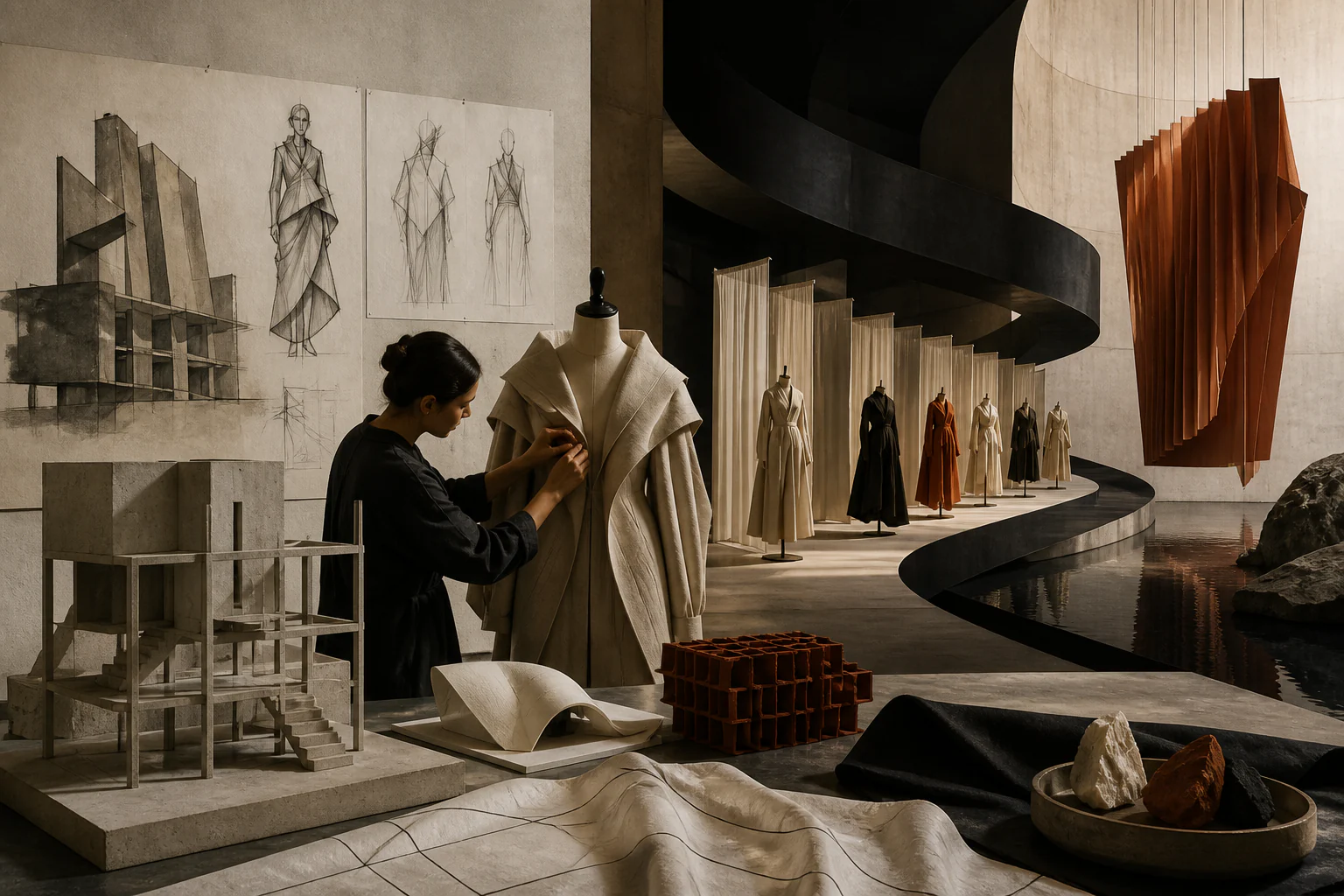
Fashion increasingly borrows from architecture not only form but a way of thinking: frame, shell, route, scale, facade, and scenography.
Fashion borrows from architecture not a shape but a method: frame, shell, route, scale, and the scenography of display.
Editorial question
To tell method from metaphor, three questions help. Does an inner structure hold the form, or starch? Is the cut calculated for load distribution? Was the space in which it is shown designed for it? Three affirmatives indicate an architectural method.
Short answer
Fashion borrows from architecture not a shape but a method: frame, shell, route, scale, and the scenography of display.
Thesis
When a collection is called "architectural", the phrase usually means a rigid silhouette. The real borrowing goes deeper: fashion took from architecture the habit of separating work into frame, shell, and finish — and of planning how a viewer moves. It is a method, not a quotation.
Fashion borrows from architecture not a shape but a method: frame, shell, route, scale, and the scenography of display.
Evidence and cases
Thesis: what is borrowed is method, not silhouette
When a collection is called "architectural", the phrase usually means a rigid silhouette. The real borrowing goes deeper: fashion took from architecture the habit of separating work into frame, shell, and finish — and of planning how a viewer moves. It is a method, not a quotation.
Frame: a garment has a load-bearing structure
A tailored jacket is held not by cloth but by an inner structure: canvas, shoulder pad, armhole. This is precisely the logic of a load-bearing frame and a hung facade. The difference between an expensive and a cheap garment more often lies in invisible construction than in the face material.
Shell: cloth behaves like a facade
A facade decides how a building takes light, water, and the gaze. Cloth decides the same for a body. Membrane and technical textiles entered clothing from construction precisely because the task is identical: to manage the permeability of a shell at minimum weight.
The pattern is a drawing
A pattern translates a three-dimensional body into a plane and back — the same operation as plan and elevation in architecture. Both disciplines work with tolerance: a seam and a joint equally decide whether an object will assemble from flat parts without stress.
Scale as argument
Architecture taught fashion to use scale as a statement rather than a fitting error. An exaggerated shoulder, an extended sleeve, or a volume that does not follow the body reads as a claim on occupied space — exactly as ceiling height does in a public building.
The show as a building for an hour
A runway is temporary architecture: entrance, route, sightline, light, and acoustics are designed before any clothing walks on them. The show determines from what distance and in what sequence a garment will first be read.
Route matters more than object
A museum and a store govern meaning through route: what is seen first, where the visitor stops, what is hidden around a corner. Fashion adopted this in the structure of the show and the lookbook — the sequence of exits works like an enfilade.
The store as the brand’s permanent facade
A flagship store does for a brand what a building does for an institution: it fixes a position in the city for years. The Prada Epicenter in New York, designed by OMA and opened in 2001, was built as a statement that retail space can be public and experimental.
The shop window is a window in the architectural sense
A shop window solves the same problem as an opening in a wall: how much of the interior to show the street, and on what terms. It regulates the boundary between private and public, and so it is designed as an element of the facade, not as a billboard.
Material comes from construction
The exchange of materials ran both ways. Steel tube, plywood, acrylic, and polyester fibres entered furniture and clothing from industry and construction; textile membranes returned to architecture as stadium roofing. A shared vocabulary of materials makes a shared vocabulary of forms inevitable.
Modernist furniture as translator
Furniture was the bridge between disciplines. Mies van der Rohe and Lilly Reich designed a chair for the 1929 German Pavilion as part of the building, not as a furnishing. From that point an object became a legitimate way to state an architectural position at body scale.
Bauhaus: one school for different fields
The Bauhaus (1919–1933) structured teaching so that the weaving workshop, the carpentry workshop, and the architecture department used one vocabulary: material, construction, proportion. This shared base explains why clothing designers and architects later understood one another without translation.
Fashion is faster, architecture is stricter
The cycles differ: a collection lives a season, a building lives decades. So fashion works as a test bed for ideas and architecture as their long-term verification. An idea that survives the move into a building was usually structural rather than decorative.
Photography translates one into the other
A fashion shoot almost always happens in a space, and the choice of space is a choice of argument. A concrete wall, a glass atrium, or an empty gallery says as much about a garment as its cut. The image records not the clothing but the clothing’s relation to architecture.
A shared critical vocabulary
The words proportion, rhythm, structure, finish, and joint work in both disciplines without a change of meaning. This is no coincidence: the vocabulary came from craft, where the difference between a building and a garment was a difference of scale, not of method.
First turn: clothing stopped being flat
The shift from decorating a surface to designing a volume is the key change. When a designer starts from a shell and the void inside it rather than from a print on cloth, they are already working architecturally, whether or not they call it that.
Second turn: the brand started building
From the 1990s major houses began commissioning buildings from leading architects, and the store stopped being rented floor area. This moved fashion into the category of architectural clients and forced it to accept architectural timescales, budgets, and liability.
Third turn: the show moved into a building
When a show takes place in a museum, a factory, or an unfinished building, the venue becomes a co-author. The choice of address makes a statement about which institution the brand aligns itself with, before the first exit.
What is usually misunderstood
The main error is to treat rigidity as architecture. An unstructured, soft, draped dress can be architectural in method: if its form is set by the calculation of a bias cut and the distribution of weight, that is construction, not the absence of construction.
Counterargument: it is only a metaphor
The objection is fair in part: the word "architectural" is genuinely often used as a compliment without content, and its overuse devalues the term. Not every stiff jacket inherits from a building.
Where the counterargument holds
It holds at the level of marketing. A press release can call any garment with a straight shoulder architectural, and the viewer cannot verify the claim — the inner construction is not visible in a photograph.
Where it fails
It stops working when we look at production. Shared materials, shared suppliers of technical textiles, shared digital modelling tools, and shared commissioning of buildings are not a metaphor but documentable infrastructure.
A test: three questions for a garment
To tell method from metaphor, three questions help. Does an inner structure hold the form, or starch? Is the cut calculated for load distribution? Was the space in which it is shown designed for it? Three affirmatives indicate an architectural method.
Link to the material entries
The topic rests on the material entries in the base: wool, lining, the bias cut, and technical textiles explain exactly how a garment shell differs from a building shell and what they share.
Link to the spatial typologies
The entries on the boutique, the concept store, the shop window, and the museum carry the second half of the argument: how designed space changes the reading of the object displayed in it.
What this changes in practice
For a working designer the conclusion is concrete: the construction decision must precede the surface decision, and the decision about the space of display must precede the shoot. The order of operations is the borrowed method itself.
What stays different
The differences do not vanish. A building must carry load, climate, and regulation; clothing must move with a body and survive washing. The architect’s liability is legally heavier, and that changes the permissible level of experiment.
The current state
Today the exchange is two-way and routine: architectural practices design stores and exhibitions for fashion houses, and fashion houses fund cultural foundations and buildings. Mutual dependence has become part of the business model rather than an occasional gesture.
Editorial conclusion
Architecture became the language of fashion not because fashion wanted to look severe, but because both disciplines needed one way of speaking about structure, shell, and public display. The shared language grew out of a shared production problem.
How to read the subject today
Look at a garment twice. The first look is at the silhouette; the second is at what holds it and in what space it is shown. If the second look adds nothing, you are facing a metaphor; if it adds something, you are facing a method.
Visual analysis
The article's visual logic can be tested through «Thesis: what is borrowed is method, not silhouette», «Frame: a garment has a load-bearing structure», «Shell: cloth behaves like a facade», «The pattern is a drawing», «Scale as argument», «The show as a building for an hour». Compare these signs within one object or sequence rather than judging them as an isolated style.
Practical implication
Practical use begins by testing the thesis against a specific object, frame, or production decision. For this subject, the working criterion is: Fashion borrows from architecture not a shape but a method: frame, shell, route, scale, and the scenography of display.
Limitations
“Why architecture became the language of contemporary fashion” is limited to its stated subject: fashion borrows from architecture not a shape but a method: frame, shell, route, scale, and the scenography of display. The analysis does not replace examination of a specific original, project, or production context.
Sources
- MoMA — Bauhaus 1919–1933: Workshops for Modernity
- Bauhaus Dessau Foundation — Chronology
- Bauhaus-Archiv — Collection
- Vitra Design Museum — Online Collection
- The Met — The Costume Institute
- V&A — 100 years of fashion photography
- Design Museum — Collection
- VANSMITHLAB AI Master Content Plan — project master plan