research
Bauhaus after Bauhaus: how the school became a world system
After its closure the school proved stronger as a network of ideas, migrations, curricula, and archives than as a teaching institution.
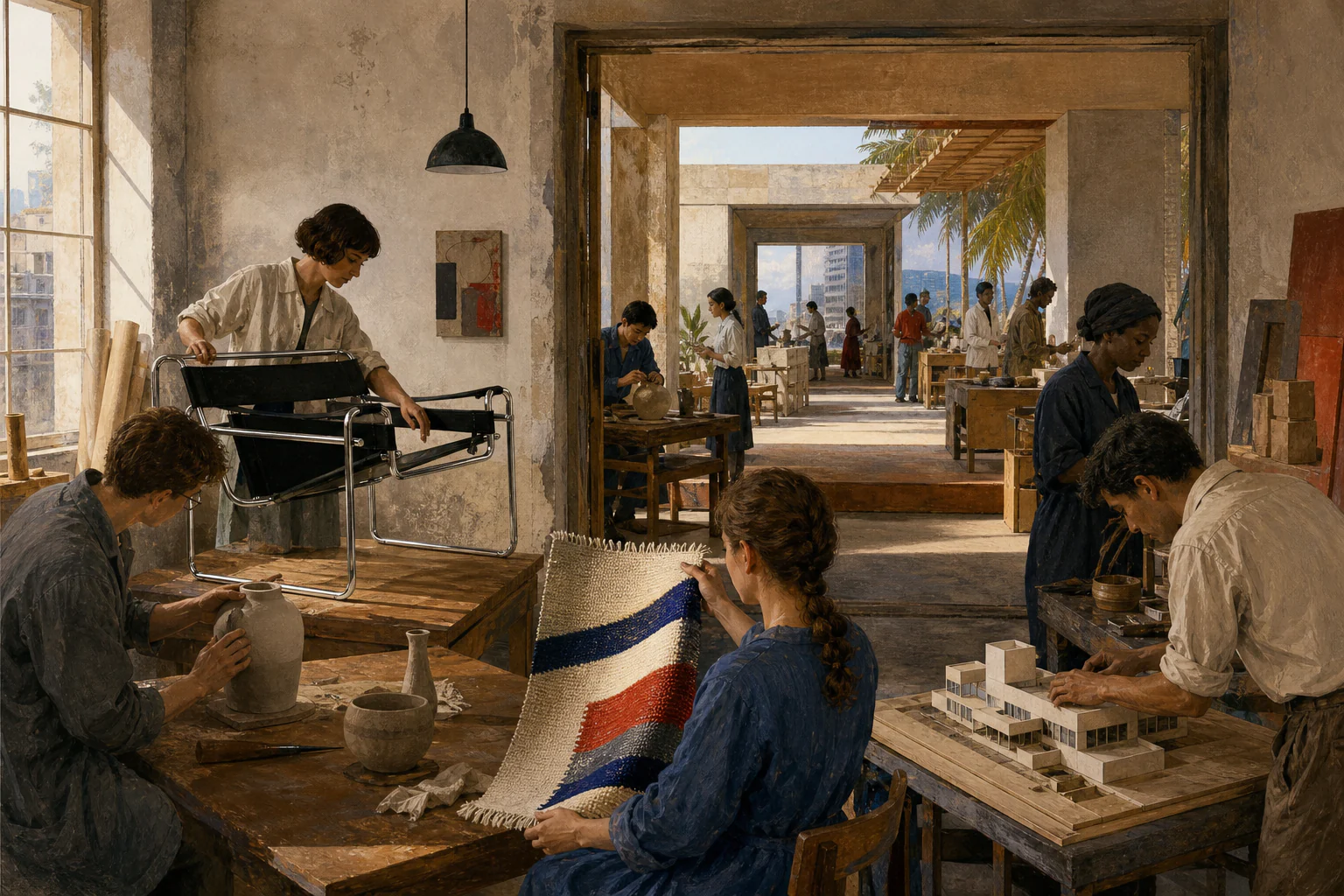
After its closure, Bauhaus became stronger as a network of ideas, migrations, schools, archives, exhibitions, and myths than as a single historical school.
1. Research thesis
The school existed for fourteen years and closed in 1933. The influence attributed to it was produced largely after the closure — through the emigration of teachers, curricula, exhibitions, and archives.
2. Why this is more than a school history
What is interesting is the transmission mechanism. A school with a few hundred graduates cannot explain the scale of its influence by itself; the explanation lies with institutions that picked up the method and distributed it.
3. Historical setup
The school operated from 1919 to 1933, moving through three cities and three directors. This instability is usually presented as drama, but it also produced a diversity of approaches within one name.
4. The school as a system
The key invention was a preliminary course, compulsory for all: work with material, colour, and form before specialisation. It gave a shared language to people who then dispersed into different workshops.
5. The workshop as an educational model
Teaching proceeded under two masters simultaneously — an artist and a craftsman. This dual structure bound intention to execution and became the most copied part of the model.
6. What was actually produced
The school’s material legacy is small: a few buildings, furniture, textiles, typographic experiments, lamps. What matters is different — the curriculum and the way it was written down.
7. The weaving workshop
The most productive workshop was the textile one, and it also stayed longest in the shade of popular retellings. This points to a skew in the canon: some workshops are remembered, others are not.
8. Closure as a condition of spread
The closure pushed teachers out of the country. The paradox of the case is that the destruction of the institution gave it a geographical reach unattainable in normal operation.
9. The migration of ideas
Former teachers took up positions in architecture and art schools overseas and in newly founded institutions. The method spread through curricula rather than through buildings.
10. Translation into another context
In transfer the programme changed: its social and craft components weakened, its formal component strengthened. What spread was already an edited version.
11. The exhibition as a mechanism of fixing
Major retrospectives from the late 1930s onward assembled scattered works into a coherent narrative. It was the exhibition, not the school, that produced "the Bauhaus" as a single phenomenon.
12. The archive as continuation
Specialised archives and collections made the material available for research and contestation. The existence of an archive turns a myth into something that can be checked.
13. Media and publication
Books, republished curricula, and teaching manuals distributed the method further than any buildings. Print proved the main means of transmission.
14. The product as trace
The school’s furniture and lamps are still reissued and form its most visible material presence. But reissue selects what sells best rather than what is most representative.
15. Canon and museum
Museum consolidation gave scattered experiments the appearance of a completed programme. A retrospective view always orders things more tidily than they were.
16. Where the myth begins
The myth begins with unity. Inside the school there were sharp conflicts about the relation of craft to industry and of art to function; no single doctrine existed.
17. A second layer of myth
A second simplification credits the school with inventing the whole modernist language. Many devices were developed in parallel in other countries and schools, and priority is often disputed.
18. Where the myth blocks analysis
A unified image obscures the fact that what spread was a pedagogical structure rather than a style. Copying outward signs without the preliminary course and dual mentorship reproduces appearance, not outcome.
19. First key example
The preliminary course is worth analysing as the principal invention. It still underlies foundational design education almost everywhere, usually without acknowledgement of its source.
20. Second key example
The postwar German school that continued the line is worth treating as an attempted correction: it replaced artistic intuition with research and method. It is the most substantive critique from inside the tradition.
21. Comparison with adjacent systems
A comparison with Russian constructivism shows a shared programme and different fates: similar ideas, different political conditions, and entirely different subsequent access to archives.
22. Link to fashion
Influence on clothing ran through the weaving workshop and through a general principle: construction before decoration. The link is real but mediated, and usually overstated.
23. Link to the image
The school’s photographic and typographic experiments established devices that entered advertising and editorial language: the diagonal, montage, work with emptiness.
24. Link to architecture and space
The school building in Dessau worked as a teaching aid in itself: a glazed facade presented construction and the organisation of labour. Architecture was part of the argument.
25. Link to technology
The declared alliance with industry was only partly realised: most products remained small-batch. The gap between declaration and production is a substantial part of the story.
26. Link to materials
Steel tube, glass, and textile were not merely materials but arguments about modernity. Material choice did rhetorical work on equal terms with form.
27. Market and logistics
Present-day presence is secured by licensing and reissues. The school’s name has become a trademark applied to objects it never designed.
28. Critique and limits
The critique is fair on several points: the social programme remained largely declarative, the role of women in the school was systematically understated, and industrial success was modest. All of this is documented.
29. What has changed today
Anniversary scholarship has substantially revised the picture: names have been restored, conflicts shown, scale corrected. The case has become more complicated and therefore more useful.
30. What to connect next
The material links to the entries on the Bauhaus as a movement, on Ulm, on constructivism, on modernism, and on design systems as a means of transmitting method.
31. Editorial conclusion
The school became a world system because its method was written down and proved transferable, and because closure scattered its carriers across continents. What was transmitted was a teaching procedure, not a style.
32. How to read this case today
On meeting a reference to the school, ask what exactly is meant: the preliminary course, a particular workshop, the building, or the trademark. These are four different subjects and should not be conflated.