research
HfG Offenbach
From craft school to design university, where form must be able to explain itself
This article reads the school not as a display of style but as an educational machine: who set the rules, how exercises worked, and why the method outlived its own period.
Editorial thesis
HfG Offenbach matters not because it produced a recognisable style. Its force lies in turning design into a system of observation, exercise, testing and argument. Offenbach does not fit a simple “Ulm after Bauhaus” lineage: its history is longer, more craft-based and institutionally less uniform.
Reader question
What actually happened inside HfG Offenbach that allowed its methods to survive changes in technology, institutions and aesthetic fashion?
Short answer
A crafts school founded in 1832 that passed through applied-arts and technical institutions before becoming the state hochschule für gestaltung in 1970. The key is design is treated as an argument: material, function, communication and technology must be connected by an explainable logic. Today hfg offenbach is a state university of art and design organized around the broad fields of art and design, while campus and study structures continue to evolve.
1. The city before the school: why new education was needed
HfG Offenbach is more useful as an answer to a particular urban, industrial and cultural condition than as a catalogue of recognisable forms. A crafts school founded in 1832 that passed through applied-arts and technical institutions before becoming the state hochschule für gestaltung in 1970. [S02]
2. Foundation: what problem was the school meant to solve
At its foundation the school addressed a practical need, but it gradually turned that need into a question about the profession itself. The important point is not only the year 1832, but the emergence of education as a place where design could separate itself from copying models. [S03]
3. Craft and industry: the profession’s first conflict
Craft supplied material knowledge, industry demanded repeatability, and the new profession of design had to connect those modes without losing meaning. Much of the school’s later discipline grew from that friction. [S04]
4. When the school began to speak in its own voice
A school acquires a voice when it develops a repeatable way of framing problems rather than a house style. For HfG Offenbach, that core can be read through design is treated as an argument: material, function, communication and technology must be connected by an explainable logic. [S05]
A practical test follows: if names and visual quotations are removed, a working method should remain that a student can apply to a new problem.
5. The building as a teaching instrument, not decoration
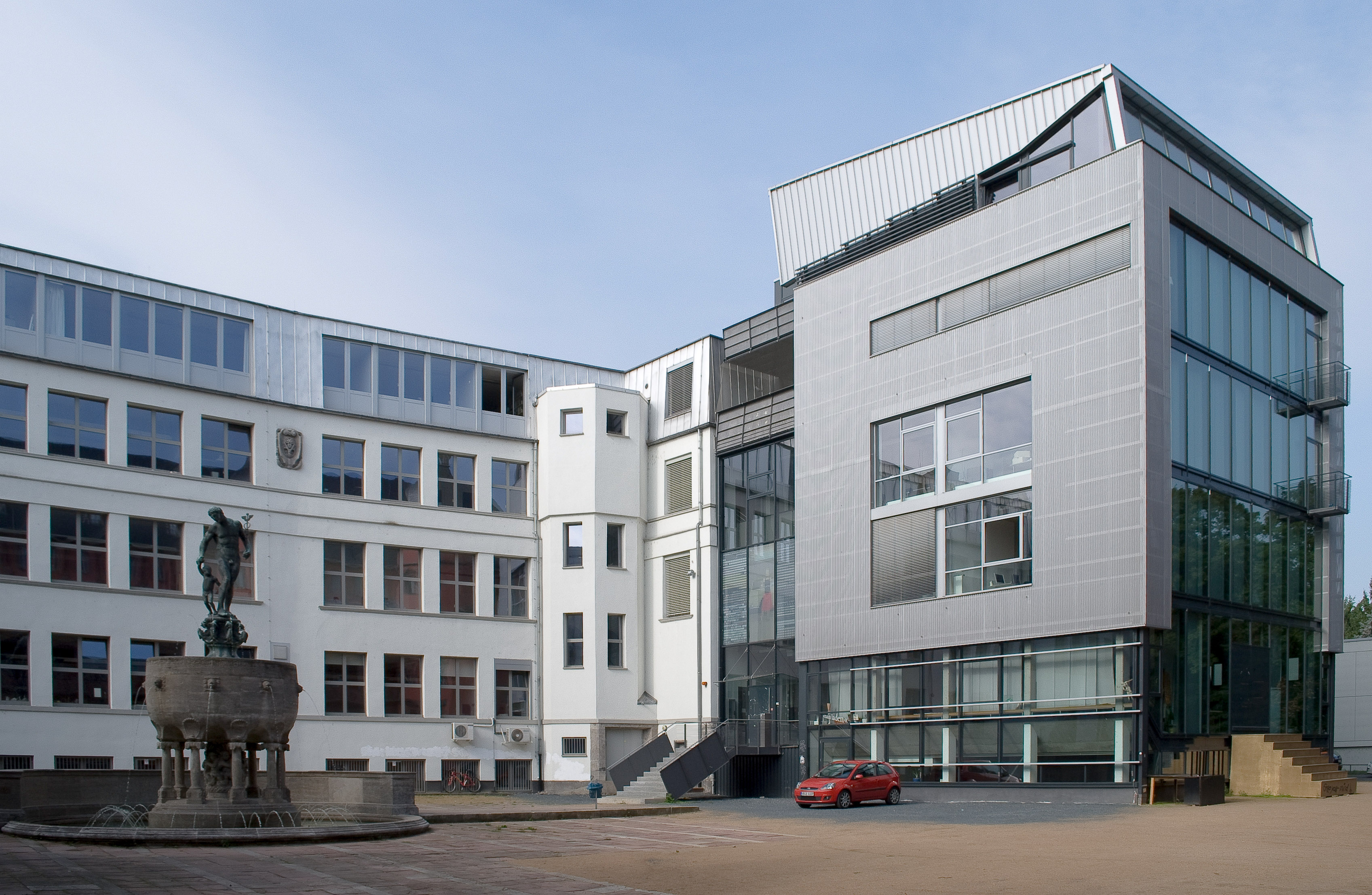
The main building began in 1910 and opened in 1913; today the campus combines the eberhardt building, west wing and isenburg castle. Architecture matters here as pedagogy: circulation, light, workshops, stairs and distances between people shape work before a class even begins. [S06]
The building photograph therefore does not merely illustrate “good architecture.” It shows how workshops, corridors, light and public space are organised around learning.
6. Foundation studies: learning to see before styling
Foundation studies matter because they temporarily remove the urge to “make it look good” immediately. Students first learn to distinguish scale, rhythm, contrast, material and causality before assembling them into form. [S07]
7. The teacher as a constructor of method
Hugo Eberhardt matters both as a director and as architect of the school building; later the school built its identity around design, media and theory. In such a system a strong teacher does not hand out recipes; they make criteria visible and force the student to defend choices. [S08]
8. The exercise matters more than the beautiful result
An exercise works like a laboratory experiment. It restricts variables so the student can see what changes the result: spacing, proportion, type, density, surface, movement or sequence. [S01]
9. Type, object or space as a system of relations
Once the school treats design as a system of relations, the isolated object loses its autonomy. Quality is tested by how it organises information, bodies, production or the space around it. [S02]
10. What actually happened on the student’s table
Process on the student’s table matters: sketch, variation, model, critique and repetition. This culture teaches students not to fall in love with the first effect and to treat form as a hypothesis that can be disproved. [S03]
11. How quality was judged
Quality cannot be reduced to a teacher’s taste. Criteria connect brief, clarity, material, scale, user and context; a strong project must survive explanation. [S04]
Project critique becomes more useful than a simple like/dislike judgment: discussion must name a criterion and show where the solution meets or breaks it.
12. Error as part of education
Error becomes productive when its cause is visible. A failed version can reveal a badly framed problem, an untested variable or the point at which form began to substitute for meaning. [S05]
13. Material: resistance rather than effect
Material resists the designer and is useful precisely because of that. Paper, metal, wood, screen and production process impose limits; mature design uses those limits as structure rather than hiding them. [S06]
14. Technology: a tool that changes thought
Technology is not neutral in this tradition: a new tool changes speed, scale and the kinds of mistakes that are possible. That is why the method still travels from print to digital interfaces without copying old aesthetics. [S07]
15. Poster, book, object or interface as a public mediator
A public mediator — poster, book, object, wayfinding system or interface — tests design against real human attention. At that point a classroom composition becomes part of the social environment. [S08]
16. Industry and real commissions
Industry and commissions matter not because education must imitate the market, but because they add resistance: deadlines, budgets, standards, scale and other people’s interests force the method to work outside the classroom. [S01]
Industry also returns ethics to the project: the designer is responsible not only for composition but for the consequences of scale, clarity and durability.
17. International links: how the method travelled
When a method travels internationally it inevitably changes. The influence of HfG Offenbach is better located in transferred pedagogical tools — exercises, critique, relational grids and argument — than in surface imitation. [S02]
18. Politics and economics around the curriculum
Every curriculum sits inside politics and economics. Funding, industrial strategy, cultural institutions and a society’s idea of “useful” design determine what can be taught and what counts as professional responsibility. [S03]
19. Reforms and renaming: institutions move with the profession
Reforms and renamings show that a school is not a fixed brand. Disciplines, degree levels and institutional ties change, while some pedagogical habits survive reorganisation. [S04]
This is where historical school names and present institutions must be separated carefully. Continuity exists, but it is not the same as administrative permanence.
20. System instead of signature style
The decisive shift is from signature style to system. A project should work not because a famous designer made it, but because the relations inside the solution are coherent, testable and repeatable. [S05]
21. Key teachers and different versions of one school
Hugo Eberhardt matters both as a director and as architect of the school building; later the school built its identity around design, media and theory. A single doctrine is therefore a convenient retrospective myth: strong schools survive precisely because different temperaments and disagreements exist inside them. [S06]
22. Students and alumni: the method leaves the building
A graduate leaves with more than a portfolio. They leave with an order of operations: research, constrain the problem, make variants, test, argue and rebuild. Pedagogy becomes professional infrastructure. [S07]
23. The central myth: why style is easier to copy than thought
Offenbach does not fit a simple “ulm after bauhaus” lineage: its history is longer, more craft-based and institutionally less uniform. The look of a school can be copied in an evening; its way of thinking can only be learned through practice and critique. [S08]
24. Bauhaus and Ulm comparisons: resemblance is not identity
Comparisons with Bauhaus and HfG Ulm are useful only when differences remain visible. Discipline, modernist faith in education and an interest in systems may overlap, while historical conditions, craft bases, scale and relations to industry differ. [S01]
Bauhaus and Ulm are useful coordinates, not universal templates. Each school set its own relation between art, science, craft, industry and social responsibility.
25. Critique: where rationality begins to obstruct
Rationality has limits. When criteria become dogma, a system stops seeing exceptions, cultural differences and new kinds of users. The stronger inheritance is the ability to explain when a rule needs to change. [S02]
26. The digital turn: what remains of the old exercises
The digital turn replaced many materials and tools without cancelling the underlying questions. Hierarchy, rhythm, sequence, feedback and iteration remain; they now unfold through time and interaction. [S03]
27. How the school works today
Today hfg offenbach is a state university of art and design organized around the broad fields of art and design, while campus and study structures continue to evolve. The present institution should not be confused with its historical photograph: programmes, structures and terminology continue to change. [S04]
Today hfg offenbach is a state university of art and design organized around the broad fields of art and design, while campus and study structures continue to evolve. For a 2026 editorial article this is not a directory detail but part of the answer to what the school considers design today.
28. Research and theory: design must be able to explain itself
Research slows design down and makes it more precise. When a designer must show sources, hypotheses, constraints and criteria, form stops being a self-sufficient gesture and becomes part of testable knowledge. [S05]
29. Why this school matters to photography, fashion, architecture and interfaces
For VANSMITHLAB this school is a bridge between fields. Its method appears in editorial photography as series structure, in fashion as collection logic, in architecture as movement scenario and in interfaces as hierarchy of attention. [S06]
30. Legacy: not a form, but a professional habit of asking the right question
The main legacy of HfG Offenbach is not a particular typeface, grid, chair or building. It is the professional habit of asking the question before choosing the form, and being able to explain why a solution should look the way it does. [S07]
Legacy is therefore better tested by the questions graduates ask before working and the evidence they demand from their own decisions than by similarity of images.