encyclopedia
Bauhaus v2 — The School That Turned Design into a System
Weimar, Dessau, Berlin, 1919–1933: fourteen years that changed design education, objects, graphics and architecture.
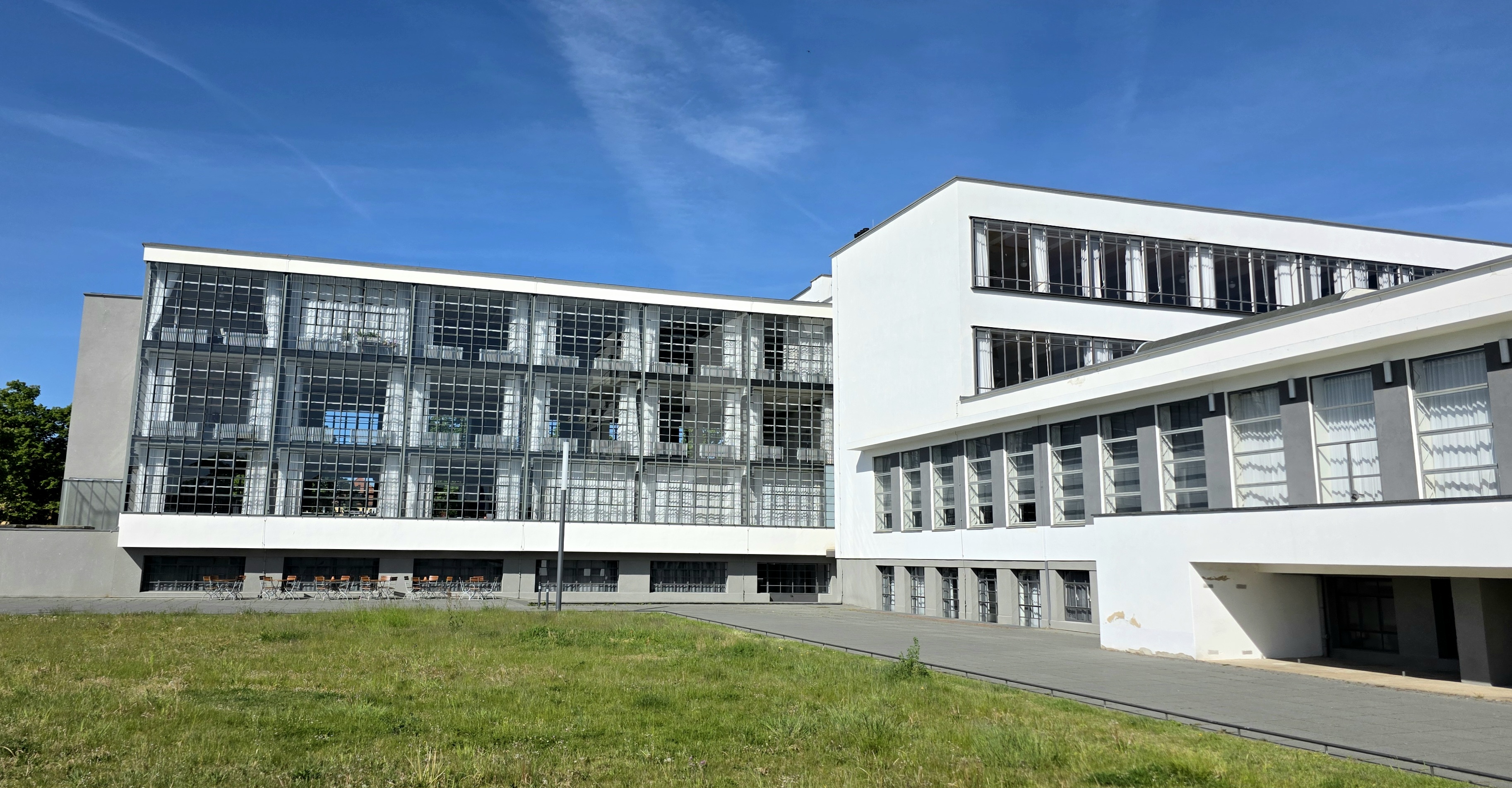
The easiest way to flatten the Bauhaus is to love triangles and red circles too much. The historical school was more interesting: it argued about craft and machine, social mission and market, freedom and discipline.
Editorial thesis
The Bauhaus is not a style but an educational machine that connected the preliminary course, workshops, industrial production, photography, typography and architecture into one system of decisions. 1
Reader question
Why does a school that lasted only fourteen years still shape how designers learn and work? 1
Short answer
Walter Gropius founded the Staatliches Bauhaus in Weimar in 1919 by uniting art and craft schools. In 1925 it moved to Dessau, in 1932 to Berlin, and in 1933 it closed. Its strength was not a single visual style but a sequential pedagogy: first learn to see material, form, colour and construction, then work in a workshop, and only then translate an idea into a serial object, building or communication. 1
1. 1919: a school after war
The Bauhaus emerged from a sense that old academic boundaries no longer worked. Gropius proposed bringing artist and craftsperson together through shared work. The manifesto was almost utopian: architecture would become the synthesis of the arts, and the school would be the place where that synthesis could be rehearsed every day. [source]
2. The preliminary course: first unlearn “pretty”
The preliminary course under Johannes Itten and later Josef Albers and László Moholy-Nagy forced students to work with contrast, texture, weight, light and material behaviour. The goal was not a finished product but a changed way of seeing. That logic of preliminary investigation outlived the school itself. 1
3. Workshops: design begins with the hands
Metal, weaving, wood, ceramics, typography and stage workshops were not optional romance but the school’s core. Even when the programme turned toward industry, material understanding remained fundamental. The machine did not cancel the hand; it demanded a clearer prototype from it. [source]
VANSMITHLAB interpretation: the school’s strength lies not in copying its outward language but in how learning is structured and observation is turned into decisions.
4. 1923: art and technology become a “new unity”
The industrial turn is often retold as a rejection of craft. More precisely, the school began looking for forms that could be repeated. That changed the demands placed on objects — less unique gesture, more standardisation, modularity, economy of material and legible construction. [source]
5. Dessau: the school gets its own architecture
In 1925 the Bauhaus moved to Dessau and in 1926 opened the complex designed by Gropius. The workshop curtain wall, bridge, separate wings and circulation turned the building into a full-scale diagram of the school. Architecture displayed the organisation of work rather than concealing it. [source]
6. Bauhaus people: one school, several incompatible positions
Klee and Kandinsky explored form and colour; Moholy-Nagy worked with photography, light and technology; Albers with material; Schlemmer with body and stage. Hannes Meyer intensified the social and functional programme, while Mies van der Rohe imposed architectural discipline. The Bauhaus was strong precisely because it was not intellectually uniform. [source]
7. Women of the Bauhaus and the limits of a progressive school
The school declared openness, yet many women students were channelled primarily into weaving. At the same time, textiles became one of the Bauhaus’s most experimental and economically successful areas. The stories of Gunta Stölzl and Anni Albers show how institutional restriction can become a laboratory for a new language without making the restriction disappear. [source]
VANSMITHLAB interpretation: the school’s strength lies not in copying its outward language but in how learning is structured and observation is turned into decisions.
8. 1933: closure and export of the method
Nazi pressure ended the institutional history of the Bauhaus but simultaneously accelerated the international movement of its teachers and students. Chicago, Black Mountain, Harvard and later Ulm became new sites where its ideas changed, argued with one another and lost parts of their original context. [source]
9. The myth of “Bauhaus style”
Today “Bauhaus style” is often sold as a package of white space, black type, primary colours and geometry. It is convenient branding but weak history. The Bauhaus matters more when a designer asks questions about material, production, function, user and system than when a red circle appears on a poster. [source]
10. What remains: design as a connected discipline
The most durable Bauhaus legacy is the idea that object, graphics, space, photography and production need not live in separate rooms. A contemporary art director might call it a campaign system, a product designer an ecosystem, an architect an environment. The Bauhaus called it a school. [source]