research
Olivetti: the company as a total design project
At Olivetti the product, the factory, the graphics, the store, the town, and social policy worked as a single design culture.
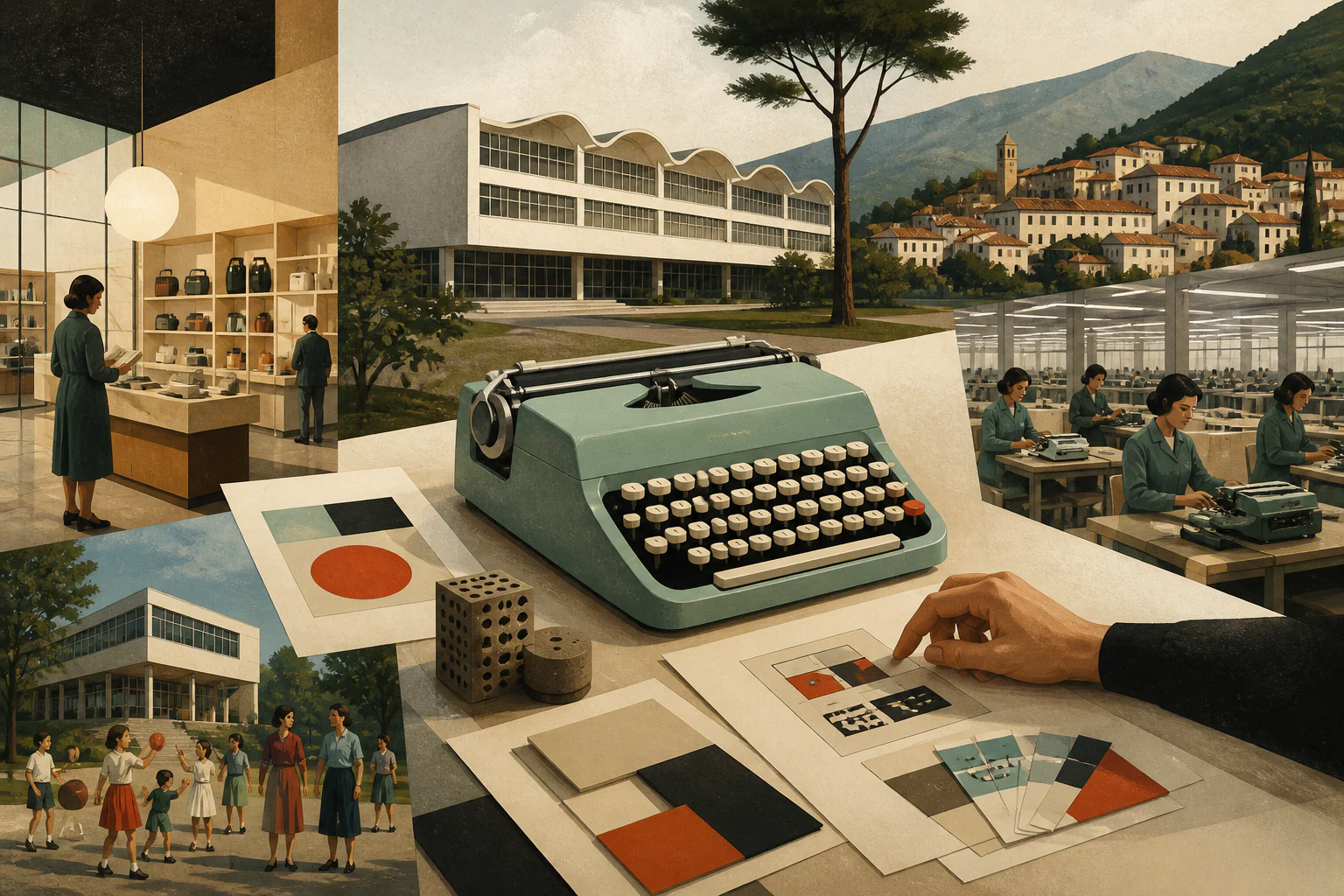
Olivetti matters as an example of a company where product, office, graphics, store, social policy, and communication form one design culture.
1. Research thesis
Olivetti is interesting not for individual successful products but because design decisions covered the entire company: the machine, the packaging, the poster, the store, the factory, and housing for workers. Design here was not a department but a mode of governance.
2. Why this is more than a company profile
Olivetti’s story is usually told through typewriters. The more interesting fact is different: the company simultaneously commissioned architecture, published magazines, maintained a library, and built housing. That makes it a case in management as much as in industrial design.
3. Historical setup
The company was founded in Ivrea at the start of the twentieth century and grew alongside the mechanisation of clerical work. Its peak came in the postwar decades, when the office became a mass workplace and the office machine an object seen by millions.
4. The company as a system
The key decision was not to separate the levels. The same circle of authors worked on the machine housing, the catalogue typography, the store interior, and the factory layout. Consistency arose not from a style manual but from a shared client and a shared conversation.
5. The object layer: the machine as office interface
The typewriter was an interface before the word existed. Key height, strike resistance, noise, weight, and portability shaped a typist’s working day. What was designed was not the appearance of an object but the conditions of someone else’s labour.
6. Portability changed the addressee
Portable models took the machine out of the office and into the home, the train, and the newsroom. The change of addressee pulled everything with it: colour instead of black, a case instead of a cast frame, advertising aimed at an individual rather than a purchasing department.
7. Valentine as the limit case
The Valentine, developed by Ettore Sottsass with Perry King and released in 1969, took this line to its limit: bright red plastic, a case that is part of the object, an address to a young owner. The machine entered museum collections and became an argument that office equipment can be a personal possession.
8. The graphic layer
Olivetti’s posters and catalogues solved a difficult problem: to explain a mechanism without showing all of it. Hence a language of sign, diagram, and colour field — graphics worked as a translation of engineering into a recognisable image.
9. The spatial layer: the store as statement
The company’s stores were entrusted to first-rank architects, and the window was treated as an exhibition stage rather than a shelf. The Venice showroom, designed by Carlo Scarpa in the late 1950s, showed that a retail point can be an architectural work.
10. Factory and town
The industrial zone of Ivrea, with housing, canteens, and social services, was designed as a single environment. In 2018 it was inscribed on the UNESCO World Heritage List — a rare case in which the protected object is a model of relations between production and town.
11. Social policy as part of the project
The library, the medical service, and shortened working hours were not philanthropy but a continuation of the same logic: if the workplace is designed, so are the living conditions of the worker. This is the most contested and most interesting part of the case.
12. Material and production
The move from cast metal to moulded plastic changed not only weight but permissible form, colour, and the cost of a tooling error. Plastic allowed radii and brightness that would have been prohibitively expensive in metal.
13. Electronics and the change of era
In the mid-1960s the company released a desktop calculating machine — an attempt to carry accumulated experience of the office object into a new technological era. The episode shows both the strength of the method and how quickly an industry shift devalues accumulated advantage.
14. The economy of form
Consistency paid for itself in recognition: a buyer identified an object’s origin before reading the mark. But it also raised the cost of every decision, because none could be taken in isolation.
15. Canon and museum
Museum recognition came early: the company’s objects entered design collections and became a teaching example. This secured the reputation but simultaneously narrowed it to a few striking objects.
16. Archive and reproducibility
Surviving archives make the case verifiable: there are drawings, correspondence, advertising layouts, and building documents. It is the existence of an archive that separates a researchable case from an attractive corporate legend.
17. Where the myth begins
The myth begins where the company is described as a humanist utopia. It was a commercial enterprise in a competitive industry, and the social programme lasted precisely as long as profit sustained it.
18. Where the myth blocks analysis
The utopian frame obscures the main point: not the nobility of intention but the workability of a coordination mechanism between departments. It is that mechanism that transfers; the intention does not.
19. Comparison with adjacent systems
A comparison with the German line of product discipline shows a difference of approach: there consistency was achieved through a body of rules, here through a shared circle of authors. The first scales better; the second produces more deviation from the mean.
20. Link to fashion
The model applies to a fashion house: collection, show, store, campaign, and headquarters can be one statement. The only difference is the cycle — a season against a production generation.
21. Link to the image
Product photography here was not illustration but part of the construction of meaning: angle and light explained the mechanism. It is an early example of what would later be called art direction of product photography.
22. Link to architecture and space
Store, factory, and housing were parts of one commission, which is rare. Usually a brand controls the shop window and not the workshop; here both were controlled.
23. Link to technology
The company’s history shows the limit of the method: a design culture built around mechanics does not transfer automatically to electronics. A change in the technological base devalued part of the accumulated craft.
24. Link to materials
Housing, key, ribbon, and case are four different material problems inside one object. Reconciling them was the main engineering work, invisible in the finished machine.
25. Market and logistics
Export required keyboard layouts for each language, a service network, and a stock of ribbons. International sale of a mechanical object is first of all service logistics, not advertising.
26. Critique and limits
The critique is justified on two points. The model depended on a single owner with unusual convictions and did not survive a change of leadership; and it did not save the company from falling behind technologically. The elegance of the method did not override the market outcome.
27. What has changed today
Today comparable consistency is delivered by design systems and policies rather than by a circle of acquainted authors. The result is more even and weaker in deviation — a gain in manageability paid for by a loss of strangeness.
28. What to connect next
The material links to the entries on the showroom, on the store as media, on industrial materials, and on the company’s individual objects. Ivrea deserves separate treatment as an urban case.
29. Editorial conclusion
Olivetti should be read not as a model of taste but as a rare mechanism that worked: one client, one circle of authors, one conversation across every level of production. The method is reproducible; the circumstances are not.
30. How to read this case today
Look at the joints rather than the objects: how a decision about a housing connects to a decision about a poster and a factory plan. Where that connection is documented the case is useful; where it is merely asserted, legend begins.