research
Polaroid: image as a physical event
Instant photography turns a delayed chemical process into an event where camera, material, waiting, and object coincide.
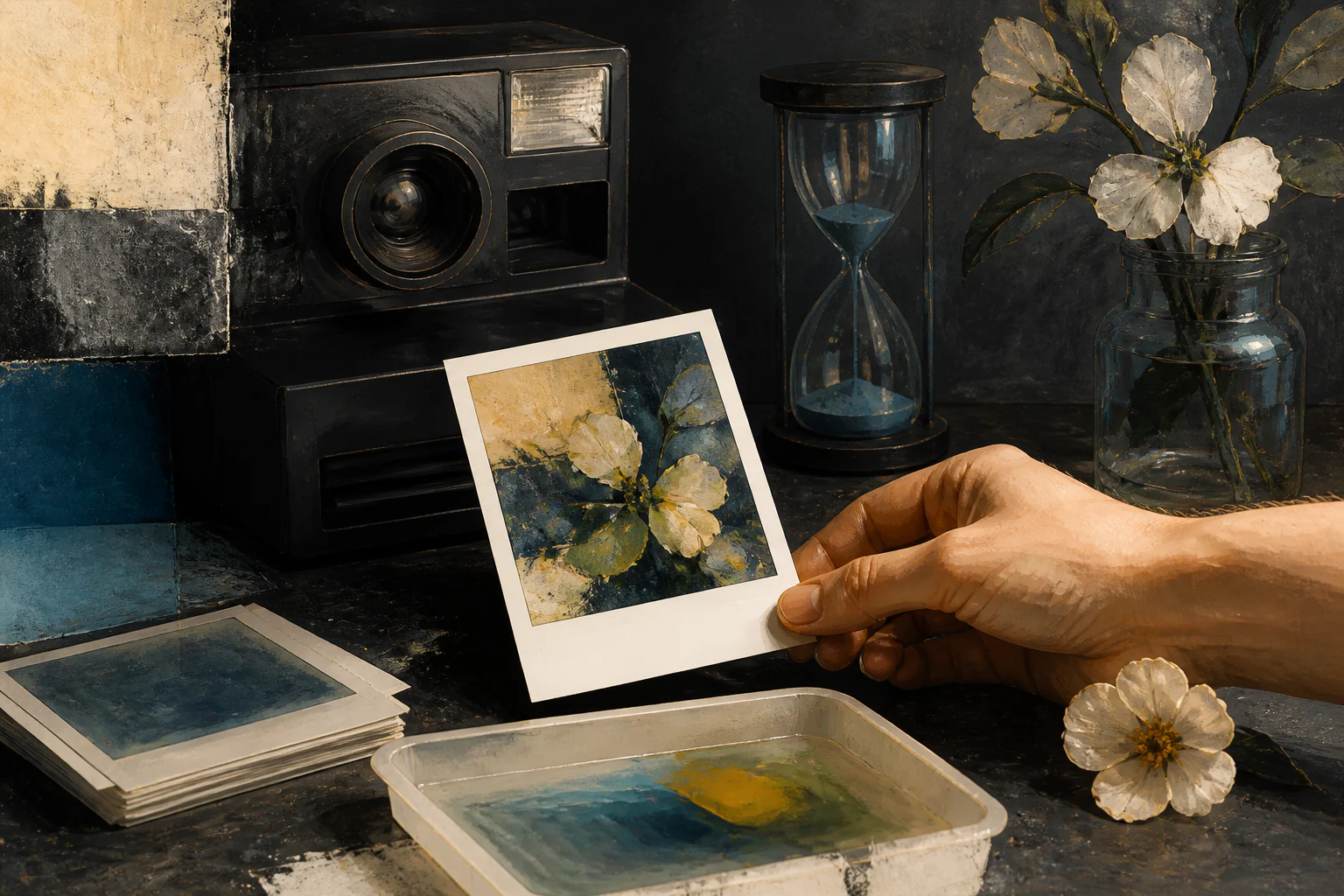
Polaroid turns photography from a delayed chemical process into an immediate physical event where camera, material, waiting, and object coincide.
1. Research thesis
Instant photography is interesting because it compresses the distance between exposure and object to minutes. The laboratory disappears, the negative disappears, and with them an entire stage of professional control.
2. Why this is more than a technology history
What matters is not the chemistry but the change of scenario. An image stops being a deferred promise and becomes an object passed from hand to hand at the site of the exposure.
3. Historical setup
The first commercial instant camera appeared in the late 1940s. It arrived when amateur photography was becoming a mass practice and waiting for development was its main inconvenience.
4. The company as a system
The manufacturer controlled camera, film, and chemistry simultaneously. This delivered precision of result and created dependency: without proprietary material the apparatus became a useless object.
5. The camera as chemical laboratory
The apparatus contained the whole process: reagents in a pod, rollers spreading the compound, and the layers where development occurs. This is not a camera with an attachment but a laboratory relocated into a housing.
6. Peel-apart and integral formats
Early systems required separating layers by hand and left chemical waste. The later integral format removed that operation: the print emerges complete and develops in daylight.
7. Waiting as part of the image
Development in front of the photographer created a new ritual. A minute of waiting became a social action, and this turned exposure into an event for a group rather than an operation by one person.
8. The print as object
The result is neither file nor negative but an object with a specific weight, format, and white border. It is the only photograph whose edition of one is a property of the mechanism rather than an authorial decision.
9. The absence of a negative changes status
Without a negative there is no original for reprinting or comparison. The print becomes unique by necessity, which brings it closer to a drawing than to a printed impression.
10. The white border as frame
The characteristic wide white border at the bottom arose from the technical need to house the reagent pod. A functional detail became the format’s identifying mark and was later reproduced purely decoratively.
11. Professional use
In studio practice the format was used as a test frame: checking light and composition before shooting on film. This was a working function invisible to the public.
12. Artistic use
Artists used the format precisely for the properties considered defects: unpredictable colour, narrow dynamic range, impossibility of repetition. The constraint became a means of expression.
13. The economy of form
The cost per frame was high and physically felt: every exposure consumed expensive material. This disciplined shooting more than any advice could — the opposite of digital abundance.
14. Interface and user
The apparatus was designed for an untrained person: minimal settings, a clear sequence, an obvious result. It is an early example of a product in which complexity is entirely hidden from the user.
15. The folding construction
The models of the 1970s solved a difficult engineering problem: a complex optical system had to fold into a flat housing. Mechanics here served portability — that is, the scenario of use.
16. Canon and museum
Both cameras and prints entered museum collections through design and through photography. The double entry reflects the object’s double nature: apparatus and image are inseparable.
17. Archive and reproducibility
Conserving instant prints is difficult: the layers continue to change chemically, and the image fades and shifts in colour. The archive here fights a process built into the construction.
18. Where the myth begins
The myth begins with nostalgic authenticity. An instant print is no more documentary than any other: framing, light, and choice of moment operate identically, and colour rendering is markedly conventional.
19. Where the myth blocks analysis
Nostalgia obscures the technical side: the format’s interest lies not in atmosphere but in having compressed a production chain into a single device. That is an engineering achievement, not a mood.
20. First key example
The folding model of the 1970s is worth analysing as an object: a combination of optics, mechanics, and chemistry in a housing that fits a coat pocket.
21. Second key example
The end of production and the subsequent revival of the film by independent efforts is worth analysing as a case of technological loss and reconstruction. The revived material is not identical to the original.
22. Comparison with adjacent systems
Digital capture delivered immediacy without an object; instant photography delivered an object without an edition. Both removed the wait but disposed of materiality differently.
23. Link to fashion
In fashion the format became a working tool for casting and for recording looks at fittings. Speed was needed for the production process rather than for effect.
24. Link to the image
The format changed the idea of a draft: the test frame became visible and material. This aligns it with the contact sheet, only at the scale of a single exposure.
25. Link to architecture and space
Photography no longer required a laboratory and became possible anywhere. The disappearance of a spatial requirement is a spatial consequence of a technical decision.
26. Link to technology
The case shows the vulnerability of a closed system: when production of the consumable stops, working apparatus becomes useless. Dependence on a single supplier is a design risk.
27. Link to materials
A print is a multilayer composite with active chemistry inside. It ages as a material rather than being stored as an image, and in this it differs fundamentally from a paper print.
28. Market and logistics
The business was built on the consumable rather than the apparatus. That model drove growth and also made the manufacturer’s collapse a catastrophe for camera owners.
29. Critique and limits
The critique is justified: image quality was inferior to film, cost per frame was high, permanence was poor, and the system was closed. The format won on scenario, not on specification.
30. What has changed today
Immediacy has become normal and lost its value; the value of the object has returned. Current interest in the format rests precisely on the materiality of the print rather than on speed.
31. What to connect next
The material links to the entries on the contact sheet, on digital photography, on composites, and on the photobook as sequence.
32. Editorial conclusion
The format’s significance is that it made an image an object at the moment of exposure. It is the only case in which a photograph does not promise an object but immediately is one.
33. How to read this case today
Holding a print, note what it lacks: a negative, a copy, and the possibility of comparison. The absence of these is what defines its status.