research
Burberry: inventing a fabric as the foundation of a brand
A house that grew not from an atelier but from a material patent, and therefore vulnerable to who wears its check.
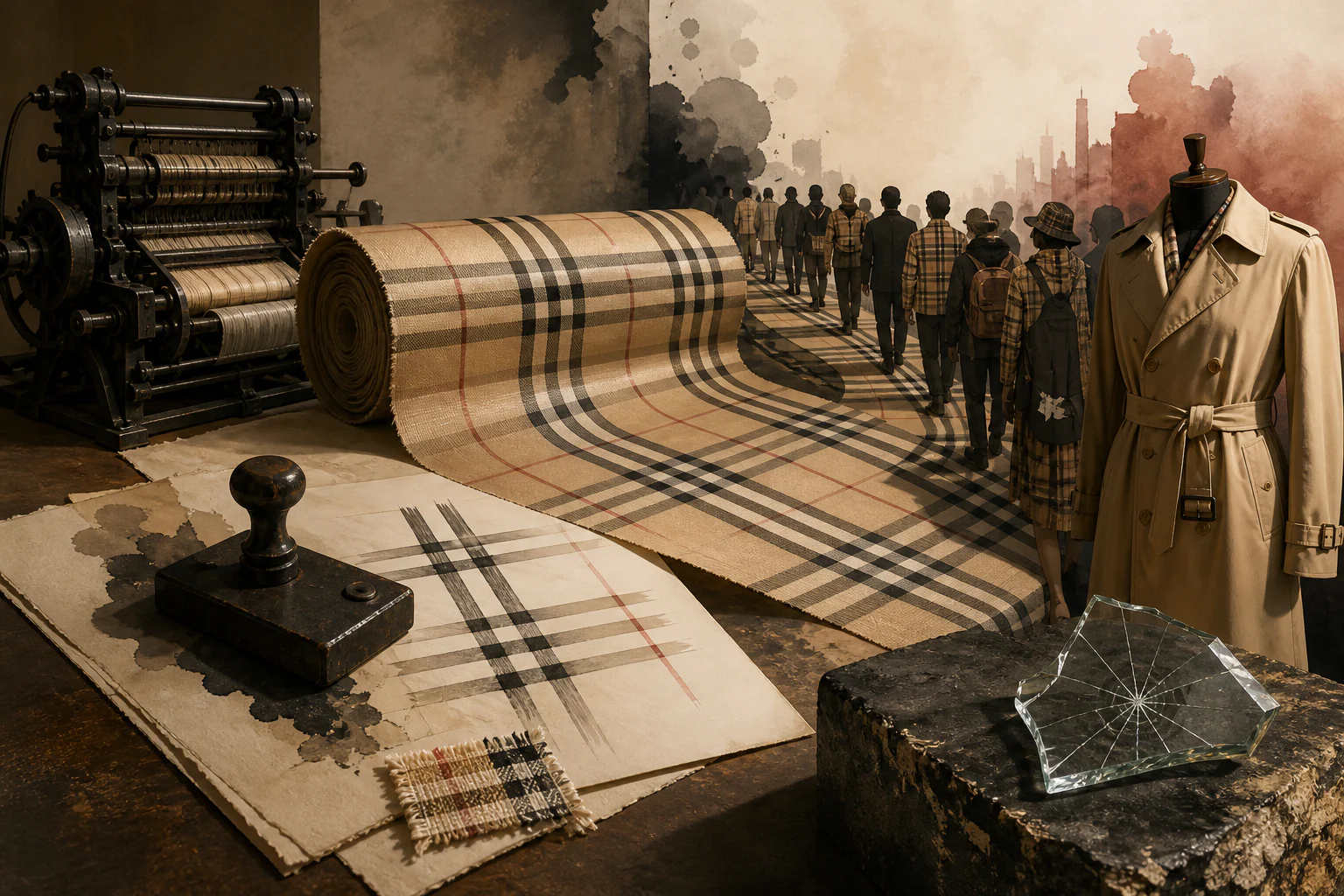
Editorial thesis
Burberry matters as a brand founded on a technical invention: the fabric preceded the fashion, and every subsequent crisis has involved attempts to govern that fabric’s meaning.
Reader question
What happens to a brand when its recognisable mark is appropriated by an audience it did not intend?
Short answer
It loses control of meaning and must rebuild its position through restriction rather than advertising. Founded 1856 by Thomas Burberry; context Basingstoke and London.
1. Origin: a draper’s shop
The brand began as a fabric and outerwear shop in the English provinces. Its foundation was commercial and technical rather than tailoring-based, and this determined the house’s entire subsequent character.
2. The invention of gabardine
The key event was the development of a dense twill woven from yarn treated before weaving. It repelled water while remaining breathable, solving the central problem of rubberised coats — that they did not breathe.
3. A patent as the brand’s foundation
The brand was built on a protected technical advantage rather than on a founder’s taste. This is rare in fashion and aligns the house more closely with an industrial enterprise.
4. Expedition use
The fabric was used on polar and high-altitude expeditions, giving the brand evidential advertising: the clothing was tested where failure means death. Credibility here was earned through use rather than through messaging.
5. Military commission and the origin of the silhouette
The coat model was developed for officers and contained functional details: epaulettes, rings, a storm flap, a belt with D-rings. Each detail had a purpose, and all of them survive as decoration.
6. Function turned into sign
The conversion of functional elements into identifying ones is a precise case of a utilitarian detail outliving its purpose. The contemporary coat quotes requirements that no longer exist.
7. The check as an internal detail
The check pattern appeared as a lining — that is, as an invisible part of the garment. Its later move to the outside was a decision that changed the brand’s entire economics.
8. Licensing and loss of control
Extensive licensing of the mark during the twentieth century produced revenue while dispersing control over quality and categories. The check ended up on too many carriers.
9. Appropriation of the mark in the early 2000s
In the early 2000s the check was widely adopted by an audience outside the target group and acquired a class connotation in the British press. The brand discovered that a mark’s meaning is set by its wearer rather than its owner.
10. Recovery through restriction
The response was cutting licences, withdrawing the check from most positions, and returning to the coat as the core product. Recovery proceeded through giving up volume rather than through a new campaign.
11. The digital turn
In the late 2000s and early 2010s the house was among the first in luxury to move to live-streamed shows with immediate sale. It was an institutional bet on a channel rather than an experiment.
12. Leadership changes of the 2010s and 2020s
Subsequent appointments shifted the register from street and print toward a more restrained British idiom. Each change was accompanied by a reworking of the mark, indicating that the question of position remains unresolved.
13. The current direction
The house develops its codes under Daniel Lee, returning to the equestrian mark and heritage palette. The bet is on provenance and on outerwear as the core category.
14. Independence as circumstance
Unlike most comparable houses, the brand remains a publicly listed company outside any conglomerate. This means quarterly reporting and shareholder pressure — a condition that governs the speed of decisions.
15. Critical questions
The critique is justified: the house’s history shows that a mark’s owner controls it legally but not semantically. Constant reworking of identity at every change of leadership also undermines the very heritage the house relies on.
16. How to read this house today
Read the brand through its fabric rather than its check. The foundation here is technical, and the most durable part of the offer remains outerwear, where a functional requirement can still be tested.