research
Vitsœ 606: a system designed for decades
The 606 matters not as a shelf but as a model for the long life of things: adaptation, repair, moving, module, and service are part of its form.
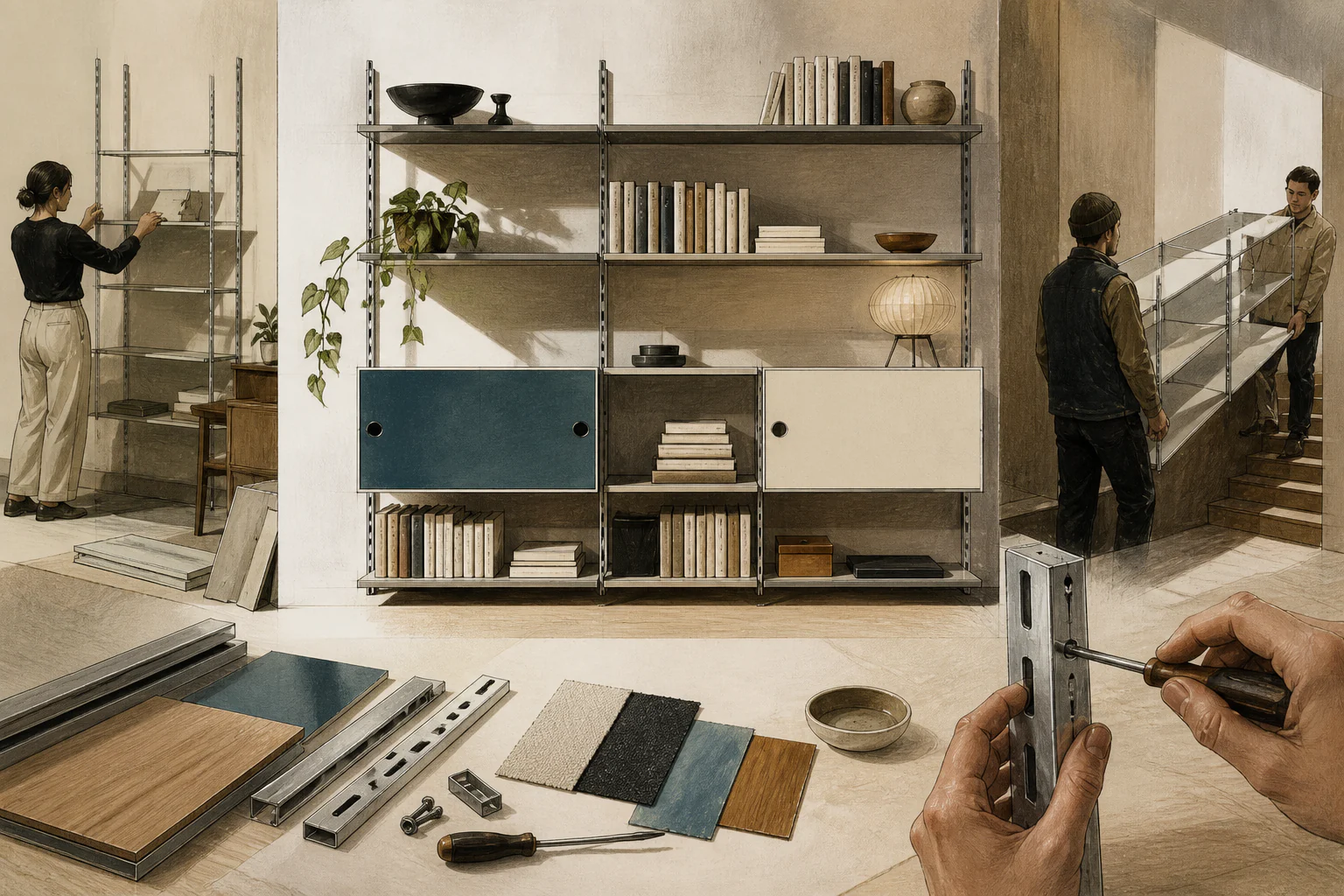
The 606 matters not as a shelf but as a model for the long life of things: adaptation, repair, moving, module, and service become part of form.
1. Research thesis
The 606 is interesting because it moves the centre of design from the object to the service life. The question is not "what does a shelf look like" but "what happens to it in twenty years, in a move, and under a new owner".
2. Why this is more than a piece of furniture
The system is sold not as a finished product but as a set of compatible elements and a promise of their future availability. That moves the purchase from the category of objects into a subscription to compatibility.
3. Historical setup
The system was developed in the early 1960s, when postwar housing was getting smaller and its contents more numerous. Wall-mounted storage solved a floor-area problem, but the original brief was broader: furniture that outlives several flats.
4. The company as a system
The manufacturer deliberately restricted its range and tied the business model to durability: sell less but service longer. Such a model requires giving up the stimulation of repeat purchase — a commercially difficult decision.
5. The object layer: the wall track as domestic infrastructure
The key element is not a shelf but a vertical track fixed to the wall. It turns a wall into a load-bearing system with a fixing pitch — that is, it introduces infrastructure into a flat rather than furniture.
6. The module as a promise
The point of a module is that it limits the future to something predictable. If pitch and profile are fixed, an element bought twenty years later will fit. The promise of compatibility is the actual product.
7. Backward compatibility as an obligation
Maintaining compatibility across generations is expensive: it forbids cost-reducing changes to profile and fixings. Every such constraint reduces engineering freedom and increases owner value.
8. Moving as a design scenario
The system is calculated for disassembly and reassembly. This changes construction: fixings must survive repeated use, and elements must tolerate transport without special packaging.
9. Service as part of form
The ability to buy an additional element, get installation advice, and order a relocation is not an added service but a condition of the model working. Without service the module becomes an ordinary shelf.
10. The spatial layer
Wall mounting frees the floor and makes room volume legible. But it also requires a load-bearing wall and leaves marks — the system enters into a relationship with the building rather than merely standing in it.
11. Material and production
The metal profile and painted or wooden shelves were chosen for repairability: a surface can be refinished, an element replaced, and a profile survive several installation cycles. Material was selected for duration rather than appearance.
12. The economy of form
A high initial price is justified by division across service life and number of configurations. The argument works only where service exists; without it, this is simply an expensive shelf.
13. Interface and user
The user becomes co-author of the configuration: they decide pitch, height, and composition. The system supplies a vocabulary and the owner composes the sentence — and this division of roles explains attachment to the object.
14. Canon and museum
The system entered design collections and teaching as an example of modular thinking. Museum recognition is slightly paradoxical here: what is exhibited only makes sense in use and alteration.
15. Archive and reproducibility
Continuous production functions as an archive in itself: drawings are not lost because they are still in use. This is a rare case of living rather than museum documentation.
16. Where the myth begins
The myth begins with the idea of permanence. The system depends on the company existing: the promise of compatibility is secured not by physics but by the commitment of a legal entity that can disappear.
17. Where the myth blocks analysis
Talk of durability obscures the question of access. The model works for a buyer able to pay in advance for service life, and describes poorly a market where decisions are made on initial price.
18. First key example
The wall track is the system’s most substantive element. It is worth analysing as a decision that what is permanent in a flat is not furniture but fixing points.
19. Second key example
The relocation service is the product’s second half. It turns a one-off sale into a continuing relationship and makes service life measurable rather than declarative.
20. Comparison with adjacent systems
Unlike mass-market flat packing, what was optimised here is not delivery cost but cost of ownership. Both strategies are logistical, but they count different quantities.
21. Link to fashion
The analogue is a wardrobe built on compatibility rather than on looks: a finite set of garments that combine with one another for years. The logic of the module transfers to clothing without distortion.
22. Link to the image
The system is hard to photograph: it reads as background and reveals itself only in a comparison of configurations. It is a rare object that loses in a single frame and gains in a series.
23. Link to architecture and space
The requirement of a load-bearing wall makes the system architectural: it places demands on the building. In that sense it is closer to fitted equipment than to furniture.
24. Link to technology
Technological risk here is minimal, and that is a deliberate choice. The system intentionally uses nothing that could become obsolete — the absence of electronics is a condition of longevity.
25. Link to materials
Durability is delivered not by strength but by repairability: a finish can be restored, an element replaced, a fixing unscrewed. Demountability matters more than hardness.
26. Market and logistics
The model requires stock of legacy items and a spare-parts store — the direct opposite of working-capital optimisation. Durability is paid for in frozen cash.
27. Critique and limits
The critique is justified: the system is expensive to enter, requires a solid wall, and presumes a certain kind of housing and level of income. It is not universal and does not claim to be.
28. What has changed today
Requirements for repairability and parts availability are becoming regulatory rather than voluntary. What was an authorial position is gradually turning into an industry norm.
29. What to connect next
The material links to the entries on logistics and form, on minimalism, on design systems, and on individual storage objects. An analysis of the regulatory side of the right to repair would be useful.
30. Editorial conclusion
The 606 should be read as a project of obligation rather than of form. Its longevity is secured not by material but by a decision to preserve compatibility and maintain service — that is, by organisational rather than aesthetic discipline.
31. How to read this case today
When assessing any "modular" system, ask about parts: is a twenty-year-old element available, and who guarantees that in ten years’ time. The answer separates a system from a set of shelves.