research
Apple: industrial design as the company interface
Product, packaging, store, operating environment, and user gesture are linked into one continuous interface.
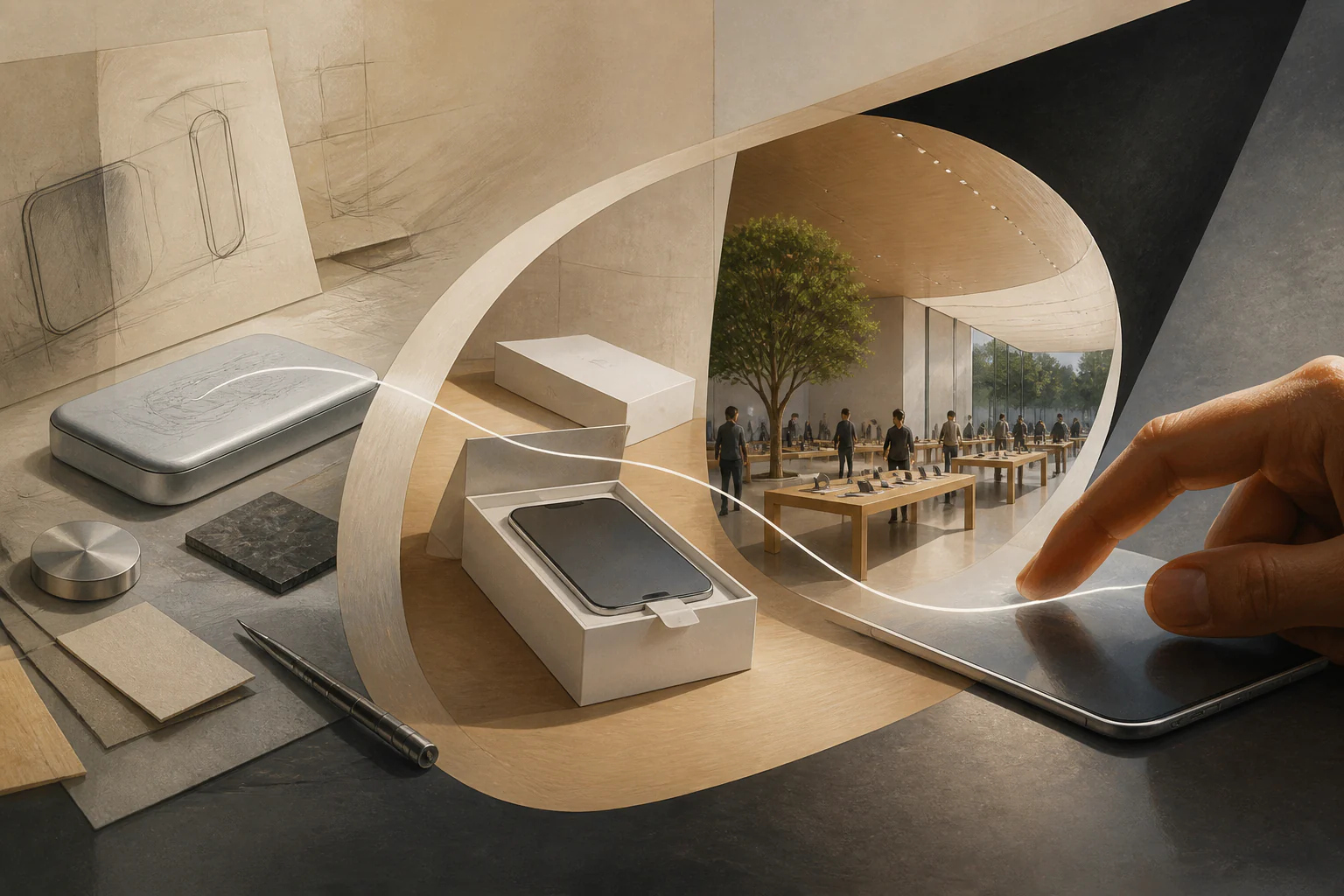
Apple shows how industrial design can become the interface of an entire company: product, packaging, system, store, operating environment, and user gesture connect.
1. Research thesis
The case is interesting not for individual products but because industrial design acquired the right to determine decisions beyond the object: packaging, retail, the screen environment, and service procedure. Design became the point of entry to the company.
2. Why this is more than a product history
The product line changed several times while the method persisted. That means the object of study is an organisational arrangement rather than a particular housing or material.
3. Historical setup
An early unified visual system for the product line was developed by an outside consultancy in the mid-1980s. It established a principle: not a single successful housing but a rule set for the entire range.
4. The company as a system
The key decision was organisational: the design group gained direct access to senior leadership and the right to participate in defining the product. Without that, no consistency would have been possible.
5. The object layer: the housing as a technology claim
The move to machined aluminium enclosures was a production rather than an aesthetic decision. It required machining capacity and tolerances unavailable to most competitors — and turned a manufacturing method into a competitive advantage.
6. Colour and translucency as a category reset
The coloured translucent housing of the late 1990s moved the computer out of the office-equipment category into that of a domestic object. Material here performed the work of positioning.
7. Packaging as the first scene
The box was designed as part of the product: the resistance of the lid, the order of extraction, the placement of documentation. Unboxing became a designed sequence rather than the removal of an obstacle.
8. Retail as an extension of the product
A proprietary store network opened in the early 2000s removed the intermediary and made space an extension of the product: the same materials, the same logic, the same service standard.
9. The service counter as typology
Introducing a technical support counter inside the store changed retail typology. A point of sale became a point of repair and instruction — a rare combination of functions in one location.
10. The screen environment as part of the product
Interface guidelines extended the same discipline to software and to third-party developers. A rule set turned the screen environment into a continuation of industrial design.
11. The gesture as a designed object
With touch input the gesture became an object of design: tap, drag, scroll inertia. This moved ergonomics from the domain of the button into the domain of movement.
12. Material and production
Aluminium, glass, and polymers were chosen for wear behaviour and for precision machinability. The cost of the decision lies in tooling and quality control rather than in raw material.
13. The price of consistency
Continuity of interface requires control over the whole chain: manufacturing, retail, software environment, and service. This is expensive and makes the system closed — the reverse side of consistency.
14. The economy of form
Consistency sustains a premium price because the buyer pays for predictability of experience rather than only for device specification. This shifts competition from parameters to the system.
15. Canon and museum
Individual products entered design collections. Yet the most influential part of the case is an organisational decision, which cannot be exhibited.
16. Archive and reproducibility
Patents, interface guidelines, and published environmental reports provide verifiable material. The internal decision process remains closed, and this limits research.
17. Where the myth begins
The myth begins with the figure of the solitary genius. A collective worked, with engineers, process specialists, and manufacturing partners; personalising the story is convenient for narrative and unhelpful for understanding.
18. A second layer of myth
A second simplification is the idea of infallibility. There were failed products, reversed decisions, and engineering compromises; the canon is built on a selected part of the history.
19. First key example
The proprietary store is worth analysing as a decision to remove the intermediary between object and buyer. Control over the final point of contact proved no less important than control over the housing.
20. Second key example
The interface guidelines are worth analysing as a design system extended to people outside the company. It is a rare case of a rule set governing third-party authors at that scale.
21. Comparison with adjacent systems
The method directly inherits German product discipline: restricted palette, priority of clarity, a set of principles. The difference is scope — here the system reached retail and service.
22. Link to fashion
The model has been reproduced in luxury almost literally: proprietary retail, control of presentation, service, and refusal of intermediaries. The convergence of strategies indicates a shared problem rather than imitation.
23. Link to the image
Product photography is standardised to the level of a technical specification: angle, light, shadow, ground. The image of an object became as controlled an element as the object itself.
24. Link to architecture and space
The stores are designed as a recognisable typology with repeatable elements. It is a design system applied to real estate, with all its advantages and constraints.
25. Link to technology
In-house development of key components closed the system: control over the hardware base allows decisions unavailable when working on someone else’s platform.
26. Link to materials
Sealed enclosures and adhesive bonds long made repair difficult. This is a direct consequence of prioritising formal wholeness, and it is exactly where the method collided with repairability.
27. Market and logistics
Unified components and packaging deliver economies of scale and simplify logistics. Consistency yields operational benefit alongside communicative benefit.
28. Critique and limits
The critique is justified: the closed system limits user choice, repairability was long sacrificed to form, and platform control raises regulatory questions. These objections concern the structure of the model rather than its execution.
29. What has changed today
Regulatory pressure on repair, connectors, and platform openness is changing the conditions. Some decisions taken for the sake of consistency now have to be revised under external requirement.
30. What to connect next
The material links to the entries on product systems, the store as media, design systems, minimalism, and the logistics of form.
31. Editorial conclusion
Industrial design became the company interface because it acquired an organisational right to decide beyond the object. That is a management construction, and it is what transfers — not the appearance of the products.
32. How to read this case today
When assessing imitators, look not at housing material but at where in the organisation form is decided. If it happens after the product is approved, you are looking at styling, not an interface.