encyclopedia
3D Scanning — A Digital Twin of the Real Object
Physical surfaces become measured point clouds and editable geometry.
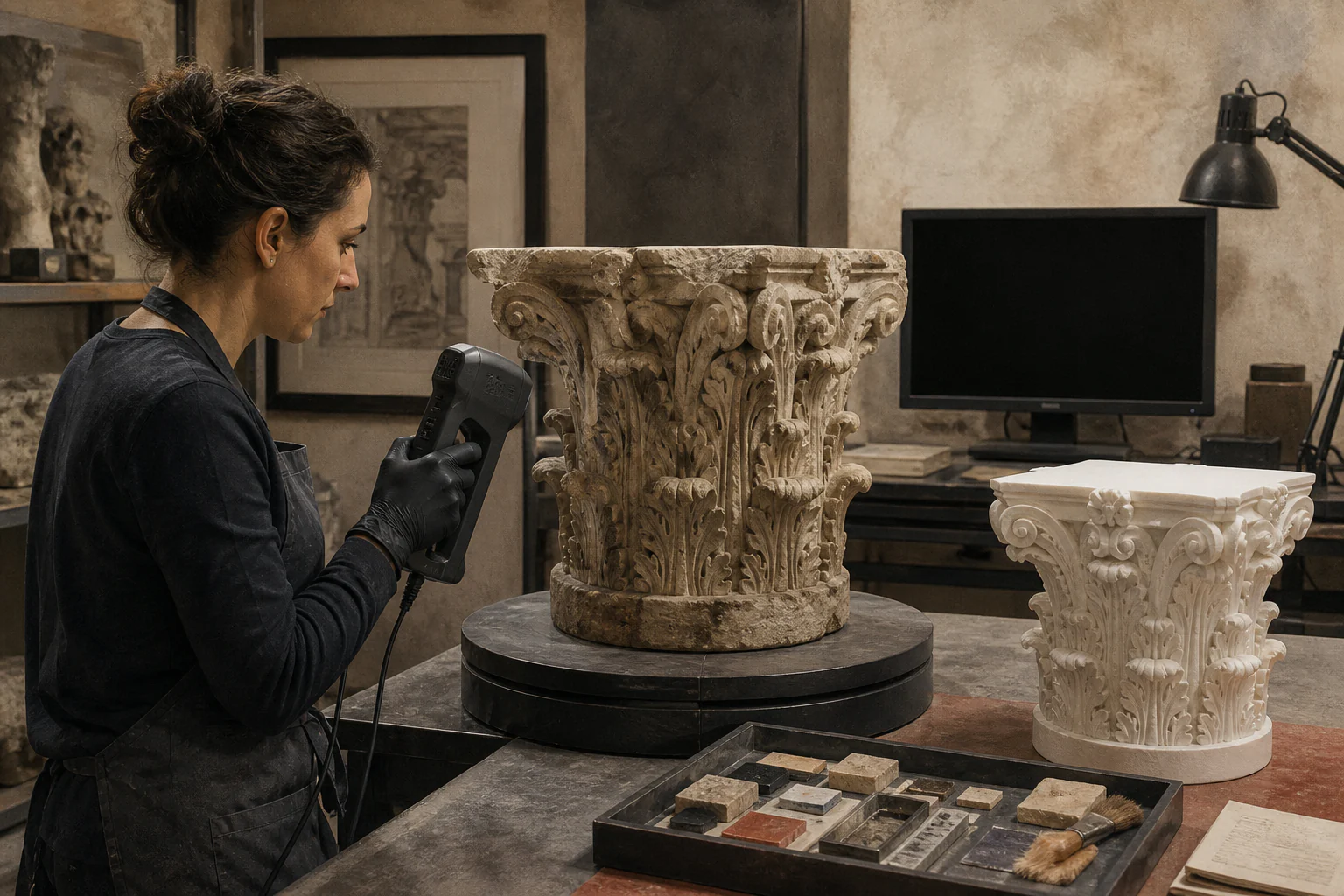
3D Scanning — A Digital Twin of the Real Object matters to VANSMITHLAB as a node connecting tools, production, material and image-making. Physical surfaces become measured point clouds and editable geometry.
Editorial thesis
3D Scanning — A Digital Twin of the Real Object matters to VANSMITHLAB as a node connecting tools, production, material and image-making. Physical surfaces become measured point clouds and editable geometry.
Reader question
What exactly did this technology change in the structure of design and production?
Short answer
Physical surfaces become measured point clouds and editable geometry. Scanning is increasingly linked to digital twins, robotics and building operations; value is shifting from spectacular point clouds toward traceable measurement datasets.
1. Definition and boundaries
Physical surfaces become measured point clouds and editable geometry. The subject is treated as a system connecting data, tools, people and outcomes rather than as the name of one application or machine.
2. Origins and prehistory
3D scanning grew from optical measurement, ranging, industrial metrology and remote sensing. Laser and structured-light systems entered construction, heritage, manufacturing and VFX as sensor costs fell.
3. Why the subject emerged when it did
The technology became possible when computation, interfaces, storage and professional demand converged in one working environment. 3D scanning grew from optical measurement, ranging, industrial metrology and remote sensing. Laser and structured-light systems entered construction, heritage, manufacturing and VFX as sensor costs fell.
4. System and components
LiDAR measures distance through laser signals; structured light analyses deformation of a projected pattern. Multiple captures are registered, filtered and converted into point clouds or surfaces.
5. Operating or production principle
LiDAR measures distance through laser signals; structured light analyses deformation of a projected pattern. Multiple captures are registered, filtered and converted into point clouds or surfaces. It is crucial to distinguish digital description from physical or visual result: a chain of interpretation and transformation always lies between them.
6. Key technical and cultural turn
The key turn is the shift from experimental method to reproducible professional infrastructure. 3D scanning grew from optical measurement, ranging, industrial metrology and remote sensing. Laser and structured-light systems entered construction, heritage, manufacturing and VFX as sensor costs fell.
7. First anchor example
Terrestrial LiDAR — millions of building points. This example matters as a demonstration of the basic principle, not only as a historical milestone.
8. Second anchor example
Structured light — close-range scanning of objects or parts. It shows the technology becoming part of a real production scenario.
9. Third anchor example
Scanning + photogrammetry — geometry plus photographic texture. The third example shows a mature system in which file, interface, equipment and outcome are inseparable.
10. Form and geometry
Form depends on how the technology represents geometry, relationships and constraints. LiDAR measures distance through laser signals; structured light analyses deformation of a projected pattern. Multiple captures are registered, filtered and converted into point clouds or surfaces.
11. Surface, light and colour
Surface, light and colour expose the boundary between computable description and perceived result. Designers must know which properties belong to data and which emerge only in material, print, screen or render.
12. Tactility, sound and movement
Tactility, sound and movement become visible when a technological scheme enters physical space or time-based imagery. The process includes station planning, calibration, capture, registration, filtering, classification, reduction and conversion. Reverse engineering adds surface reconstruction and comparison with CAD.
13. Production system
The process includes station planning, calibration, capture, registration, filtering, classification, reduction and conversion. Reverse engineering adds surface reconstruction and comparison with CAD.
14. Tools and infrastructure
Infrastructure includes software, formats, equipment, storage, naming, versions and quality control. The process includes station planning, calibration, capture, registration, filtering, classification, reduction and conversion. Reverse engineering adds surface reconstruction and comparison with CAD.
15. Mass adoption
Mass adoption begins when a method no longer requires a unique laboratory and enters education, standard file exchange and accessible professional equipment. Scanning is increasingly linked to digital twins, robotics and building operations; value is shifting from spectacular point clouds toward traceable measurement datasets.
16. Professional practice
Professional practice requires reproducibility: another participant should understand source data, version, scale, tolerances and criteria for the result. The process includes station planning, calibration, capture, registration, filtering, classification, reduction and conversion. Reverse engineering adds surface reconstruction and comparison with CAD.
17. Connection to architecture
In architecture the technology connects design geometry, existing space, visualisation, coordination and fabrication. Its importance is clearest when one digital model crosses several disciplines.
18. Connection to product design
In product design, the technology shows that form cannot be separated from how it is described and manufactured. LiDAR measures distance through laser signals; structured light analyses deformation of a projected pattern. Multiple captures are registered, filtered and converted into point clouds or surfaces.
19. Connection to fashion
In fashion the technology appears in form and surface development, prototyping, accessories, show scenography and image production. Its real productive role should be separated from decorative displays of “technology.”
20. Connection to image-making
For image-making, the subject changes what counts as source and final result: a frame, model or page becomes the outcome of a chain of decisions. Physical surfaces become measured point clouds and editable geometry.
21. Connection to technology
The subject bridges neighbouring VANSMITHLAB technologies: data pass between systems and the constraints of one stage become inputs for another. Scanning is increasingly linked to digital twins, robotics and building operations; value is shifting from spectacular point clouds toward traceable measurement datasets.
22. Connection to materials
Material remains the test of digital abstraction. Thickness, reflection, grain, strength, viscosity, thermal behaviour or optics can alter the outcome even when a file is formally correct.
23. Institutions and canon
The canon is formed by inventors, companies, universities, museums, archives, standards and professional communities. Its history should therefore be read across objects, software, patents, documentation and practice.
24. Market and commercial logic
Commercial logic depends on iteration speed, repeatability, scale, equipment cost and the price of moving from design to result. Digital simplicity does not necessarily mean cheap production.
25. Criticism and limitations
A scanner measures only surfaces visible to it; occlusion, glass, specularity, range and movement create gaps and false points. Point clouds always require interpretation.
26. Errors and myths
A common mistake is to treat a spectacular outcome as proof of methodological quality. A scanner measures only surfaces visible to it; occlusion, glass, specularity, range and movement create gaps and false points. Point clouds always require interpretation.
27. Sustainability, longevity and maintenance
Sustainability must be assessed across the chain: energy, materials, equipment life, repairability, number of trials, logistics and the reusability of data. Digitalisation alone does not make a process environmentally benign.
28. Current state
Scanning is increasingly linked to digital twins, robotics and building operations; value is shifting from spectacular point clouds toward traceable measurement datasets.
29. What it changed in the discipline
The subject changed the discipline by redistributing decisions among people, data, software, machines and materials. Physical surfaces become measured point clouds and editable geometry.
30. How to read the subject today
Today it is more useful to read the subject as a change in authorship and production structure than as a battle between old and new. Scanning is increasingly linked to digital twins, robotics and building operations; value is shifting from spectacular point clouds toward traceable measurement datasets. A scanner measures only surfaces visible to it; occlusion, glass, specularity, range and movement create gaps and false points. Point clouds always require interpretation.