encyclopedia
Architectural Textiles
Membranes, light and the soft construction of space
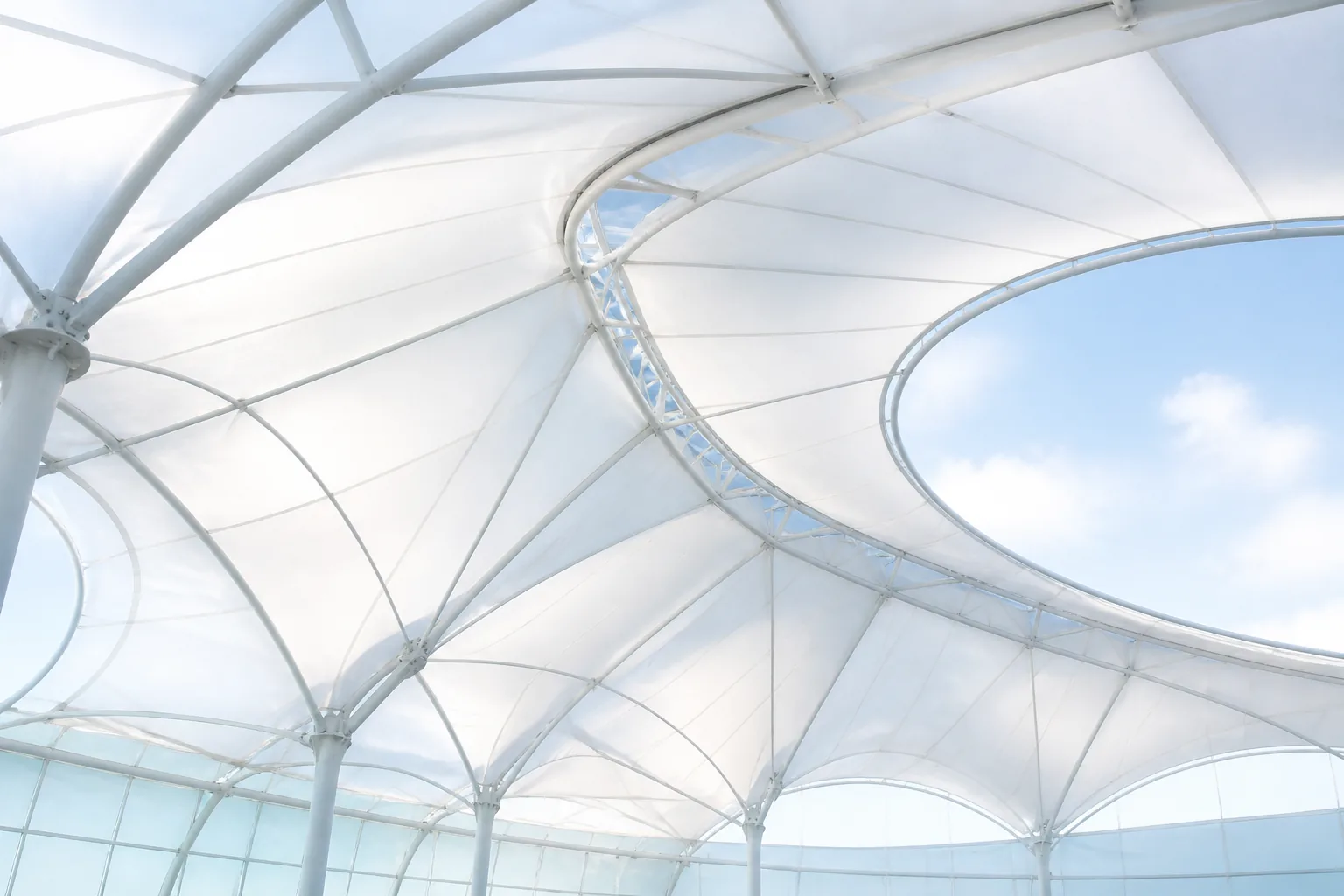
Textile enters architecture not by pretending to be a wall but by revealing its own logic. It stretches, transmits light, moves in wind and turns minimal mass into space where structure and atmosphere become one surface.
Editorial thesis
Architectural textiles begin not with pattern but with a different attitude to mass. Stone resists form through weight and steel through rigidity; a membrane works through tension. It barely conceals force: every valley, peak, seam and edge reveals how the surface holds itself in equilibrium.
Textile in architecture is therefore not soft decoration. It may become roof, façade, acoustic layer, solar screen or movable boundary. Its visual language is made by light and movement, but its quality depends on calculation, patterning, detailing and maintenance.
Reader question
How can a thin sheet cover the scale of a stadium, while a heavy curtain sometimes changes the feeling of a room more profoundly than a new wall?
Because architectural textiles organise not only matter but flows: they distribute tensile forces, diffuse light, slow air, soften sound reflections and alter spatial boundaries without the sense of permanent immobility.
Short answer
Architectural textiles are woven, mesh, laminated and coated materials used as structural membranes, façade screens, acoustic surfaces, curtains and spatial dividers. In tensile systems, form is stabilised by prestress, double curvature and interaction with cables, masts or rigid frames. 13
The essential distinction is not between “fabric” and “architecture” but between systems. PVC-coated polyester, PTFE-coated fibreglass, meshes and ETFE differ in mechanics, light transmission, fire performance, service life and repair. ETFE is a polymer foil rather than a textile, although it belongs to the same professional conversation about lightweight envelopes. 1
1. Textile as one of the earliest architectures
Before the wall there was the envelope. Portable dwellings made from hides, felt and woven cloth created protected volume without massive foundations. TextielMuseum describes tents as among the earliest forms of dwelling and links them to mobility and material economy. 1
This history matters not as romantic prelude but as technical principle: a light skin works with frame, rope, peg and tension. The modern membrane is more complex in chemistry and calculation, yet preserves the same clear dependence between surface and support.
2. From tent to engineered envelope
Industrial architecture long treated fabric as temporary shelter: pavilion, circus, military camp or canopy. In the second half of the twentieth century, research into lightweight structures turned temporariness into an engineering discipline.
The shift occurred when form stopped being drawn as a façade effect and began to be found through stress. Standards and design guides now treat membranes as full building materials requiring analysis, documentation, fabrication and erection control. 13
3. Fibre, yarn and surface
Textile behaviour begins at fibre scale. Fibres form yarns, yarns form interlacing systems, and interlacing produces a surface that stretches, cuts, folds and transmits light in specific ways.
A coating may almost conceal the woven substrate but cannot cancel its mechanics. Beneath the smooth white finish remains a directional system of yarns; the material cannot be calculated as identical in every direction.
4. Fabric, mesh, membrane and foil
Fabric is formed by interlaced yarns. Mesh deliberately retains open cells. Membrane is the wider term for a thin load-bearing or enclosing surface. Foil is made without weaving and may work as a single skin or pneumatic cushion.
Critical context
Not every lightweight transparent envelope is textile. ETFE is extruded polymer foil, while the transparent skin of Munich Olympic Park is made from acrylic panels. They share a lightweight-surface logic, not a manufacturing method.
5. How a soft material becomes structure
A soft surface does not resist compression like a beam or slab. It becomes structure when loads are converted into tension and distributed across the area.
This changes the image of architecture. Mass is replaced by a continuous stress field; the roof appears light not because it hides structure but because its form is literally a map of material action.
6. Tension, prestress and stability
Prestress is introduced before snow, wind and rain act on the surface. It removes wrinkles, limits excessive movement and helps preserve the intended geometry.
Too little tension produces flapping, pockets and fatigue. Too much raises demand on seams, edges and supports. Stability comes not from maximum tension but from an accurately balanced system.
7. Double curvature: the form that refuses to sag
A flat sheet sags easily. A tensile surface becomes more stable when it acquires opposing curvatures, like a saddle where one direction rises and the other falls.
Double curvature is not a decorative wave but a geometric mechanism. It distributes load and prevents the surface from becoming an uncontrolled bag under water or snow.
8. Form-finding: design through equilibrium
Form-finding does not place an expressive envelope over a completed plan. It searches for a shape in which geometry, supports and stress can coexist.
The architect sets boundaries, heights, anchor points and loading principles, but the final surface is refined through equilibrium. The material participates in authorship rather than simply obeying a drawing.
9. Physical models, soap films and digital analysis
Frei Otto used chains, nets, cloth and soap films because physical models revealed minimum or balanced forms quickly. Later computational models allowed more precise analysis of wind, snow and nonlinear behaviour. 1
Digital simulation does not replace the model. Physical work reveals wrinkle, touch, light and human scale; analysis checks forces and deformation. Strong design uses both ways of seeing.
10. Warp and weft: the anisotropy of fabric
Warp and weft carry different manufacturing histories and usually different stiffness. Under load, fabric first rotates yarns and changes weave angle before behaving as a stiffer plane.
Panel orientation therefore affects form, seams and visual grain. A poorly oriented fabric may remain structurally adequate yet produce unwanted wrinkles and uneven highlights.
11. Patterning: translating a curved surface into flat panels
A doubly curved surface cannot be unfolded onto a table without distortion. It is divided into strips, geometrically compensated for stretch and converted into cutting patterns.
Pattern lines remain visible after installation. They become part of the architectural drawing, so engineering logic and visual composition must be designed together.
12. Seams, welding and lines of force
Panels are joined by welding, sewing or mechanical profiles. The connection must transfer force, remain weather-tight and survive repeated movement.
A seam thickens the surface and catches light differently. In a strong envelope it reads as a calm line of force; in a weak one it becomes an arbitrary scar revealing poor coordination between analysis and patterning.
13. Edges, cables and details
The edge gathers distributed forces and delivers them into cable, extrusion, mast or anchor. Here the thin surface meets heavy engineering.
The beauty of a tensile structure is often decided within a few centimetres: reinforcement radius, cable pocket, clamping plate, drainage and access for replacement. The detail must allow movement without turning movement into damage.
14. PVC-coated polyester: affordability and flexibility
PVC-coated polyester is widely used for cost, weldability, colour and geometric flexibility. Birdair describes PVC as a cost-effective alternative to conventional roofing and notes its broad colour range. 1
Its character is less permanent than the whiteness of a new sample suggests. Plasticisers, dirt, ultraviolet exposure, thermal cycling and cleaning affect the surface, so service life and replacement strategy must be defined early.
15. PTFE-coated fibreglass: the durable white envelope
PTFE-coated fibreglass combines woven glass fibre with a fluoropolymer coating. It is used in permanent structures and offered in different strengths and light-transmission levels. 1
During the first months it may appear warmer or beige before whitening. Architecturally it creates a characteristic milky light: not glass transparency but the gentle absence of hard shadow.
16. ETFE: transparent foil rather than textile
ETFE may be used as a single layer or as pneumatic cushions made from two or three foils. Birdair notes its very low weight and high transparency compared with glass systems. 1
Foil can carry printed patterns and modify solar gain through changing layer configurations. Yet the cushion depends on air, extrusions, sensors and equipment: visual lightness is supported by an invisible technical infrastructure.
17. Meshes and open textiles
Mesh acts as filter rather than complete boundary. It passes air and partial views, reduces direct sun, conceals services and produces moiré as the observer moves.
Cell density changes the scale of the surface. From a distance the façade may appear solid; close up it dissolves, leaving only a fine rhythm of yarn between body and city.
18. Light transmission and diffusion
Light rarely passes through membrane neutrally. Fibre, coating, thickness, print and dirt diffuse it, reducing contrast between sun patch and shadow.
This can make space visually calm but may also erase the direction of the day. Good design combines diffuse enclosure with controlled openings, views and orientation points so softness does not become endless uniform light.
19. Night architecture: the envelope as lantern
At night the logic reverses: the source moves inside and the roof becomes luminous volume. By day it reflects the sky; after dark it becomes a distant sign.
Uniformity depends on luminaire distance, structural depth, seams and soiling. Excessive brightness turns thin materiality into a flat advertising screen.
20. Colour, printing and large-scale graphics
Printing may provide solar control, wayfinding, ornament or temporary identity. Across a large surface a small repeat becomes urban scale.
Graphics must anticipate deformation. A circle in the flat artwork may become an ellipse after tensioning, while a perfect line may cross seams and details where the visual logic breaks.
21. Shade and solar control
An external textile screen can reduce direct solar load before radiation reaches the glass. Unlike an internal blind, it works before the primary façade heats up.
Performance depends on orientation, mesh openness, colour, cavity depth and ventilation. A beautiful veil without climate analysis may trap hot air rather than remove it.
22. Acoustic textiles
Fabric alone does not guarantee sound absorption. Porosity, fullness, air gap and concealed absorber work together. ASTM C423 measures absorption in a reverberation room and warns that real rooms differ from laboratory conditions. 1
Critical context
A thin decorative fabric placed directly against a hard wall may do little at low frequencies. Acoustic performance must be assessed as a system: material, area, fullness, mounting, cavity and frequency range.
23. Curtains, drapes and soft partitions
A curtain changes space without constructing a new wall. It blocks view, gathers sound, regulates light and allows a room to move between open and intimate states.
Its architecture lies in the path: where it stores, how it touches the floor, what happens at a corner and how it looks half open. The fold is not excess fabric but variable wall depth.
24. The textile façade as a second climatic layer
A secondary textile façade can protect glazing, unify uneven floors and create an intermediate zone between weather and interior.
The screen cannot be designed separately from the building. It must coordinate with opening vents, fire routes, cleaning, lighting, bird safety and access to services.
25. Heat, air and condensation
A thin envelope has almost no thermal mass of its own. Comfort is created through air, reflection, layering and control of solar gain.
Condensation or frost may appear where surface temperature falls below dew point. In large envelopes, climate must be designed not only as air temperature but as a distribution of warm and cold surfaces.
26. Rain, snow and water pockets
Water makes geometry visible. If the surface does not drain, a pocket forms, increasing deflection and collecting even more water.
Snow adds not only weight but irregularity. Shade, wind and adjacent volumes create local drifts, so the symmetry of a rendering rarely matches the real load map.
27. Wind, movement and the sound of the envelope
Wind does not merely press the envelope; it also sucks, excites edges and drives oscillation. A soft surface may answer with rustle, slap or low-frequency hum.
Movement is not always a defect because it expresses lightness. But amplitude must remain controlled, and details must not turn every cycle into friction and fatigue.
28. Fire, smoke and regulation
Fire behaviour depends on fibre, coating, mass, geometry and mounting. NFPA 701 assesses flame propagation of textiles and films under defined test conditions. 1
Critical context
Passing one test does not describe the behaviour of an entire room or roof system. The project still requires jurisdiction-specific rules, smoke analysis, dripping behaviour, adjacent materials, fixings and egress strategy.
29. Soiling, cleaning and repair
White membrane is unforgiving of water, dust, birds and urban pollution. Soiling changes not only colour but the evenness of night-time glow.
Repair must be planned: access, temporary release of tension, patch compatibility and seam inspection. A material that can be locally renewed may outlast a system advertised as maintenance-free.
30. Temporary and permanent architecture
Temporary architecture allows rapid installation, reuse and a strong image within a limited life. Permanent work demands another discipline: design life, fire strategy, maintenance and documentation.
Temporary does not mean less serious. Assembly and dismantling create their own risks, and repeated reuse can test details more severely than calm permanent service.
31. Material efficiency and its limits
A lightweight envelope can reduce supporting mass and transport volume. This economy attracted Frei Otto, who linked minimal structures to resource awareness. 3
Interpretation
Minimum mass does not automatically mean minimum impact. Coatings, composite layers, separation difficulty, ETFE-cushion blowers, service life and long-distance logistics belong in the lifecycle assessment.
32. Frei Otto: form as discovered equilibrium
Frei Otto turned lightweight enclosure into a research method. He built physical models, studied biological structures and searched for forms capable of working with very little material. The Pritzker Prize emphasises his role in advancing tensile and membrane systems. 3
His influence is not a recognisable “tent” shape. The deeper lesson is to abandon the pre-drawn gesture and let force, material and collaboration between architect and engineer form the space.
33. The German Pavilion at Expo 67
The German Pavilion at Expo 67 in Montreal became the international breakthrough of Frei Otto, Rolf Gutbrod and Fritz Leonhardt. It developed a cable-net system and lightweight enclosure at the scale of a city block. 31
The pavilion was temporary, yet its idea outlived the building: architecture could be large, public and nationally representative without monumental weight.
34. Munich Olympic Park: a textile idea without a textile skin
The roof of Munich Olympic Park joined stadium, hall and swimming pool beneath a continuous cable landscape. The official city page gives an area of about 78,000 square metres and describes acrylic panels carried by a steel cable net. 1
Clarification
The Munich roof belongs to the history of textile architecture because of its tensile-net logic and Frei Otto’s legacy, but its transparent skin is acrylic glass rather than woven membrane. It transfers textile thinking into another material.
35. Denver International Airport and Khan Shatyr: two climatic images
Denver’s Jeppesen Terminal uses the image of white peaks: the airport describes its recognised tent roof of about 240,000 square feet and its relationship to the Rocky Mountain skyline. 1
Khan Shatyr in Astana answers the opposite condition: not a light canopy in a moderate climate but a vast protected urban interior. Buro Happold describes a 150-metre tensile structure; ETFE and cable net translate the tent archetype into a climatic machine for Kazakhstan’s extreme temperatures. 13
36. How designers, photographers and art directors should read architectural textiles
Designers should read the system rather than the colour: fibre, coating, yarn direction, prestress, seam, edge, support, light and maintenance. A full-scale mock-up matters more than a small catalogue swatch.
Photographers should show two conditions: envelope as surface and envelope as light. Art directors should resist the automatic code of “futurism”: architectural textile can be ancient, domestic, acoustic, temporary or almost invisible. Its strongest image is not softness but precise equilibrium.