encyclopedia
Deconstructivism
Fracture, tension and unstable form
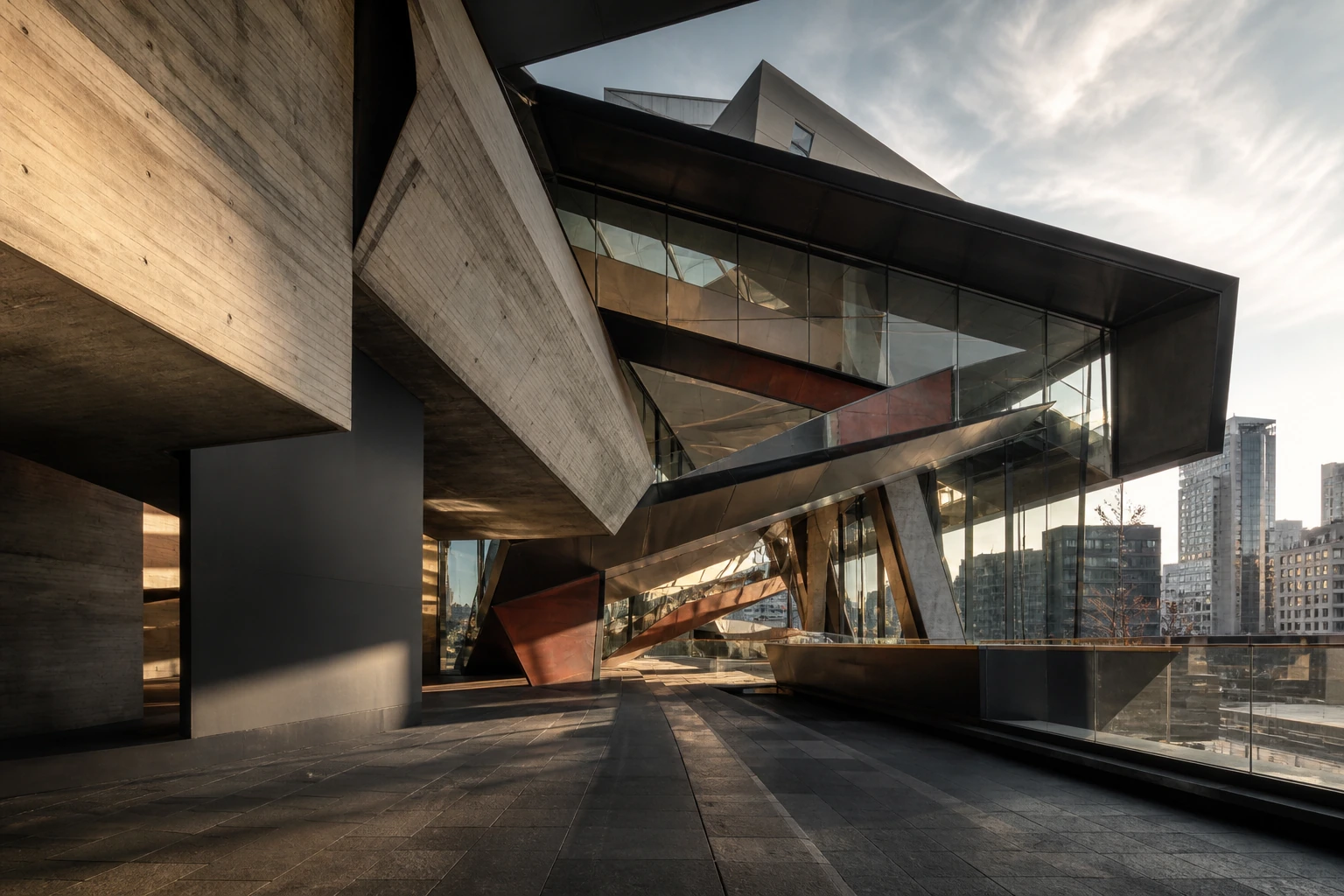
Form no longer promises calm. It shows cut, conflict, shifted grid and the moment when architecture, object or image stops pretending to be whole.
Editorial thesis
Deconstructivism matters not because buildings began to look broken. Its force lies in showing form as tension: a grid can shift, a wall can lose its calm, a structure can become a question rather than only an answer.
The visual language of the movement is built from fracture, overlap, cut, diagonal force, conflicting systems and a sense of instability. Yet it is not random chaos. A strong deconstructivist project depends on precise control of structure, movement, light, route and cultural memory. 13
Reader question
Why do some buildings and objects feel calmly assembled, while others seem caught in a moment of displacement - even though they are just as calculated, built and functional?
The answer lies between philosophy, the avant-garde, engineering and late twentieth-century visual culture. Deconstructivism does not simply destroy form; it makes visible a conflict that modernism often tried to hide: between order and event, construction and perception, programme and the viewer’s body.
Short answer
Deconstructivism is a late twentieth-century movement in architecture and design associated with fragmented form, shifted axes, disrupted symmetry, conflicts between skin and structure, complex routes and a feeling of controlled instability. The term became widely known after the 1988 MoMA exhibition Deconstructivist Architecture, organized by Philip Johnson and Mark Wigley. 12
This article reads the movement beyond architecture: through graphic design, photography, fashion, scenography, object design and digital form. Its central idea is simple: deconstructivism works when fracture becomes a way of reading the world, not a decorative effect.
1. After modernism: why stable form was no longer enough
By the end of the twentieth century, the modernist belief in universal clarity no longer felt sufficient. The city had become more complex, media faster, memory more painful and function itself less neutral. In that context the stable rectangle began to look less like the only rational answer and more like one mode of control among others.
Deconstructivism appears where order no longer cancels conflict. It does not abandon modernism completely: it inherits abstraction, technology and construction. But instead of calm logic it shows form at the moment of displacement.
2. The term: deconstruction is not simple destruction
Deconstruction is often misread as simple destruction. In architectural and design terms it is more accurate to speak of dismantling a system: the form remains, but its internal rules become visible and unstable. 3
The method is closer to exposing a seam than blowing up a wall. A project seems to show that behind any continuous surface there are forces, axes, compromises, cultural quotations and technical decisions.
3. Fracture, displacement and conflicting systems
The central visual mechanism is the conflict of systems. One grid collides with another, a diagonal cuts through straight order, a plane bends, and verticality loses its role as the primary support of perception.
The viewer reads not only the object but the tension between its parts. Fracture becomes language: it speaks of speed, anxiety, memory, conflict, the city and the impossibility of returning to innocent symmetry.
4. Avant-garde roots: constructivism, suprematism and fragment
Deconstructivism did not emerge from nowhere. It carries echoes of the Russian avant-garde, constructivism, suprematism, futurist dynamism and modernist experiments with the grid. Zaha Hadid’s early paintings show directly how a pictorial field can become architectural space. 45
The difference is that the early twentieth-century avant-garde often connected rupture with a utopian social project, while late twentieth-century deconstructivism presents rupture as a normal condition of culture after modernism’s grand promises.
5. MoMA 1988: the public naming moment
The MoMA exhibition Deconstructivist Architecture, held from June 23 to August 30, 1988, became the moment when different authors were read as one field. It included projects by Gehry, Hadid, Koolhaas, Libeskind, Eisenman, Tschumi and Coop Himmelb(l)au. 12
The exhibition did more than record an existing style. It created a powerful frame through which architectural culture began to read fragmentation, instability and formal conflict.
6. Philip Johnson and Mark Wigley: exhibition as a reading frame
Philip Johnson and Mark Wigley proposed reading these architects not as a group with a manifesto but as authors working with a related formal tension. This distinguishes deconstructivism from schools built around a single programme, pedagogy or political slogan. 12
It is therefore more useful to understand the movement as an optical and intellectual mode. It does not say that every building should be broken. It asks what happens when stable form begins to reveal its own internal contradiction.
7. Zaha Hadid: painting, trajectory and impossible perspective
Zaha Hadid turned perspective into a field of movement. Her early projects and paintings look as though architecture has not yet settled: planes fly, the city is layered, and the horizon no longer needs to remain calm.
The Pritzker Prize emphasizes her theoretical and practical role; in 2004 Hadid became the first woman to receive the prize. For deconstructivism, her key contribution is the translation of abstract composition into built spatial trajectory. 45
8. Frank Gehry: gesture, cladding and the liberated skin
Frank Gehry works with a different kind of instability. His forms often seem gestural, almost improvised, but they are supported by precise work with skin, material, models and engineering coordination.
In Gehry’s work a building can behave like unfolded paper, metallic skin or a fragment of movement frozen at urban scale. The point is not only the effect, but the way cladding begins to contest the conventional idea of the façade. 6
9. Peter Eisenman: grid, trace and intellectual cut
Peter Eisenman is linked to the intellectual side of deconstructivism: grid, trace, overlay, cut and the disruption of typological clarity. His projects often demand reading rather than immediate impression.
The Wexner Center for the Arts shows how architecture can work with absent history, shifted axes and a space that refuses to become an easy image. 11
10. Daniel Libeskind: memory line and architecture of trauma
For Daniel Libeskind, line becomes a carrier of memory. In the Jewish Museum Berlin, the zigzag, voids and intersecting axes are not abstract effects but ways of speaking about trauma, loss and the impossibility of a straight route. 78
Here deconstructivism is far from a game of form. Space becomes an emotional and historical instrument: it not only houses an exhibition but forces the body to pass through rupture.
11. Bernard Tschumi: event, route and Parc de la Villette
Bernard Tschumi proposed architecture as the combination of space, event and movement. Parc de la Villette in Paris matters not as a single form but as a system of points, lines and surfaces in which route matters more than a classical compositional axis. 10
This changes the visitor’s role. One does not simply look at the object; one activates it by moving through scenarios, crossings, pauses and accidental coincidences.
12. Rem Koolhaas / OMA: programme, collage and urban instability
Rem Koolhaas and OMA stand at the edge of deconstructivism and another logic: the analysis of programme, city and mass culture. What matters is not only formal fracture but the collision of functions, flows, scenarios and infrastructures. 12
For VANSMITHLAB this is especially useful: form here is not born from one aesthetic gesture but from pressure exerted by programme. The building becomes a montage of urban forces.
13. Coop Himmelb(l)au: the roof as structural explosion
Coop Himmelb(l)au treated architecture as an energetic rupture. Their projects often resemble a moment of explosion, addition or intervention within an existing structure. MoMA includes the practice within the field of deconstructivism, marking its role in the movement. 9
The roof is especially important in their work. It stops being a calm ending and becomes an event. The top of a building can become the most charged zone, where structure, air and city collide.
14. Materials: steel, glass, concrete and the charged edge
Materials in deconstructivism rarely remain neutral. Steel shows frame and resistance, glass breaks reflections, concrete holds mass, and metal can become a skin that feels both rigid and mobile.
The edge is crucial. In calm architecture it is often hidden; here it operates as a line of cut. Where materials meet, the project often speaks most loudly.
15. Light and shadow: making fracture legible
Fracture cannot be read without light. Diagonal, fold, slit and tilt become convincing only when shadow shows depth and reflection reveals the change of plane.
This is why deconstructivist form cannot be judged only by plan or elevation. It must be seen in motion and under changing light: graphic in the morning, theatrical at dusk, a luminous cut at night.
16. Fashion: outside seams, layers, dismantling and the body
In fashion, deconstructive logic appears through exposed seams, unfinished edges, layers, displaced closures, dismantled tailoring, broken symmetry and garments that reveal their own making.
The body does not simply wear the form; it enters into conflict with it. A garment can appear to be under construction, repair or collapse - and that is precisely what makes it contemporary.
17. Maison Margiela and deconstruction in fashion culture
Maison Margiela became one of the central examples of deconstruction in fashion culture: visible seams, reworked linings, Tabi, reuse of existing garments and attention to authorial anonymity created a different language of luxury. [source]
This matters for understanding the movement beyond architecture. Deconstruction can be spatial, but it can also be object-based: it dismantles clothing status, brand, authorship and the idea of a perfect surface.
18. Object design: showing how an object is assembled
In object design, a deconstructive object often shows its own assembly. A chair leg may seem displaced, a body cut, a surface layered from fragments.
A strong object still remains functional. Its task is not to destroy use completely, but to make the user feel that a familiar thing could have been assembled differently.
19. Graphics: broken grids and typography under tension
In graphic design, deconstructivism appears through broken grids, layered typography, interrupted reading, scale conflict and image fragments. It is not simply messy design, but a way to show that messages do not always arrive through a clean channel.
This language is powerful in posters, magazines, music graphics and cultural communication. It produces a feeling of noise, speed, urban layering and visual resistance.
20. Photography: angle, fragment and dramatized form
Photography of deconstructivism depends on angle. One view can turn a building into a neat composition; another can reveal it as a collision of planes, shadows and force lines.
The photographer should not flatten the form into a postcard. The task is to find tension, scale, edge, route and the body’s encounter with unstable space.
21. Critique: when fracture becomes styling
The main critique of the movement is the risk of turning intellectual fracture into surface effect. When a diagonal has no reason and a fragment is unrelated to programme, memory, route or structure, the project quickly becomes theatrical scenery.
The test is simple: if the broken gesture is removed, does the project lose its meaning? If not, it is styling. If yes, fracture is working as a structure of thought.
22. From deconstructivism to parametricism and digital skins
Digital tools changed the fate of deconstructivism. What once seemed almost impossible to calculate and fabricate became part of complex modelling, parametric coordination and digital manufacture.
But parametricism and deconstructivism are not identical. The first often seeks a continuous smooth system; the second prefers conflict, displacement and rupture. The transition shows how culture moved from the drama of the fragment to the logic of flow.
23. City and public space: navigation without a calm axis
Deconstructivism works strongly in the city because the city itself is made from incompatible systems: transport, memory, advertising, economy, height, voids and pedestrian routes.
A project can refuse to calm that complexity and instead make it readable. One main axis is replaced by a field of collisions in which the visitor chooses a path and continually reassembles the image of space.
24. Interior: the unstable room and controlled anxiety
In interiors, a deconstructive approach demands restraint. Too many tilts, ruptures and charged edges quickly exhaust the user. But one precise wall cut, shifted ceiling plane or tense stair can give a space strong character.
The logic works best where the interior must speak about transition: gallery, concept store, theatre, night space, exhibition or cultural centre. In quiet housing it should be used sparingly.
25. Retail and exhibition design: route as dramaturgy
In retail and exhibition design, deconstructivism is useful as a tool of dramaturgy. It can guide visitors through ruptures, unexpected perspectives, vitrine slits, tilted planes and zones where the object is not revealed immediately.
Yet a commercial space should not become a maze for the sake of effect. A strong project keeps the route legible even when it looks visually unstable.
26. How to photograph deconstructivism
Photographing deconstructivism means avoiding two extremes: overly flat documentation and excessive dramatization. The first kills tension; the second turns the project into fantasy detached from scale.
A useful strategy is a series: establishing view, movement along the façade, diagonal perspective, edge detail, human scale, night light and reflection. This reveals that the form is not merely strange but spatially active.
27. Strong project or “broken for the sake of broken”
A strong deconstructivist project has internal necessity. Its fracture is connected to route, programme, site history, structure, light or bodily experience.
A weak project uses the same language as a ready-made filter: random angles, decorative cracks, aggressive geometry and no reason. Visual noise alone does not create thought.
28. Deconstructivism in contemporary visual culture
Today deconstructivism has dissolved into mass visual culture. Its traces appear in sneakers, concert scenography, gaming environments, posters, music videos, pop-up spaces and AI visuals of fragmented cities.
This makes the movement especially relevant to art directors. Even when the source is unnamed, the language of rupture still works as a sign of complexity, speed, anxiety and technological future.
29. Limits: cost, maintenance, access and formal fatigue
The movement has real limits: expensive coordination, complex skins, unusual joints, difficult maintenance, demanding repair and the risk of user fatigue.
Deconstructivism is not universal. It is powerful as a cultural, institutional or dramaturgical statement, but it requires a precise reason for space to need instability.
30. How designers, photographers and art directors should read deconstructivism
A designer should read deconstructivism as a system: which grid has been disrupted, what causes the shift, where the body moves, how light behaves, what happens to material and why the form cannot remain calm.
A photographer must find tension rather than only a dramatic angle. An art director should not reduce the movement to broken geometry. The stronger story is about a world in which whole form no longer appears honest, and so the project shows its ruptures openly.