encyclopedia
Bias Cut
The technique of Madeleine Vionnet
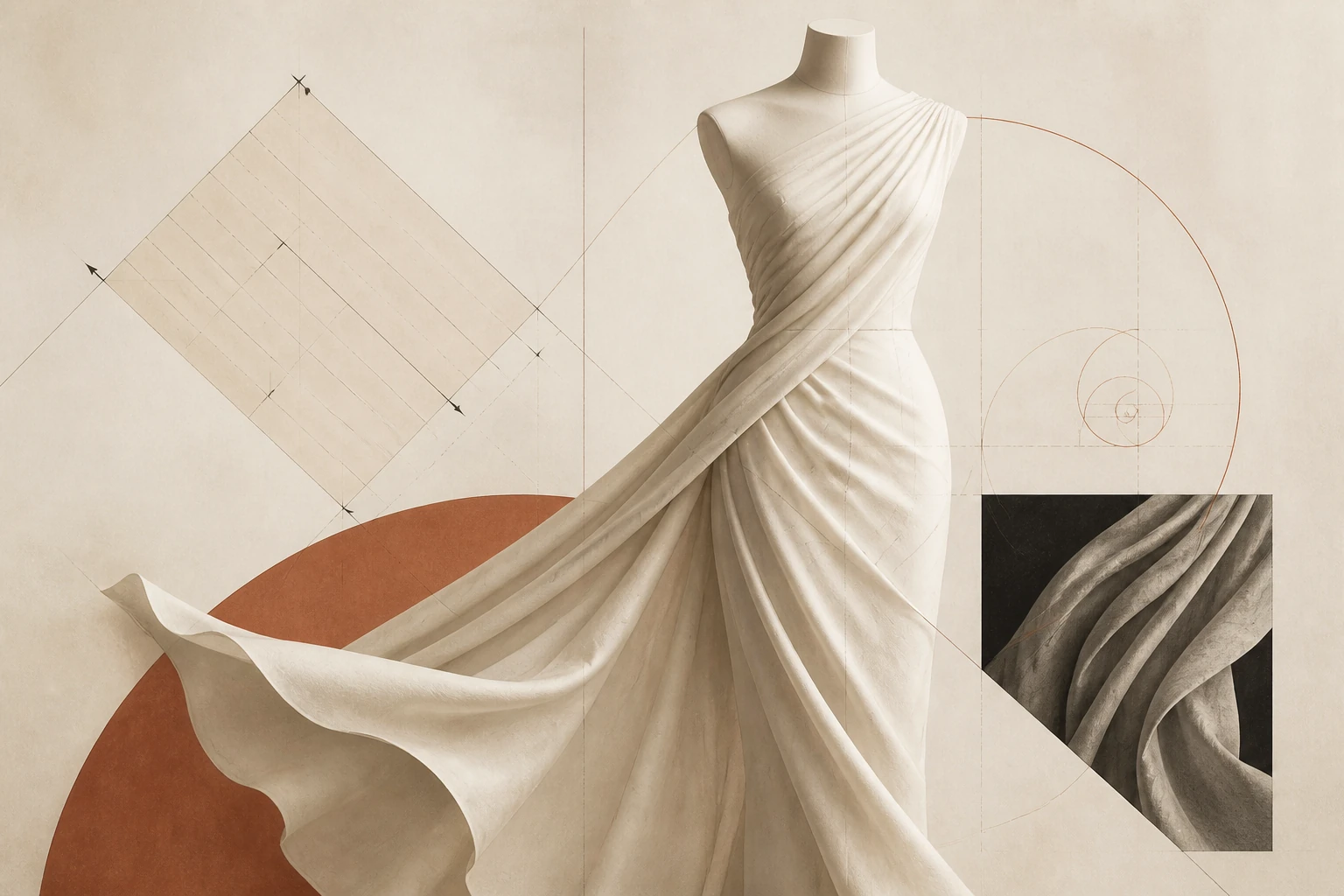
Bias turns textile structure into a mechanism of movement: form emerges not despite the material, but through its capacity to shift, fall, and follow the body.
Editorial thesis
Bias cutting is one of the rare cases in which changing pattern direction radically changes material behaviour. Madeleine Vionnet did not invent the bias cut, but transformed it into a modern construction system based on geometry, movement, and the response of cloth to the body.1
Reader question
Why does the same cloth behave so differently when its pattern pieces are turned roughly 45 degrees?
Short answer
On the bias, warp and weft can shift relative to one another more readily than on straight grain. Cloth becomes more compliant, follows curved form, and responds differently to gravity.
Vionnet used this property not as an isolated effect but as a construction system. The Met emphasises both her innovative use of bias and the mathematical precision of her garments.1
1. What bias cutting is
Bias cutting places garment pieces diagonally to the lengthwise and crosswise grain. Along this direction cloth gains mobility and can flow more readily around volume.
2. Lengthwise, crosswise, and bias
Lengthwise grain is usually the most stable, cross grain behaves differently, and true bias runs at roughly 45 degrees to both. The same cloth therefore acquires different mechanical behaviour.
3. Why cloth becomes more mobile
Under diagonal load, warp and weft can shift slightly relative to one another. Woven cloth does not become knit, but it gains a characteristic suppleness.
4. Bias is not an elastic fibre
The effect comes primarily from weave geometry rather than fibre elasticity itself. Bias behaviour therefore depends on density, yarn, and cloth structure.
5. Fluidity
Bias cutting lets cloth fall and redistribute around the body's curved surface. This fluidity became one of the defining visual codes of 1930s dress.
6. Madeleine Vionnet
The V&A describes Madeleine Vionnet as one of Europe's great couturiers and emphasises her pioneering role in the revolutionary bias-cut dress that changed women's fashion.1
7. She did not invent the bias
It is important to separate influence from myth. The Met explicitly notes that Vionnet is often incorrectly credited with inventing bias cutting: the technique existed earlier, but she radically expanded its constructive possibilities.1
8. Working in three dimensions
Vionnet did not begin with conventional flat sketching. The Met describes her working directly on a reduced-scale dress form that could be rotated and studied in the round.1
9. Cloth dictates form
The V&A notes that Vionnet experimented intensively with fabrics and often allowed the material to dictate the shape or effect of a garment.1
10. Geometry
Her garments appear fluid, yet their construction often rests on strict geometry: squares, rectangles, triangles, and circular elements.
11. Mathematical precision
The Met characterises Vionnet as a consummate technician known for mathematically precise construction and innovative use of the bias.1
12. Form without a rigid frame
Bias allows cloth to support silhouette through its own structure and weight. The Met has described the bias-cut dress as a form in which the textile's inherent structure helps shape the garment.1
13. The body instead of the corset
Vionnet's fluid construction stood in direct contrast to the heavily corseted silhouette of the early twentieth century and allowed clothing to follow the body.1
14. Fit without numerous darts
Bias mobility can create soft fit through redistribution of cloth. It does not eliminate seams or shaping, but it changes their role.
15. Movement
Bias cutting is most evident in movement rather than stillness. Cloth responds to walking, turning, and breathing, producing a continuously changing line.
16. Silk crepe
Silk crepe combines weight, a matte or restrained lustre, and pliability. The Met presents it as a characteristic material for Vionnet's sophisticated bias constructions.1
17. Chiffon
Chiffon cut on the bias gains especially lively movement but requires careful control of stretch. In a 1929–30 dress, The Met notes bias-cut chiffon and bias ruffles that retain their bounce.1
18. Satin
Satin amplifies construction through highlights: even slight tension or distortion becomes visible. Cutting, seams, and hanging therefore require precision.
19. Lamé and heavier cloths
Heavier materials intensify vertical fall and can turn bias into an almost sculptural surface, but they require reliable anchor points.
20. Stretch after cutting
A bias-cut piece can change length under its own weight. Professional construction therefore allows the material to rest and hang before final hemming.
21. Garment balance
If different areas stretch unevenly, hems and seams can shift. Balance is checked on the form or body after the cloth has stabilised.
22. Seam direction
A seam on the bias carries different forces from one on straight grain. It may ripple, stretch, or twist if construction ignores cloth behaviour.
23. Controlled seam allowances
Overly heavy seam allowances can disrupt fluidity. Finishing must stabilise the seam without turning it into a rigid line.
24. Bias and neckline
Bias edges stretch easily. Necklines and armholes require control before the material loses its intended length.
25. Bias and hem
The hem is especially sensitive to uneven drop. Its final line should be established only after the garment has stabilised.
26. Vionnet's minimalism
Vionnet often allowed construction to perform the decorative role. The Met notes that her technical solutions frequently created visual effect without added trimming.1
27. Construction as ornament
Pleats, knots, gathers, and seam direction can become visible results of textile engineering. Ornament emerges from the way form is built rather than being placed on top.
28. The 1930s
FIT links Vionnet's bias-draped soft crepes to a generation of designers who shaped the characteristic fluid silhouette of the 1930s.1
29. Influence on other designers
FIT names Alix Grès, Augustabernard, Louiseboulanger, Elizabeth Hawes, Valentina, Claire McCardell, Jo Copeland, and Adrian among designers working within her sphere of influence.1
30. Bias and Hollywood
Fluid bias worked exceptionally well on film: moving cloth registered clearly on camera, while lustrous surfaces amplified studio light.
31. Bias and the modern evening dress
The modern slip dress often uses the same physics: minimal structural elements, precise grain direction, and a silhouette dependent on the body.
32. Why it is difficult to copy
Visual simplicity is deceptive. An error in cutting angle, balance, seam handling, or cloth properties can completely alter fit.
33. Toiling
A toile helps test geometry, but inexpensive cloth does not always mimic final silk. Matching weight is especially important in bias construction.
34. Layout
Bias-cut pieces occupy cloth differently from conventional cutting and may require more yardage. The direction of every piece must be part of the design.
35. Paired pieces
Mirrored pieces require precise layout so their mechanical behaviour matches. Otherwise one side may stretch differently from the other.
36. Print and pattern
Bias rotates surface pattern relative to the body. Stripes become diagonals, checks become diamond systems, and large motifs shift composition.
37. Light
On fluid cloth, light reveals not only surface but direction of tension. A highlight can show where material is stretched and where it falls freely.
38. How to photograph bias cut
The technique reads best through a combination of full silhouette and movement. One soft side source can reveal long diagonals without destroying mid-tones.
39. Model pose
An overly static symmetrical pose can hide bias mechanics. A slight weight shift or torso turn reveals how cloth redistributes.
40. Macro
Macro is useful for seams, yarn direction, and surface, but it cannot explain the essential relationship between cloth and body. It should be paired with a wider view.
41. What a designer should analyse
Check grain direction, cutting angle, weight, density, hanging behaviour, edge stability, seams, and stabilisation time before hemming.
42. What a photographer should analyse
Look for diagonal tension lines, hem movement, light reflection, and the difference between cloth at rest and in motion.
43. What an art director should analyse
Bias cut already creates a strong visual language between body and cloth. Complex backgrounds or excessive styling can easily overwhelm the subtlety of construction.
44. Vionnet's central lesson
Her legacy is not merely diagonal pattern placement. The central lesson is to design with the physics of material rather than forcing cloth to obey a predetermined drawing.
45. Conclusion
Bias cutting turns the internal structure of cloth into a tool for shaping form. Madeleine Vionnet developed this logic into a system in which geometry, gravity, movement, and body become equal parts of construction.