encyclopedia
CAD — From Drawing Board to Digital Model
Drawing became editable geometry and the project became a system of connected data.
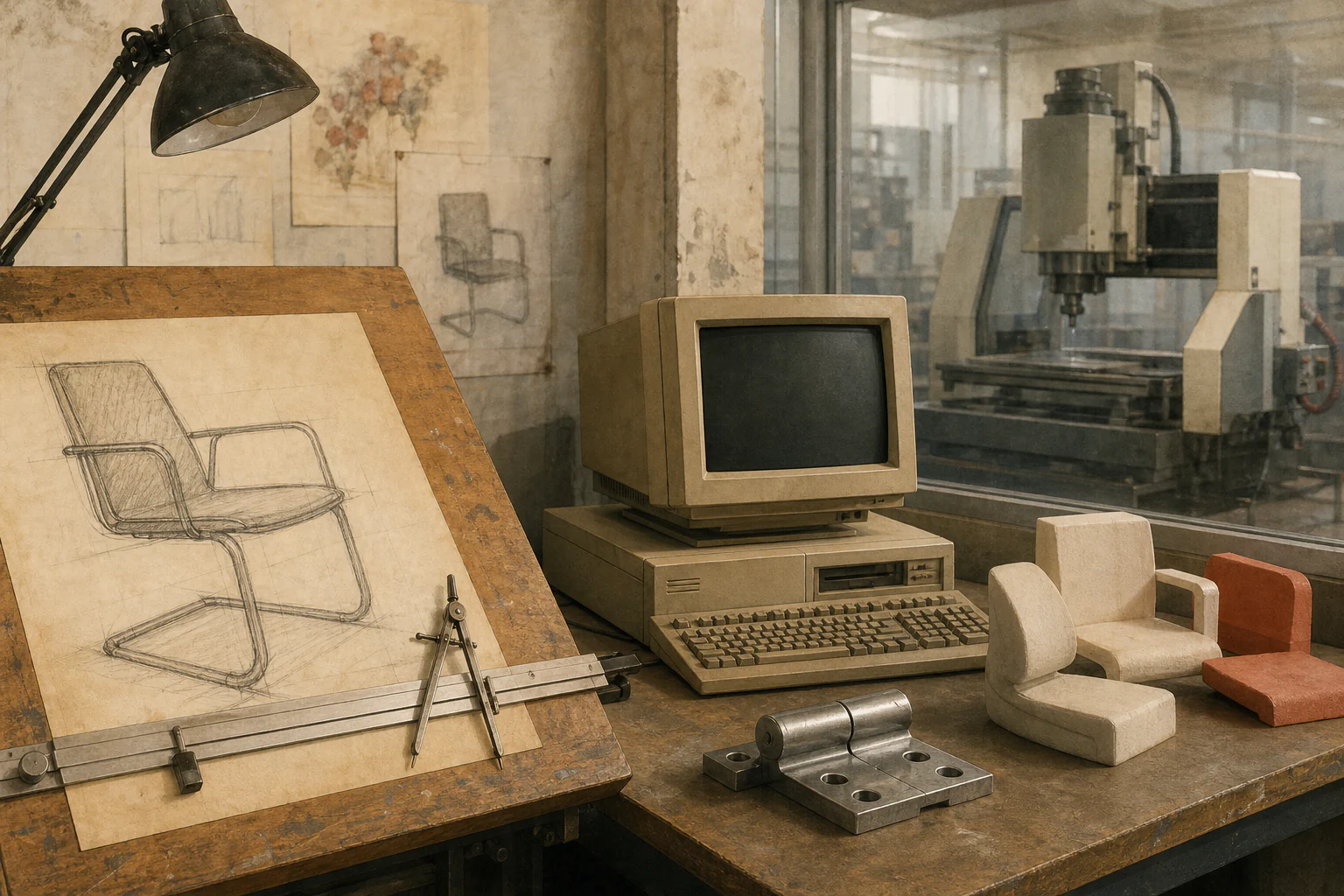
CAD — From Drawing Board to Digital Model matters to VANSMITHLAB as a node connecting tools, production, material and image-making. Drawing became editable geometry and the project became a system of connected data.
Editorial thesis
CAD — From Drawing Board to Digital Model matters to VANSMITHLAB as a node connecting tools, production, material and image-making. Drawing became editable geometry and the project became a system of connected data.
Reader question
What exactly did this technology change in the structure of design and production?
Short answer
Drawing became editable geometry and the project became a system of connected data. Today CAD is connected to BIM, parametric modelling, cloud collaboration, CAM and computational design; the model matters as a carrier of decisions, not merely as a digital drawing.
1. Definition and boundaries
Drawing became editable geometry and the project became a system of connected data. The subject is treated as a system connecting data, tools, people and outcomes rather than as the name of one application or machine.
2. Origins and prehistory
Interactive graphics of the 1960s showed that geometry could be manipulated on screen. Ivan Sutherland’s 1963 MIT Sketchpad became a key prototype; AutoCAD in 1982 symbolised the move of CAD to personal computers.
3. Why the subject emerged when it did
The technology became possible when computation, interfaces, storage and professional demand converged in one working environment. Interactive graphics of the 1960s showed that geometry could be manipulated on screen. Ivan Sutherland’s 1963 MIT Sketchpad became a key prototype; AutoCAD in 1982 symbolised the move of CAD to personal computers.
4. System and components
CAD stores coordinates, curves, surfaces, solids, dimensions, dependencies and parameters. Changes can propagate through views and downstream data for specifications, CAM and manufacture.
5. Operating or production principle
CAD stores coordinates, curves, surfaces, solids, dimensions, dependencies and parameters. Changes can propagate through views and downstream data for specifications, CAM and manufacture. It is crucial to distinguish digital description from physical or visual result: a chain of interpretation and transformation always lies between them.
6. Key technical and cultural turn
The key turn is the shift from experimental method to reproducible professional infrastructure. Interactive graphics of the 1960s showed that geometry could be manipulated on screen. Ivan Sutherland’s 1963 MIT Sketchpad became a key prototype; AutoCAD in 1982 symbolised the move of CAD to personal computers.
7. First anchor example
Sketchpad — interactive geometry and linked instances. This example matters as a demonstration of the basic principle, not only as a historical milestone.
8. Second anchor example
DAC-1 — an early link between digital design and automotive industry. It shows the technology becoming part of a real production scenario.
9. Third anchor example
AutoCAD — the desktop model of digital drafting. The third example shows a mature system in which file, interface, equipment and outcome are inseparable.
10. Form and geometry
Form depends on how the technology represents geometry, relationships and constraints. CAD stores coordinates, curves, surfaces, solids, dimensions, dependencies and parameters. Changes can propagate through views and downstream data for specifications, CAM and manufacture.
11. Surface, light and colour
Surface, light and colour expose the boundary between computable description and perceived result. Designers must know which properties belong to data and which emerge only in material, print, screen or render.
12. Tactility, sound and movement
Tactility, sound and movement become visible when a technological scheme enters physical space or time-based imagery. CAD becomes most productive when one model feeds drawings, CNC, laser cutting, additive manufacturing and coordination.
13. Production system
CAD becomes most productive when one model feeds drawings, CNC, laser cutting, additive manufacturing and coordination.
14. Tools and infrastructure
Infrastructure includes software, formats, equipment, storage, naming, versions and quality control. CAD becomes most productive when one model feeds drawings, CNC, laser cutting, additive manufacturing and coordination.
15. Mass adoption
Mass adoption begins when a method no longer requires a unique laboratory and enters education, standard file exchange and accessible professional equipment. Today CAD is connected to BIM, parametric modelling, cloud collaboration, CAM and computational design; the model matters as a carrier of decisions, not merely as a digital drawing.
16. Professional practice
Professional practice requires reproducibility: another participant should understand source data, version, scale, tolerances and criteria for the result. CAD becomes most productive when one model feeds drawings, CNC, laser cutting, additive manufacturing and coordination.
17. Connection to architecture
In architecture the technology connects design geometry, existing space, visualisation, coordination and fabrication. Its importance is clearest when one digital model crosses several disciplines.
18. Connection to product design
In product design, the technology shows that form cannot be separated from how it is described and manufactured. CAD stores coordinates, curves, surfaces, solids, dimensions, dependencies and parameters. Changes can propagate through views and downstream data for specifications, CAM and manufacture.
19. Connection to fashion
In fashion the technology appears in form and surface development, prototyping, accessories, show scenography and image production. Its real productive role should be separated from decorative displays of “technology.”
20. Connection to image-making
For image-making, the subject changes what counts as source and final result: a frame, model or page becomes the outcome of a chain of decisions. Drawing became editable geometry and the project became a system of connected data.
21. Connection to technology
The subject bridges neighbouring VANSMITHLAB technologies: data pass between systems and the constraints of one stage become inputs for another. Today CAD is connected to BIM, parametric modelling, cloud collaboration, CAM and computational design; the model matters as a carrier of decisions, not merely as a digital drawing.
22. Connection to materials
Material remains the test of digital abstraction. Thickness, reflection, grain, strength, viscosity, thermal behaviour or optics can alter the outcome even when a file is formally correct.
23. Institutions and canon
The canon is formed by inventors, companies, universities, museums, archives, standards and professional communities. Its history should therefore be read across objects, software, patents, documentation and practice.
24. Market and commercial logic
Commercial logic depends on iteration speed, repeatability, scale, equipment cost and the price of moving from design to result. Digital simplicity does not necessarily mean cheap production.
25. Criticism and limitations
Digital precision does not remove physical tolerances, material, tooling or assembly; errors in units, coordinates or versions can propagate downstream.
26. Errors and myths
A common mistake is to treat a spectacular outcome as proof of methodological quality. Digital precision does not remove physical tolerances, material, tooling or assembly; errors in units, coordinates or versions can propagate downstream.
27. Sustainability, longevity and maintenance
Sustainability must be assessed across the chain: energy, materials, equipment life, repairability, number of trials, logistics and the reusability of data. Digitalisation alone does not make a process environmentally benign.
28. Current state
Today CAD is connected to BIM, parametric modelling, cloud collaboration, CAM and computational design; the model matters as a carrier of decisions, not merely as a digital drawing.
29. What it changed in the discipline
The subject changed the discipline by redistributing decisions among people, data, software, machines and materials. Drawing became editable geometry and the project became a system of connected data.
30. How to read the subject today
Today it is more useful to read the subject as a change in authorship and production structure than as a battle between old and new. Today CAD is connected to BIM, parametric modelling, cloud collaboration, CAM and computational design; the model matters as a carrier of decisions, not merely as a digital drawing. Digital precision does not remove physical tolerances, material, tooling or assembly; errors in units, coordinates or versions can propagate downstream.