encyclopedia
Charred Wood
Yakisugi (Shou Sugi Ban), protection and black texture
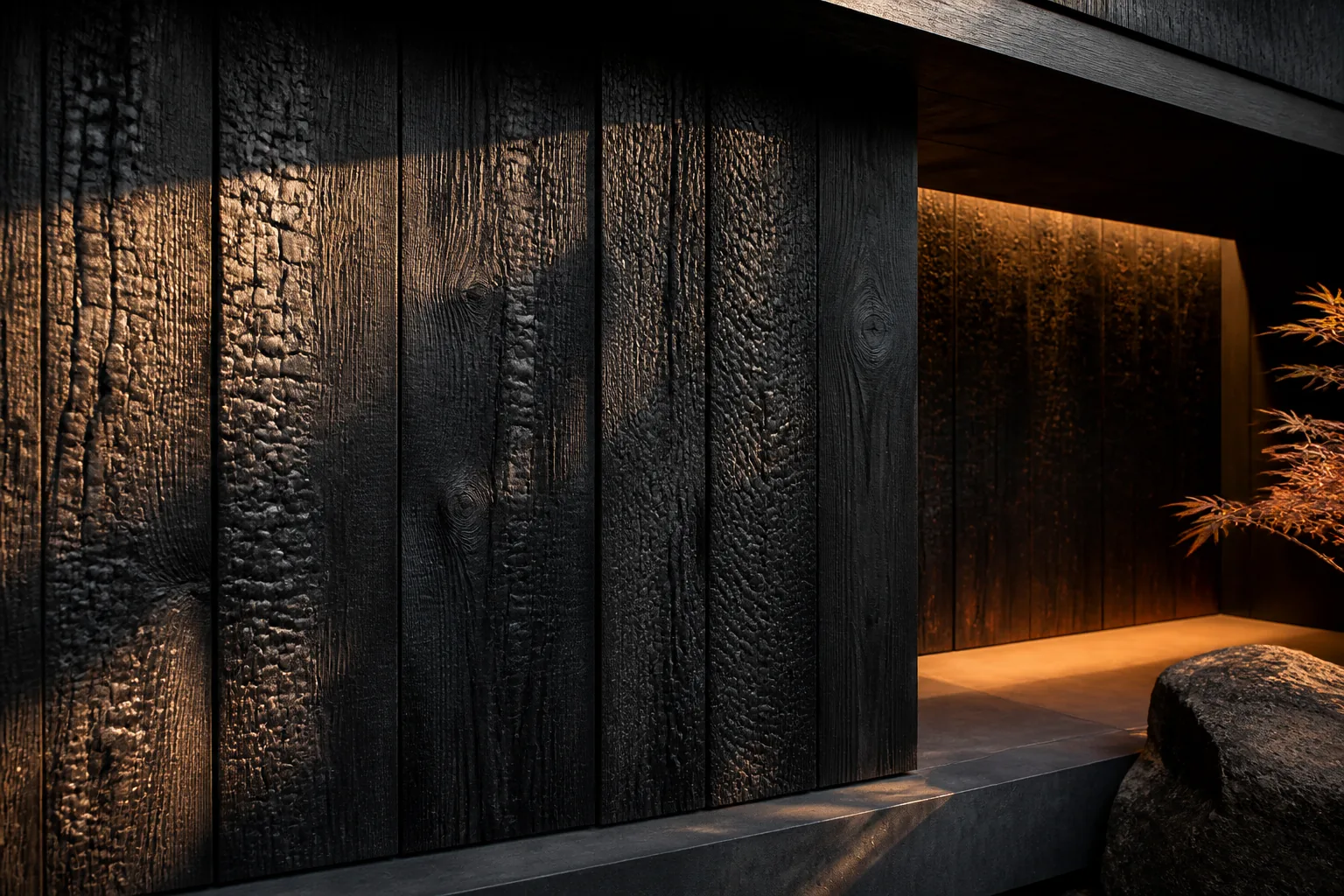
Fire does not apply a new colour to timber - it reveals the hidden geography of the grain. The black surface becomes a protective shell, evidence of process and a material that continues to change after installation.
Editorial thesis
Charred wood is easily reduced to a decorative formula: a black wall, a Japanese phrase and a promise of permanent protection. The real material is more interesting. Species, moisture, burn method, char depth, cleaning, coating, assembly and climate create its character.
Yakisugi should be read as a process rather than a colour. Fire strengthens the visual grain while making the surface more fragile; carbon may repel a droplet yet cannot replace a façade system; traditional knowledge matters, but laboratory evidence does not support every marketing claim.
Reader question
Why does one burnt board resemble deep black ceramic, another reveal golden grain, a third shed carbon when touched, while a fourth becomes silver-grey after several years?
The answer lies between fire and use: species controls the response of the grain, the burn creates char depth, brushing changes relief, coating binds particles, and sun, rain, snow and touch continue to edit the surface.
Short answer
Yakisugi is a traditional Japanese method of burning sugi siding. In the classic process three boards are tied into a triangular chimney, ignited from within, opened and extinguished; the surface may remain deeply scaled or be cleaned and brushed. 12
The process can alter wetting, moisture movement, texture and surface heating, but it does not automatically make every timber fire-resistant, decay-proof or insect-proof. Actual performance depends on species, char depth, coating and construction detail. 17
1. Yakisugi and Shou Sugi Ban: naming the technique accurately
In Japan the technique is called yakisugi: yaki means burning and sugi refers to Japanese cryptomeria, commonly called Japanese cedar. The expression Shou Sugi Ban, widespread in Western design culture, emerged from an inaccurate reading and is barely used in Japan outside international marketing. 1
The distinction is more than linguistic correctness. It returns the method to a particular species, region and purpose. Passing a blowtorch over an oak tabletop or pine slat produces charred wood, but not necessarily traditional yakisugi.
2. Sugi: why the wood species matters
Sugi is Cryptomeria japonica, a lightweight softwood with generally straight grain and clearly differentiated earlywood and latewood. It is often translated as Japanese cedar although it is not a true cedar botanically. The traditional process developed around the way this particular timber responds to fire. 12
Species controls the rate of charring, crack depth, adhesion of the carbon layer and the ability of the surface to survive transport and installation. Many timbers can be made black; they do not acquire identical physical behaviour.
3. Western Japan: a practical technique before it became an aesthetic
Before modern preservatives, yakisugi served as practical exterior cladding in western Japan. Along coastal streets the burnt boards worked against salt, rain, wind and dense timber construction. Japan’s National Parks still describes the façades of Takeno as a defining element of the local townscape. 1
Today a black board is frequently read as minimalism or luxury, but historically it was first a sensible way to extend the service of exterior siding. The aesthetic emerged through repeated use of a practical solution rather than from a pre-existing moodboard.
4. The triangular chimney: the traditional three-board burn
In the traditional method three boards are bound into a tall triangular channel. Fire is lit at the bottom and the draught rapidly pulls the flame along the full length. Experimental studies reproduce this chimney effect and demonstrate the intense temperatures and airflow generated inside a simple wooden tube. 2
The method looks almost primitive yet depends on precise judgement. Board moisture, channel width, wind and grain orientation alter the result. One craftsperson creates a dense scale; another, using the same batch, produces a thinner and more fragile char.
5. What happens to wood in fire
As wood heats it first loses moisture, then its components decompose and release volatile compounds. A carbon-rich layer forms at the surface while a zone of thermally altered wood remains underneath. This is not paint: the colour is created by changing the wood itself.
Fire draws and destroys at the same time. It emphasises growth rings, creates networks of cracks and removes surface mass, but excessive burning turns a powerful shell into weak powder. Texture appears at the boundary between control and material loss. 2
6. Char-layer thickness: depth rather than a decorative scorch
A quick pass with a torch produces a dark tone but not the deep carbon shell associated with the traditional process. In experiments using the triangular method on spruce and fir, average char-layer thickness reached approximately 2.5-4.5 mm, depending on species and treatment. 2
Depth changes both durability and image. A light burn leaves visible grain and can be brushed. A thick layer produces large reflective scales that feel almost mineral and require more careful handling.
7. Stopping combustion: water, air and the moment of control
When the desired depth is reached, the boards are separated and extinguished with water. This is an abrupt transition: heat remains inside the surface, and a late response can deepen cracks or burn through thin areas. 12
After quenching, the material must dry and stabilise. A black façade begins not with the dramatic image of fire but with the discipline that follows it: sorting, removing weak fragments, checking geometry and preparing the boards for finishing.
8. Charred, cleaned and brushed surfaces
A deeply charred surface may be retained with its characteristic alligator-like scale. Removing loose carbon with a brush reveals the relief of growth rings; more aggressive brushing creates a graphic surface but removes part of the carbon shell.
These are not one product offered in several colours. They differ in touch, dusting, rain response and repair. A specification should define depth of burn, degree of cleaning and acceptable particle loss, not only a black shade.
9. Oil, wax and transparent coatings
Oil can deepen black, bind dust and make the material calmer to touch. Wax provides local protection indoors. Clear lacquer or resin stabilises fragile scale but turns an open carbon surface into a composite of wood and film.
The coating changes the meaning of the material. Unsealed yakisugi ages and responds to weather; beneath glossy resin, burning becomes a preserved image of fire. Both approaches can be valid, but they should not be presented as the same thing.
10. Three black languages: charcoal scale, graphic grain and smoky grey
The first visual family is deep charcoal scale, an almost black mirror made of small cracks. The second is brushed timber, with dark recesses strengthening the grain. The third is washed or weathered material moving towards graphite, silver and brown.
The architectural choice matters. A monolithic volume can carry large scale; furniture needs a surface that does not shed under contact; an interior wall may work at the threshold between a black field and legible timber.
11. Water and surface hydrophobicity
Charring can increase the water contact angle and make the surface less wettable. Research records reduced sorption and altered moisture movement, but performance depends on method, species, cracking and coating. 16
Surface hydrophobicity does not create a waterproof wall. Water still enters through ends, fixings, joints and damage. Yakisugi may assist the façade, but it does not replace overhangs, drips, a ventilation cavity and competent detailing.
12. Moisture, warping and board movement
Wood remains hygroscopic: it exchanges moisture with air and changes dimension across the grain. The USDA Wood Handbook stresses that many performance problems in wood arise from moisture and changes in moisture content. 1
A charred face and untreated reverse may respond asymmetrically. Initial moisture, board orientation, thickness, fixing spacing and the ability to dry from both sides remain essential. Black colour does not cancel wood physics.
13. Decay and fungi: where tradition meets laboratory evidence
Tradition associates yakisugi with decay resistance, yet laboratory evidence is more complicated than the marketing phrase. A USDA study of several commercial species found no systematic improvement in resistance to fungal decay; individual combinations produced different and sometimes opposite outcomes. 1
Other surface studies show that char depth and test method matter. The responsible conclusion is that burning changes moisture transport and the food available at the surface, but it cannot be treated as a universal preservative for every species and assembly. 1
14. Insects and termites: caution with promises
Char is frequently described as a barrier to insects, but the claim cannot be transferred automatically to every pest. USDA research found that surface charring did not prevent subterranean termites from locating and infesting wood. 7
In a building, insect risk depends on species, moisture, ground contact, ventilation and local biology. The most dangerous mistake is to read a black surface as proof that nothing can live inside the board.
15. Fire after fire: why yakisugi does not mean non-combustible
A char layer can slow the heating of the wood beneath it, but yakisugi does not make timber non-combustible. Tests on commercial products did not show systematic improvement in flammability; the effect varied between species and treatments. 1
Later tests on fir with a thick one-sided char layer recorded improvements in particular small-flame measures, again demonstrating the importance of thickness and method. 1 A project must still comply with fire regulations rather than rely on the legend of wood that has “already survived fire”.
16. Weather, ultraviolet light and the slow disappearance of black
Under sun, rain and frost, the carbon surface gradually changes. Artificial weathering records mass loss, colour shift and weakening of the outer layer; coatings may slow the process but do not stop it permanently. 1
Ageing is not necessarily a defect. Black may open into brown, graphite or silver, while raised areas become lighter than cracks. The real question is whether this transition is part of the concept and whether it occurs evenly across façade orientations.
17. Other species: when the product is no longer traditional yakisugi
The contemporary market chars larch, spruce, fir, pine, oak and thermally modified timber. This expands the palette and local availability but changes the historical and technical basis of the process.
Such products are more accurately described as charred timber, with species and process named. Yakisugi is appropriate when sugi and its tradition are involved; industrially burnt pine is a different material system even when the appearance is similar.
18. Growth rings, cracks and the pattern of charring
Fire amplifies the internal geography of a board. Dense latewood and softer earlywood char differently, while the direction of cut affects relief and stability. Cracks form a network related to the directional properties of timber and thermal stress. 2
A hand-sized sample therefore says little about a façade. Knots, density and moisture change along a long board, and no crack pattern repeats exactly. A series must be designed as controlled variation rather than a printed pattern.
19. Façade system: ventilation gap, fixings and edges
Exterior siding succeeds only as part of a façade system. A drained and ventilated cavity is needed behind the board; ends must dry; fixings must accommodate wood movement and the local corrosion environment.
The carbon layer is especially vulnerable around screws, cuts and exposed edges. Predrilling, concealed fixing or carefully expressed fasteners should be selected after testing the actual product. An ideal black plane should not be designed first and then randomly punctured with bright metal.
20. Interior use: touching a surface that resembles charcoal
Indoors, charred wood creates a physical contradiction: the surface invites close inspection but not always touch. Deep scale resembles charcoal and may release particles; brushed and oiled timber is more welcoming to the hand.
The material should therefore be distributed by distance. A wall behind a bed may accept a fragile texture; a door pull, table or bench requires stabilisation. Touch is not a side effect but part of the functional programme.
21. Odour, dust and indoor safety
Freshly burned timber carries a pronounced smoke odour and loosely bound carbon can dust. Before interior installation, boards should be fully dried, cleaned and assessed in an enclosed room, especially near textiles and pale surfaces.
A clear coating binds particles but must be checked for emissions, compatibility and fire performance. Indoors, the romance of the bonfire must stop where air quality, skin, clothing and routine cleaning begin.
22. Light: a black surface that is not always matte
Black absorbs much of the incident light, yet charcoal scale can produce sharp silver highlights. Under grazing illumination the surface becomes almost metallic; under frontal light it collapses into a flat dark field.
Depth is read through the difference between ridges and cracks. A narrow source emphasises relief, a large soft source explains overall tone, and backlight separates the jagged edge from the background. “Matte black” never has a single meaning here.
23. How to photograph charred wood
Yakisugi should be photographed as topography rather than colour. A frontal frame explains module and joint; side light reveals scale; macro photography shows the transition from timber to carbon; the wide view explains the scale of the dark mass in the landscape.
Exposure needs restraint: the camera easily turns texture into blocked shadow, while automatic HDR makes the char grey and plastic. The image should preserve a true black while retaining fine information in cracks and highlights.
24. Maintenance, repair and acceptable ageing
Maintenance depends on surface type. Intact charcoal scale should not be scrubbed with a hard brush; brushed boards can be locally refreshed with oil; deep chips may require replacing an element or accepting a repair that remains visible.
The central question is what kind of ageing is acceptable. If a client expects uniform black for ten years, a more controlled finish and maintenance programme are required. If patina is valued, the specification should permit difference rather than turning natural evolution into an endless defect list.
25. Cold, snow and the climate of Almaty
Almaty combines intense sunlight, dry periods, frost, snow and sharp seasonal shifts. A south façade will lose colour faster and experience greater heat; a north façade may retain moisture after snow; lower zones receive mechanical wear from ice and cleaning.
Local use requires full-size outdoor samples on different orientations, testing of fixings and careful plinth details. Deep charcoal scale near a path can be damaged by snow and contact; above hand level it is likely to retain its character for longer.
26. Takeno: yakisugi as the fabric of a coastal town
In Takeno on the Hyogo coast, yakisugi is not a single design gesture but a repeated street material. Japan’s tourism authority describes the burnt cedar façades as protection from wind, salt, rain and moisture and as part of the historic identity of the fishing town. 1
Repetition creates the power: dozens of differently aged boards form a shared dark ground for signs, doors and narrow lanes. The material becomes urban fabric rather than an accent wall.
27. Terunobu Fujimori’s Coal House: craft as a collective event
At Terunobu Fujimori’s Coal House, the outer walls are clad in yaki-sugi and a small tea room projects from the second floor, reached by a cypress ladder. The project joins a cave-like interior to a crafted and deliberately imperfect shell. 1
For Fujimori, burning is also a process of participation: architects, clients and helpers may prepare the boards together. Unevenness records collective work. Yakisugi is set against the anonymous industrial panel; the surface remembers who held the fire.
28. Denpaku The Beachfront MIJORA: tradition in contemporary hospitality
Denpaku The Beachfront MIJORA on Amami uses yakisugi within contemporary hospitality architecture, linking minimal volumes to local building traditions. JNTO identifies the charred timber as an element that connects modern simplicity with island culture. 1
Here the material is not a quotation of an old house. The black shell gathers reflections of tropical vegetation and sea, strengthens the low silhouette and allows the new building to appear as though it already belongs to the place.
29. Maarten Baas Smoke: burnt furniture, but not yakisugi
In Maarten Baas’s Smoke series, furniture is literally burned and then preserved with clear epoxy resin. The designer describes charcoaled design icons being made functional again; Moooi produces objects from burnt wood finished with epoxy. 1
The distinction matters. Smoke uses fire as destruction, authorship and conservation of form. Yakisugi is historically a surface treatment for siding. Visual kinship does not make the methods identical: one extends a building skin, the other turns evidence of burning into a collectible object.
30. How designers, photographers and art directors should read charred wood
A designer should ask not whether the project needs black wood, but which species, char depth, brushing level, coating, touch distance, assembly and ageing scenario are required. A full-size mock-up should survive rain, sun and installation tools.
A photographer must show where colour ends and relief begins. An art director should avoid reducing yakisugi to an automatic symbol of Japan, wabi-sabi or expensive minimalism. The stronger story is more direct: an ordinary board passes through fire and becomes a surface in which time is visible before use begins.