encyclopedia
Couture Embroidery
The Lunéville hook and the French ateliers
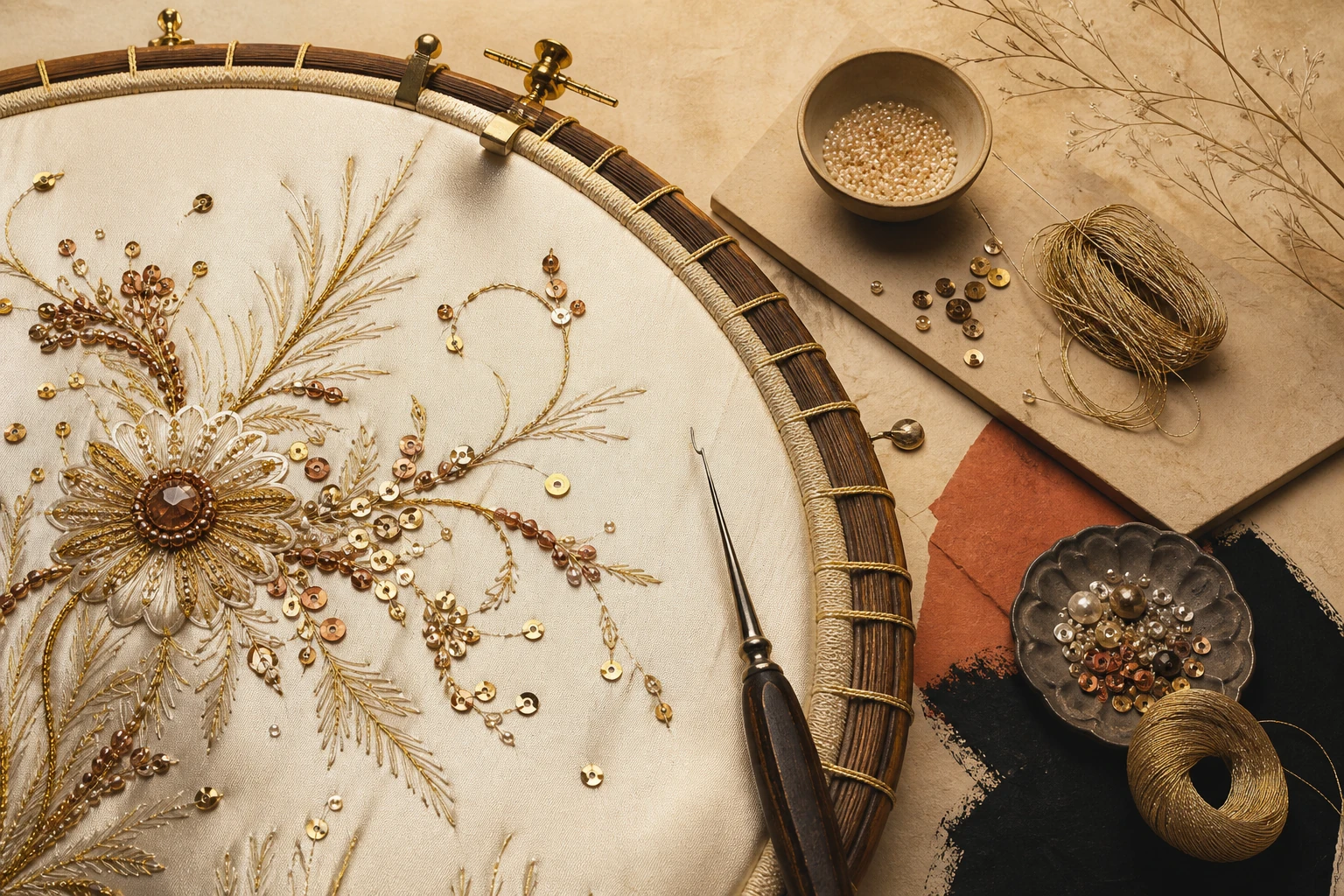
In couture, embroidery does not decorate a finished surface: it designs light, weight, relief, and movement together with the garment's construction.
Editorial thesis
Couture embroidery is not a decorative layer added to a finished garment but a system in which image, weight, light, tactility, and construction are designed together. The Lunéville hook accelerated the attachment of beads and sequins with chain stitch, yet quality still depends on drawing, sampling, fabric tension, material distribution, and collective atelier labour.1
Reader question
Why can two dresses carrying the same number of sequins differ radically in quality, movement, light, and price?
Short answer
In couture embroidery, what matters is not only the material but how it is fixed, stitch direction, density, weight, the reverse, and the relationship to garment construction. Lunéville uses fabric stretched on a frame and a small hook working from the reverse to create chain stitch and secure beads, pearls, and sequins.11
French maisons d'art divide work among drawing, sampling, fabric preparation, embroidery, mounting, and quality control. Lesage, Atelier Montex, and other specialist houses serve haute couture and ready-to-wear while preserving hand techniques and introducing new materials and processes.16
1. Couture embroidery as a system
Couture embroidery is designed with the silhouette. Material, density, and motif direction must account for bodily movement, seams, and garment weight.
2. The history of Lunéville
The Met links the development of Lunéville embroidery, also called tambour beading, to Louis Ferry-Bonnechaux's invention in the mid-1860s.1
3. The frame
Fabric is stretched on a wooden frame so that surface tension remains stable. Weak tension distorts chain stitch; excessive tension can deform the ground.
4. Working from the reverse
The hook usually works from the reverse while beads and sequins are fed on the face. The embroiderer must sense both sides at once.1
5. Chain stitch
The continuous chain is the basis of the technique. It secures elements quickly but demands even rhythm and constant thread control.
6. The Lunéville hook
A fine hook passes through the cloth, catches the working thread, and forms a loop. Rotation determines whether the chain holds or unravels.
7. Beads on the thread
Beads are pre-strung on the working thread and fed one at a time. Speed depends on coordination between the hand below the frame and the hand above.
8. Sequins
Sequins may lie flat, overlap, stand vertically, or hang freely. Direction determines reflection and movement.
9. Pearls and large elements
Heavy elements often need additional needle securing. Lunéville is efficient, but it does not replace every type of hand embroidery.
10. Needle and hook
Needle embroidery and Lunéville complement one another. le19M distinguishes needle, crochet, and hand-guided machine embroidery.1
11. Cornely
Atelier Montex also specialises in Cornely, a hand-guided embroidery machine capable of working several threads and producing dimensional textures.1
12. The design
Before embroidery, a dessin translates the designer's idea into an executable motif, accounting for scale, density, and material direction.
13. The sampler
le19M states that a sampler first creates a small prototype interpreting the client's artistic instructions.1
14. Pouncing
An outline may be transferred through pricked tracing paper and powder passing through the holes, a process shown by CHANEL in Atelier Montex.6
15. The ground fabric
Organza, tulle, silk, crepe, wool, leather, and synthetics respond differently to puncture, weight, and tension.
16. Transparent organza
Organza exposes the internal logic of stitches and can make decoration appear suspended, but reverse-side errors become highly visible.
17. Tulle
Tulle visually dissolves the ground but its open cells demand precise placement of every puncture.
18. Dense cloth
Wool, leather, and dense jacquard can carry heavy decoration but resist the hook and increase total weight.
19. Thread
Cotton, silk, polyester, metallic thread, and monofilament differ in strength, visibility, and response to light.
20. Materials beyond tradition
Contemporary couture embroidery uses plastic, resin, metal, wood, film, and found matter. The Met notes that new synthetics expanded surface embellishment.1
21. Motif density
High density can turn cloth into an almost rigid surface. Sparse embroidery retains movement and allows the ground to participate.
22. Weight
Every bead adds mass. Weight must be distributed or the garment stretches, loses balance, and loads the shoulders.
23. Light
Sequins reflect directionally, beads fragment light, pearls produce a soft glow, and metallic thread creates linear highlights.
24. Colour
Colour is formed by material, reflection, and shadow. The same sequin can read differently on flat and curved areas.
25. Relief
Padding, cords, dimensional pieces, and layered application create raised embroidery, changing both light and fabric mechanics.
26. Direction
Identical sequins laid in different directions create different light fields. Direction can model bodily volume.
27. Gradient
Gradients can shift colour, size, density, and material—not merely replace one hue with another.
28. Negative space
Empty areas are as important as filled ones. They preserve movement and create pauses inside complex surfaces.
29. Seam and motif
A motif must intentionally cross a seam or stop before it. Accidental interruption destroys the image.
30. Embroidery on flat pieces
Pieces are often embroidered before final assembly while flat enough to stretch on a frame.
31. Embroidery after assembly
Some elements are added after assembly to hide joins, restore continuity, or work across volume.
32. Mounting
Finished embroidery is removed from the frame, stabilised, and integrated with garment construction. Mounting is a distinct stage.
33. Lesage
Maison Lesage traces its modern history to 1924, creates embroidery for haute couture, ready-to-wear, and accessories, and joined CHANEL's Métiers d'art in 2002.1
34. École Lesage
École Lesage opened in 1992 at François Lesage's initiative. le19M reports more than 4,000 students and training for beginners and professionals.1
35. The sample collection
Lesage preserves the world's largest collection of embroidery samples, an archive of techniques, materials, and visual language.1
36. Atelier Montex
Atelier Montex specialises in needle embroidery, Lunéville crochet, and Cornely, combining historic techniques with experimentation.1
37. le19M
le19M, initiated by CHANEL and opened in Paris in 2021, brings together 11 maisons d'art and functions of production, transmission, and public culture.6
38. Schiaparelli and Lesage
In the 1930s Schiaparelli and Lesage created surreal and thematic surfaces. The Met credits House of Lesage for the embroidery of her 1937 Zodiac jacket.1
39. Yves Saint Laurent and Lesage
Yves Saint Laurent used embroidery to translate painting and decorative art into dress. The Met links Lesage to his 1968–69 black dress and 1988 Irises.1
40. Irises
The 1988 Irises jacket required more than 600 hours, 250 metres of ribbon, 200,000 beads, and 250,000 sequins in 22 colours; nine women worked on separate sections.1
41. Embroidery and painting
In Irises, materials do not copy painting literally: sequins, beads, and ribbon translate Van Gogh's brushwork, colour, and impasto into textile structure.
42. Balmain and weight balance
In a 2001 Balmain dress, the direction of Lesage embroidery helped balance light organza against heavy crystal beading and control the hem's fluted fall.1
43. Collective authorship
The final object is produced by designer, embroidery designer, sampler, embroiderers, pattern cutters, seamstresses, and mounting specialists. Authorship is distributed.
44. Time and price
Price reflects not only hours but drawing complexity, rare materials, number of prototypes, risk of error, and team expertise.
45. How to photograph embroidery
At least two scales are needed: full view for silhouette and macro for stitch. Side light reveals relief; controlled frontal light clarifies colour and sheen.
46. Movement in the frame
Sequins and hanging elements need movement because their light effect unfolds over time. Total freeze can conceal the mechanics.
47. What a designer should analyse
Check ground cloth, weight, element size, density, load points, seams, assembly order, and access to the reverse.
48. What an art director should analyse
Complex embroidery is already the principal image. Background, jewellery, and props should reinforce one thesis rather than compete.
49. The ethics of craft
Couture embroidery should not be described as magical handwork while concealing names, conditions, and collective expertise.
50. Conclusion
Couture embroidery turns garment surface into a controlled system of light, weight, relief, and image. The Lunéville hook accelerates execution, but quality comes from drawing, sampling, materials, mounting, and collective atelier knowledge.