encyclopedia
Cyanotype
Process, colour and contemporary application
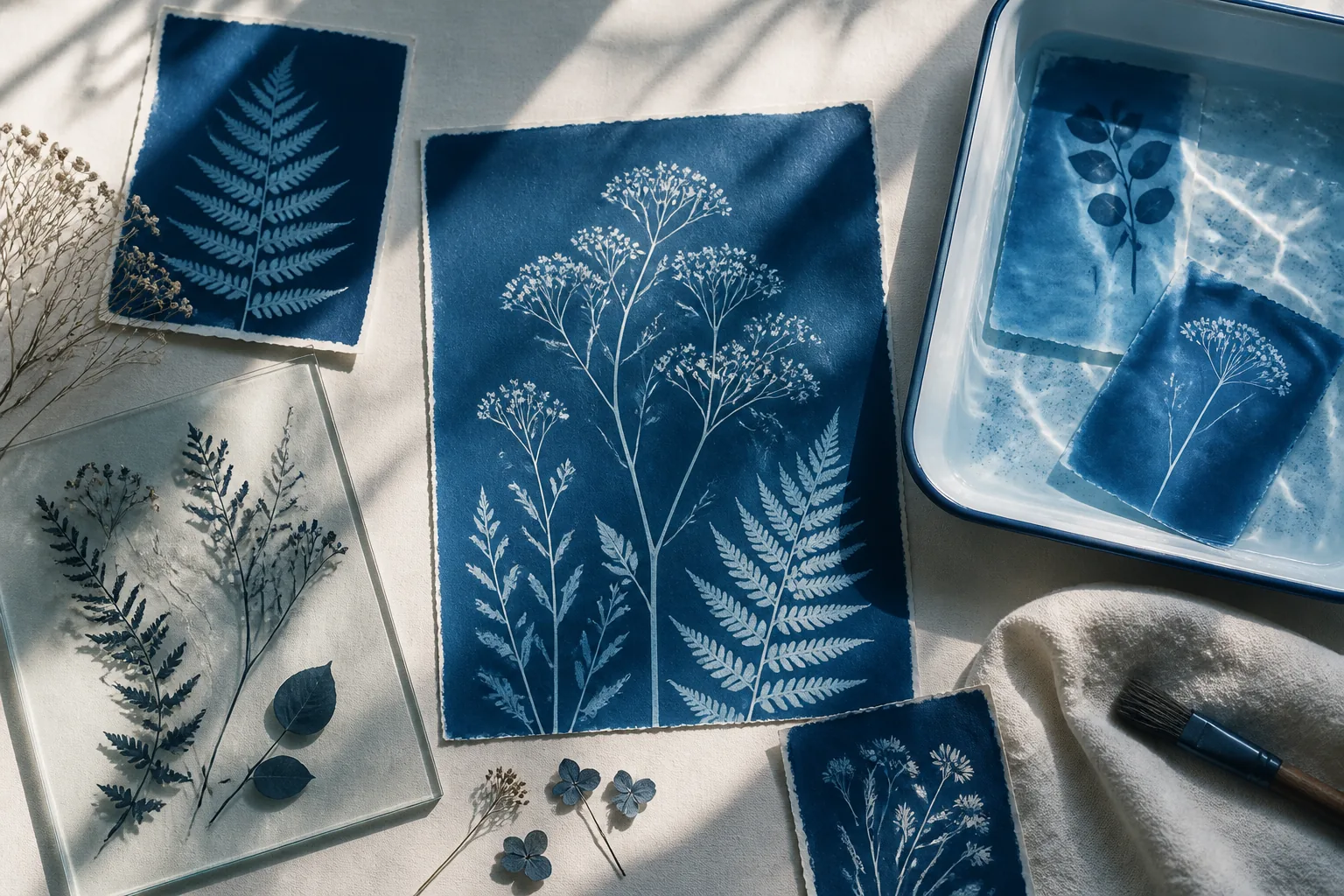
Cyanotype makes light visible through a single colour. On paper or cloth, blue is not an applied effect but the residue of a real process: iron changes state under ultraviolet light, water removes the excess, air deepens the tone, and the object becomes part of the image.
Editorial thesis
Cyanotype reduces photography to a single colour, yet that colour is not a limitation. Deep blue can appear scientific, architectural, nocturnal, technical or almost bodily, depending on the paper, light, object and washing method.
The process is powerful because its causality remains visible. A leaf, textile, negative or body has physically stood between ultraviolet light and a sensitive surface. The image retains not only form, but also traces of duration, water, pressure and chemical transformation.
Reader question
Why is a nineteenth-century process developed through scientific experiment and technical copying again being used in art, fashion and graphic design?
Because cyanotype holds opposites together. It is technically accessible yet visually unpredictable; it can be repeated from a negative while preserving manual irregularity; and it produces a recognisable blue that behaves differently on every material.
Short answer
Cyanotype is an iron-salt photographic process associated with John Herschel’s experiments in the early 1840s. A surface is coated with a mixture of iron compounds, dried in darkness, exposed to ultraviolet light through an object or negative, and washed in water. Prussian blue forms in the exposed areas, producing pale shapes against a saturated blue field. 12
The print is shaped by solution chemistry, support absorbency, humidity, spectral distribution and exposure time, contact pressure and washing quality. Cyanotype can therefore become a botanical photogram, a precise technical copy, a photograph from a digital negative, a textile print or a large-scale art object.
1. Cyanotype: an image constructed in blue
Cyanotype declares its nature immediately through colour. Unlike silver-gelatin photography, it does not aim for a neutral grey scale; the image is constructed within blue, where density becomes an equivalent of light, duration and the quantity of pigment formed.
The colour can create both distance and material presence. It evokes sky, water and nocturnal shadow, yet on paper it remains a dense chemical image held within the fibres.
2. John Herschel and the discovery of the process
John Herschel introduced the cyanotype process in the early 1840s while investigating the light sensitivity of iron compounds. The National Science and Media Museum and Kew associate the first cyanotypes with his experiments of 1841–1842. 14
Herschel mattered not only as the author of a formula but as a mediator between chemistry, astronomy and image-making. The process began not as a finished artistic style but as a scientific attempt to make light produce a durable sign.
3. Iron rather than silver
Most early photographic processes relied on light-sensitive silver salts. Cyanotype uses iron compounds, giving it a different chemistry, colour and pattern of ageing.
The iron-salt process requires neither a conventional developer nor fixer: after exposure, unreacted compounds are removed in water. This simplicity helped it spread through education, amateur practice and technical copying.
4. How Prussian blue is formed
During exposure, light alters the state of iron in the sensitised layer. Subsequent reactions form an insoluble pigment known as Prussian blue. Getty identifies cyanotype analytically through its iron-containing blue image. 1
The blue is not applied as a ready-made paint. It forms within the coating through light and chemistry, so tone is linked to penetration depth, fibre structure and washing quality.
5. The two-part sensitiser
The classical working system uses two stock solutions kept separately and mixed shortly before coating. The National Science and Media Museum identifies ferric ammonium citrate and potassium ferricyanide as the principal components of the traditional formula. 1
Separate storage reduces premature reaction. Once mixed, the solution becomes UV-sensitive, so working time, ambient light and tool cleanliness begin to shape the result.
6. Paper as an active participant
Paper is not a neutral carrier. Cotton watercolour paper, smooth printmaking stock and a loose handmade sheet absorb sensitiser differently, changing contrast, sharpness and blue density.
On a suitable sheet the image holds detail without reading as a surface film. On a highly absorbent paper the chemistry sinks deeply and softens edges; a weak sheet may distort or break down during prolonged washing.
7. Sizing, absorption and surface
Sizing regulates how readily paper absorbs water and solution. A heavily sized surface holds sensitiser closer to the face and may produce a clearer image, but can also encourage uneven coating.
Alkaline buffers present in some papers can be hostile to Prussian blue. Professional practice therefore begins not with surface beauty but with testing a specific support for colour, clearing and stability.
8. Coating the solution
The solution may be applied with a brush, glass rod, foam applicator or other coating method. The gesture can be hidden within an even rectangle or left visible as part of the composition.
A layer that is too heavy dries slowly, clears poorly and may stain. One that is too thin limits maximum density. Getty teaching materials treat coating consistency as a key condition of predictable results. 1
9. Drying and latent sensitivity
The coated support is dried in darkness or under safe working light. While damp, sensitivity and solution distribution may remain unstable; contact with dust, metal or a contaminated surface can mark the sheet before exposure.
A dry sensitised sheet appears pale yellow or greenish. The image does not yet exist, but the complete future reaction is already contained in a thin, almost invisible layer.
10. Sunlight, UV lamps and the light spectrum
Cyanotype is primarily sensitive to ultraviolet and near-blue wavelengths. Sunlight provides a free but variable source; a UV lamp offers a more repeatable exposure that can be measured and controlled.
Clouds do more than reduce brightness. They alter spectral and spatial distribution, so equal minutes on different days are not equivalent exposures. Test strips, UV index readings and records are more reliable than intuition alone.
11. Contact printing and pressure
To obtain a sharp contact print, the object or negative is pressed firmly against the coated support under glass or in a printing frame. Any gap allows lateral light to soften the line.
Pressure also enters the image. A thin leaf flattens under glass, textile compresses, while a three-dimensional object preserves different heights—from exact contact to a diffuse shadow.
12. Opacity, translucency and tone
An opaque object protects the surface and leaves a pale silhouette. A translucent material passes part of the UV and creates blue gradations: leaf veins, film, lace and glass produce their own tonal maps.
Tone is not determined only by visible transparency. A material may appear clear to the eye while blocking UV, which makes testing more dependable than visual prediction.
13. Exposure and colour change before washing
During exposure the coating changes from yellow-green towards grey-blue, bronze or a partially reversed tone. This is not the final image: washing will remove unreacted compounds and transform contrast dramatically.
Experienced printers learn to read the intermediate colour but do not depend on it alone. Humidity, solution age and paper type can make the same visual signal misleading.
14. Water as developer and clearing bath
After exposure the sheet is washed in water. Water removes soluble compounds from unexposed areas and the pale parts gradually clear. Kew describes this wash as the stage through which the characteristic white-and-blue image appears. 4
Insufficient washing leaves a yellow cast and residual chemistry in the support. An aggressive water jet may damage fibres or remove a poorly held coating, especially on textiles and weak papers.
15. Oxidation and the deepening of blue
A freshly washed print often appears lighter than it will several hours later. Contact with oxygen deepens Prussian blue. This may be accelerated, but natural oxidation reveals the character of the image without unnecessary intervention.
The deepening of blue should be distinguished from simple paper drying. A wet sheet is darker and more transparent than a dry one, so final judgement belongs after complete drying and colour stabilisation.
16. Negatives and repeatable images
When a transparent negative replaces the object, cyanotype becomes a repeatable printing process. Light passes through clear areas and forms deep blue, while dense areas preserve the colour of the support.
The negative must account for the process’s tonal curve. A conventional photographic negative may not deliver the required contrast, so historical printers used specially prepared originals and contact copies.
17. Digital negatives and the hybrid process
Today an image can be adjusted digitally and printed on transparent film. This expands format, permits density control and joins contemporary photography to a hand-coated iron-salt print.
Critical context
A digital negative does not make the result less material, but it changes the chain of authorship. Direct botanical photograms, analogue negatives and digitally prepared files should be described honestly as different production systems.
18. Paper, fabric, wood and other supports
Cyanotype can be coated on paper, cotton, silk, wood and other porous materials. Yet the ability to accept solution does not guarantee durability: a support must survive water, avoid hostile chemical interaction and retain the image after drying.
A smooth non-porous material requires an intermediary layer or special preparation. The image then depends not only on cyanotype chemistry but also on the adhesion of the ground to the support.
19. Cyanotype on textiles
On cloth, blue penetrates between fibres and becomes part of the surface, but behaves differently from an image on paper. Weave density, factory finishes, synthetic content and washing quality influence definition and permanence.
MoMA’s Edward Steichen archive notes that cyanotype textiles are vulnerable to visible and UV light, alkaline substances and washing losses. The record exposes the difference between a striking print and a conservationally stable textile. 1
20. Blueprint: the technical drawing as a blue print
In the late nineteenth and early twentieth centuries cyanotype was widely used to copy architectural and engineering drawings. MoMA links the process’s characteristic colour to the origin of the word blueprint. 1
Critical context
Blueprint now often means any project drawing, but historically the term referred to a specific photographic copying system. Not every blue drawing is a cyanotype, and not all technical documentation was produced as a blueprint.
21. Anna Atkins and Photographs of British Algae
Anna Atkins began issuing Photographs of British Algae: Cyanotype Impressions in 1843. The Met dates its album to 1843–1853 and holds it as a collection of cyanotypes. 1
The choice of process was precise: thin seaweeds produced detailed pale forms against blue, while contact printing preserved the morphology of a specimen without hand drawing.
22. The botanical specimen as image and evidence
For Atkins, the image was more than a beautiful silhouette. Labels, classification, consistent page format and sequence made the print into a scientific tool.
Scientific purpose did not remove visual intelligence. Placement, scale of empty paper and the curvature of a plant produce compositions that now read as both evidence and modern abstraction.
23. Anna Atkins and Anne Dixon: authorship as collaboration
Getty records Anne Dixon’s participation in producing botanical cyanotype albums with Atkins. 1
Critical context
The history of the first photographic book is often centred on a single name. A fuller account includes scientific networks, exchanged specimens, Anne Dixon’s assistance and the material labour required to sustain a large series.
24. Book, series and scientific sequence
Photographs of British Algae is not a pile of individual “blue pictures” but an editorial system. Title, handwriting, taxonomic order, page size and repetition construct a book in which scientific knowledge is visually organised.
Sequence distinguishes an archive from an incidental collection. For contemporary practice the lesson is clear: one striking print demonstrates a process, while a series establishes a language.
25. Robert Rauschenberg and Susan Weil: the body as mask
In the early 1950s Robert Rauschenberg and Susan Weil made large cyanotype works using bodies and objects. MoMA includes their collaborative Untitled within the history of the process. 1
The body becomes both subject and physical mask. The blue field converts contact into a trace of presence, while scale moves the intimate process from the laboratory to the wall.
26. Christian Marclay: the cassette as vanishing medium
Christian Marclay used cassettes and magnetic tape in large cyanotype photograms. The Met describes Memento (Soul II Soul) as a memento mori for both nineteenth-century cyanotype and the ageing audio cassette. 1
The object does more than create shape. Its technological death becomes the subject: one obsolescent medium records another.
27. Birgit Jürgenssen: body, clothing and blue distance
Birgit Jürgenssen’s cyanotypes connect body, clothing and the distance between image and skin. MoMA includes her works of 1988–1989 within the modern history of the process. 1
Blue removes ordinary bodily colour and creates a cold, almost radiographic space. Clothing stops acting as a simple cover and becomes a sign of identity and constraint.
28. Délio Jasse: historical process and postcolonial archive
In contemporary photography a historical process can become a method for addressing archives and visual power. In 2025 The Met presented works by Délio Jasse that reprise cyanotype in new views of industrialising Angola. 1
The old blue process does not function as nostalgia. It opens a temporal gap between colonial documentation, the contemporary city and the authority that controls the archive.
29. Toning and moving beyond blue
Blue can be altered with tannins, tea, coffee and other chemical treatments. Toning changes colour and may remove part of the original Prussian blue, so the result depends on bleaching, washing and re-colouring sequences.
A toned print no longer demonstrates cyanotype’s central optical code. That may be deliberate, but the maker should understand that a new chemical system is being produced, not merely a different filter.
30. Light sensitivity and reversible fading
Cyanotypes may fade visibly during prolonged exposure to light and partially regain density after resting in darkness. Getty treats this behaviour as an important diagnostic and conservation characteristic. 1
Reversibility does not mean invulnerability. Repeated cycles of strong light, contamination and chemical damage can produce changes that darkness cannot repair.
31. Alkali, humidity and storage risks
Prussian blue is sensitive to alkaline conditions. Buffered papers, cleaning products, cement dust and unsuitable storage materials may alter or bleach the image. MoMA specifically warns of the alkaline vulnerability of cyanotype textiles. 1
High humidity encourages contaminant movement and reactions in paper. For an artwork, light is only one factor; adjacent materials, enclosure and mounting conditions matter equally.
32. Display, storage and museum light
Museum display requires controlled illumination, UV filtration and rest periods. The V&A describes monitoring Anna Atkins cyanotypes for colour change during display. 1
The same principle applies in private interiors: a cyanotype should not sit in direct sunlight or next to alkaline building materials without protective framing and informed mounting.
33. Environmental claims and safe chemical practice
Cyanotype is often called “eco-friendly” or “non-toxic” because it contains no silver and develops in water. That description is too simple.
Critical context
Chemical salts require labels, gloves, a clean work zone and responsible handling of stock solutions and wash water. Accessibility does not remove the need for risk assessment, local disposal rules and protection of skin and eyes.
34. Cyanotype in fashion, graphics and product design
In fashion, cyanotype can print the silhouette of lace, seams, plants or hardware directly on fabric. In graphic design it links object and sign, while product design can turn packaging, lampshades or panels into light-sensitive archives.
A strong project uses the process as meaning rather than decorative “blue vintage”. Blueprint may speak about construction, botanical contact about the archive of nature, and a bodily mask about presence and scale.
35. What photographers, designers and art directors can use
Photographers should study exposure curves, contact, washing and digital negatives. Designers need to understand colour on different materials, repeatability and edition limits. Art directors must manage the historical associations of blue and describe the process accurately.
The central practical rule is to test the whole system. Solution, support, UV source, negative, water and drying operate as one instrument; changing any component changes the image.
36. Conclusion: why this blue remains contemporary
Cyanotype remains contemporary not because it returns us to the nineteenth century, but because it makes visible what digital images often conceal: the physical cause of colour, material resistance, incomplete repeatability and the duration of hand production.
Its strongest blue does not look like an effect. It looks like evidence that light physically touched a surface and left material memory behind.