encyclopedia
Arts and Crafts
Craft, labour and the beauty of everyday things
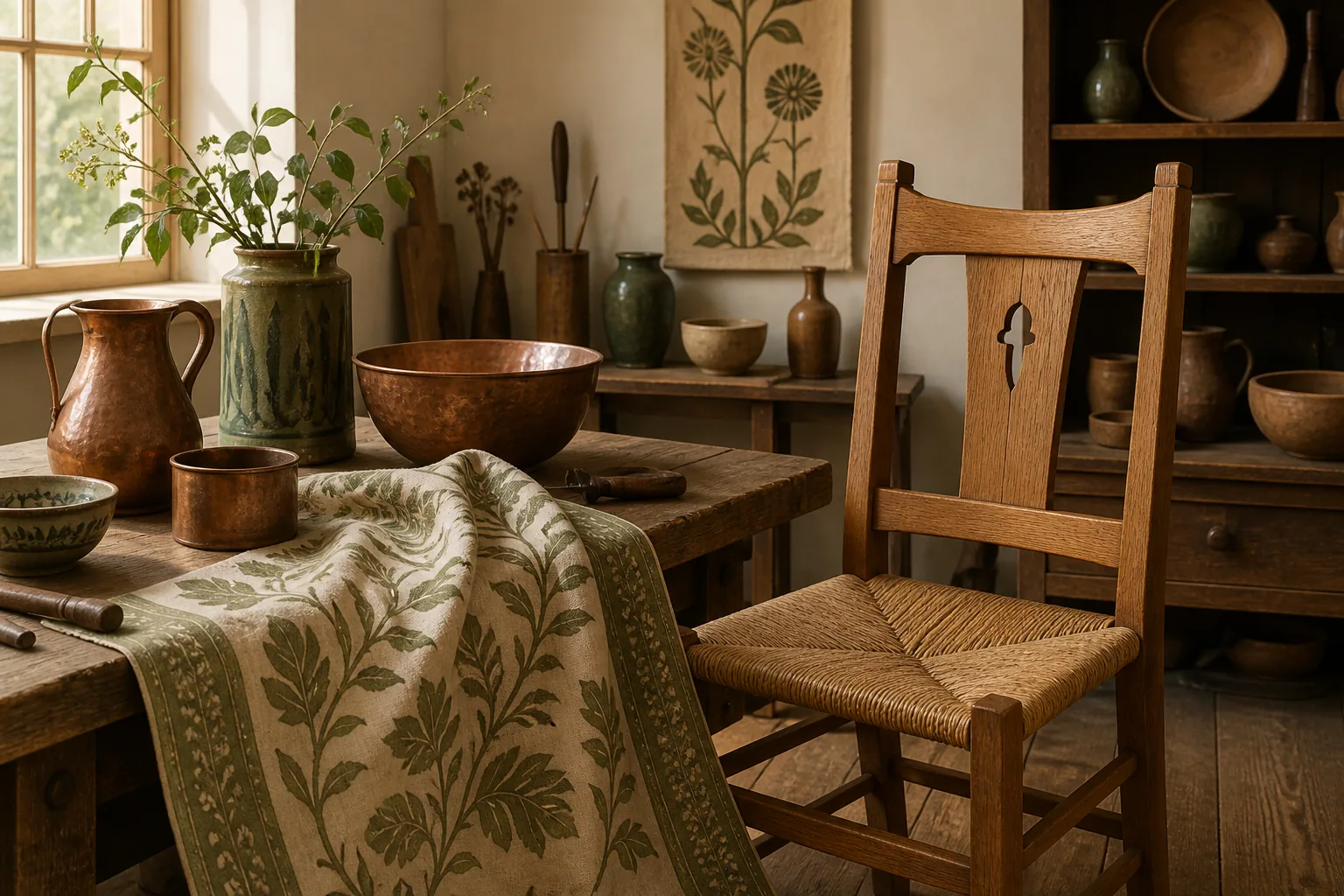
Arts and Crafts returns an inconvenient question to design: a beautiful object cannot be separated from the way it is made. Hand, material, labour and everyday life become part of form — which is why the movement matters far beyond its floral patterns.
Editorial thesis
Arts and Crafts should be read not as a nineteenth-century decorative style but as one of the first major modern attempts to connect form with the conditions of production. Its central subject is not ornament, but dignity of labour, truth to material and the belief that the quality of everyday things can alter the quality of everyday life. 1
Reader question
Why did a movement associated with William Morris, floral wallpaper and handmade furniture become foundational to modern design, graphic design, interiors, fashion and even today’s debate about AI and automation?
Short answer
Because Arts and Crafts made the method of production part of aesthetics. It placed designer beside maker, house beside object, material beside labour, and then forced the twentieth century to debate whether the quality of craft could survive industrial scale. 1
1. Why the machine made craft political
By the mid-nineteenth century the machine had become more than a tool; it had become a social system. Factories could produce more objects at greater speed, but quantity brought questions about quality, working conditions and authorship. Arts and Crafts emerged from that unease. It was not originally a style of floral wallpaper, but an argument about what happens when designing is separated from making. 1
That is why the movement still feels current. It asks not only whether a chair is beautiful, but how it was made, by whom, from what material, for whom and what kind of life its production supports. Arts and Crafts is one of the earliest large-scale design debates in which aesthetics, labour, economics and the everyday environment become inseparable.
2. The Great Exhibition of 1851: when the beautiful commodity became suspect
The Great Exhibition of 1851 at the Crystal Palace celebrated the industrial power of Britain and also provided design reformers with a convenient target. Mass-produced goods demonstrated technical capacity, yet critics saw excessive ornament, imitation of costly materials and weak relationships between form, function and manufacture. The V&A connects this criticism directly to the reform agenda that would later shape Arts and Crafts. 1
The exhibition should not be reduced to a cartoon of the “bad factory”. Industry created unprecedented scales of production and consumption. The concern was that machinery was shaping objects faster than culture could develop a language for the mass-produced thing. Arts and Crafts tried to put quality of decision, material intelligence and human responsibility back into that conversation.
3. Pugin and Ruskin: design before the movement had a name
Before William Morris, Augustus Welby Northmore Pugin and John Ruskin had already built much of the intellectual foundation. Pugin linked good architecture to structural honesty and attacked meaningless applied decoration. Ruskin went further, treating the separation of design from manual work as both an aesthetic and a moral injury. The V&A identifies both as major precursors of the movement. 1
From this comes an idea that repeatedly returns in twentieth- and twenty-first-century design: a material should not pretend to be another material, construction does not need to disguise its logic, and beauty cannot be separated from the way an object is made. This is not yet the modernist slogan “form follows function”, but the ground for a modern design discipline is already being prepared.
4. Hand, head and labour: when production became an aesthetic question
For Ruskin, a good object could register living labour. He valued the maker’s ability to think inside the process, make decisions and leave evidence of participation rather than merely produce sterile perfection. The V&A describes this position through his criticism of separating the act of designing from the act of making. 1
This is why Arts and Crafts returns whenever technology changes production. The more work becomes a chain of specialised operations, the sharper the question becomes: where does authorship remain? Today the same question can be asked about automated factories, parametric models or generative AI with surprising continuity from nineteenth-century arguments about machinery and industrial division of labour.
5. William Morris: designer, businessman, socialist and inconvenient hero
William Morris became the face of the movement even though the name itself was established later. He designed textiles, wallpapers, furniture, carpets, stained glass and books, wrote fiction and poetry, engaged in politics and ran a business. The V&A emphasises his resistance to the Victorian idea of industrial “progress” as an unquestioned good and his desire to restore meaning and pleasure to making. 1
Morris is most useful when he is not turned into a saint of handcraft. He wanted beautiful surroundings for a broad public, yet labour-intensive production made many of his products expensive. He criticised capitalist factories while operating a commercial firm. Those contradictions are exactly why he matters to VANSMITHLAB: design appears not as a look, but as a conflict between ideals, production and the market.
6. Red House: the house as an early manifesto
In 1859 Morris commissioned his friend Philip Webb to design a house in Bexleyheath; the family moved into Red House in 1860. The National Trust describes it as a crucial site in the early history of Arts and Crafts. The building rejected showy symmetry and applied facade costume in favour of brick, utility, medieval associations and a close relationship between interior and garden. 11
Red House matters because it develops a modern idea of a coordinated environment. Architecture, furniture, wall painting, stained glass, textiles and garden should speak to one another. The house becomes a prototype for what would later be called total design: the author is no longer shaping one isolated object but the relationships between objects.
7. The Firm: Morris, Marshall, Faulkner & Co. and the idea of the complete interior
Frustration with available furnishings helped Morris and his circle establish Morris, Marshall, Faulkner & Co. in 1861, later reorganised as Morris & Co. The decorative-arts firm worked across furniture, stained glass, embroidery, wallpaper, textiles, carpets and other components of the interior. It turned the ideal of an artistic workshop into an operating commercial system. 1
This is an important reminder that Arts and Crafts did not exist only in manifestos. It had to solve sourcing, materials, pricing, retail, clients and repeatability. That is why Morris’s firm is so important to design history: it shows an artistic position becoming a product system and a brand long before the vocabulary of contemporary creative direction.
8. Nature as a system: pattern without botanical copying
Morris patterns can look like direct copies of the garden, but they are much more constructed. He knew plants and historic ornament intimately yet did not aim at botanical illustration. Natural forms were translated into rhythm: stem becomes route, leaf becomes pause, flower becomes accent, and repetition organises the field. The V&A stresses his rejection of literal imitation in favour of ordered stylisation. 1
A convincing Arts and Crafts pattern is therefore not simply “many leaves”. Its power lies in directing attention. The eye moves across the surface without an obvious beginning or end; the module repeats but tries not to feel mechanical. This is one of the movement’s productive paradoxes: a handmade aesthetic is supported by an exact system of repetition, almost an algorithm hidden beneath foliage and birds.
9. Wallpaper: repetition that hides the grid
Wallpaper became one of the most recognisable fields of Morris & Co. The repeat unit was carefully organised but its boundaries were often softened so that the wall read as a continuous growing surface. Designs such as Trellis, Acanthus and Fruit demonstrate how the geometry of repeat can be concealed inside organic movement. 1
The technical lesson remains useful: ornament is not simply an image multiplied across a wall. The seam, density, direction, scale and the viewer’s ability to detect repetition all have to be designed. The same rule applies to a digital pattern, packaging or a fashion print; when the grid is too obvious, the surface quickly becomes mechanical and cheap.
10. Textiles: dye, weave and tactile intelligence
Morris was interested not only in textile imagery but in dyeing, weaving, embroidery, carpet making and tapestry. The V&A emphasises his practical engagement with historical processes and his understanding that technique changes visual outcome. 1
Textiles are therefore a perfect Arts and Crafts case study. Colour cannot be separated from fibre, surface from technique, or pattern from the limitations of production. The designer becomes a researcher of material rather than someone who merely supplies a decorative image. The key question is what a specific thread, dye and weave can do best.
11. Furniture: construction should not lie
Arts and Crafts furniture valued readable construction: wood should remain recognisably wood, a joint should read as a joint, and a domestic object should not pretend to be a palace piece through applied decoration. Simplicity here is not identical to modern minimalism; furniture could be heavy, carved or ornamental, but its structure was expected to remain believable. 1
This produces an aesthetic of the honest joint. Peg, tenon, fastener and the meeting of leg and frame gain permission to be visible. The idea would later reappear in very different contexts, from American Craftsman furniture to modernism and Japanese product design. Construction stops being the engineer’s hidden secret and becomes part of the visual language.
12. Ceramics, metal and glass: material sets the rules
The movement was never limited to timber and textiles. Ceramics, enamel, silver, copper, glass, jewellery and stained glass tested the same principle across different materials: form should acknowledge resistance, softness, heat, reflectivity and the trace of tools. The Arts and Crafts Exhibition Society explicitly worked to raise the status of these so-called minor arts alongside painting and sculpture. 1
Material thus becomes a co-author. A silver vessel need not imitate marble; ceramics can acknowledge the kiln; hammered metal may retain the mark of the hammer. Today this can sound self-evident, but in the nineteenth century it formed part of a major cultural reform — an attempt to give applied art intellectual status.
13. The home as a total work: from door handle to garden
For Arts and Crafts, an interior is not assembled from unrelated attractive objects. Architecture, furniture, light, textiles, wall surface and garden should form a coherent rhythm. The V&A notes that many leading figures were trained as architects and therefore naturally thought in terms of the “total” interior, with objects understood as parts of a larger system. 1
The principle is familiar to any strong art director or interior designer today. A project needs more than a set of good elements; it needs a visual logic governing scale, material, detail and human movement. Arts and Crafts made this systemic view especially convincing in the domestic environment, where design is tested by daily use rather than by a single photograph.
14. Kelmscott Press: the book as small architecture
In 1891 Morris founded the Kelmscott Press and transferred his criticism of mass production to the book. He designed typefaces, initials, borders, title pages and the overall colour of the printed text. The V&A records the carefully designed output of the Press, while the William Morris Society treats the Kelmscott Chaucer of 1896 as the culmination of Morris’s ideal-book project. 1
The point is not the medieval ornament by itself. Morris treats the page as architecture: black text mass, white field, ornamental border, illustration and type size must hold one another in balance. Content, printing technology and paper become inseparable. This is a direct ancestor of editorial design as a discipline.
15. The Arts and Crafts Exhibition Society: craft enters public space
The movement’s name became established through the Arts and Crafts Exhibition Society, founded in London in 1887, with its first exhibition held in 1888. The V&A emphasises its ambition to raise the public and intellectual standing of ceramics, textiles, metalwork, furniture and other decorative arts that had historically received less attention than painting and sculpture. 1
This was an institutional shift. Craft gained not just a workshop and shop, but a platform for exhibition, criticism and public discussion. Today it seems natural to discuss a chair, textile or typeface in a museum as a cultural object. Arts and Crafts helped establish exactly that habit of looking at the everyday thing as a carrier of ideas.
16. C. R. Ashbee and the Guild of Handicraft: the workshop as social experiment
C. R. Ashbee founded the Guild of Handicraft in 1888 as a cooperative workshop. The Metropolitan Museum describes a guild of craftspeople working across furniture, metalwork, leather and jewellery. Ashbee was concerned not only with how objects looked but with the organisation of work itself — collective production, training and a closer relationship between designer and maker. 1
The Guild exposes the utopian side of Arts and Crafts. The workshop was intended to function as production, school and model of dignified life at once. Such enterprises were often financially fragile, yet the idea survived their business models. Contemporary studio culture, maker spaces and small-batch production still carry a similar dream of a compact team in which knowledge is not broken into isolated operations.
17. May Morris and the women without whom the movement would look very different
Arts and Crafts has often been narrated through famous men even though women were essential as designers, embroiderers, makers and organisers. May Morris, William Morris’s daughter, ran the embroidery department at Morris & Co., designed textiles and jewellery, taught and argued for the professional recognition of women in decorative art. The V&A identifies her as a major British Arts and Crafts figure and a pioneer of art embroidery. 1
This correction changes the movement itself. “Handwork” in the Victorian home was frequently gendered and could remain invisible as authorship. Bringing May Morris, Jessie Newbery and other makers into view reveals Arts and Crafts not as a club of a few celebrated designers, but as a broad production culture in which the question of whose labour counts as creative is as important as the quality of the object.
18. Fashion and dress reform: freeing the body and showing the work of the hand
Arts and Crafts also shaped clothing. The V&A connects the movement to looser historicising silhouettes, embroidery, natural motifs and dress-reform efforts that resisted the rigid and over-constructed Victorian body. Embroidery was especially significant as a field in which women increasingly worked not only as makers but as independent designers. 1
For fashion, the useful inheritance is not literal medieval costume but an attitude to body and surface. Fabric should retain movement, ornament can reveal technique, and silhouette can allow material to breathe. Versions of this logic return later in reform dress, artistic dress, Japanese fashion, slow fashion and contemporary craft couture.
19. Architecture: brick, timber, local tradition and the honest joint
Arts and Crafts architecture rejected a universal stylistic mask. A house should respond to site, climate, local brick, stone, timber and building traditions. Philip Webb, C. F. A. Voysey, William Lethaby and others produced buildings in which asymmetry could grow from the plan and detail from actual construction rather than from stylistic obligation. 1
This is why an Arts and Crafts house can feel as though it accumulated rather than being imposed by one symmetrical diagram. Roof, window, chimney, porch and garden organise the composition through the life inside. It offers a powerful alternative to architecture as icon: a building can be expressive not because it shouts, but because it belongs precisely to its place.
20. Standen: a house that seems to grow from the landscape
Standen in West Sussex, designed by Philip Webb for the Beale family in the 1890s, is a strong example of mature Arts and Crafts domestic design. The National Trust emphasises the building’s relationship to the local landscape and interiors filled with Morris & Co. textiles, wallpapers and furnishings. The movement appears here as a sequence of coordinated decisions rather than a single spectacular object. 11
The lesson of Standen is the absence of theatrical separation between architecture and furnishing. Materials, furniture and decoration do not compete for attention. They produce an inhabited system whose quality reveals itself slowly. For contemporary interior photography it is almost an ideal subject: the story is not a “wow detail” but the relationship between surfaces.
21. The machine paradox: Arts and Crafts was not simply a war on technology
Arts and Crafts is often described as anti-machine, but the V&A presents Morris’s position more carefully. He did not reject machinery automatically; he objected to division of labour and the loss of connection between worker and result. A machine could be acceptable when it served quality or removed meaningless drudgery rather than reducing a person to an appendage of a process. 1
That distinction matters for digital tools today. The problem is not whether CNC, 3D printing or AI is used. The question is who defines the system, whether the author understands the material, whether the result can be controlled, and whether technology remains a means rather than the sole source of decisions. In this reading Arts and Crafts becomes less an opposite of technology than an ethical filter for it.
22. The price paradox: beauty for everyone that not everyone could afford
The movement’s most painful internal contradiction was price. Morris imagined beautiful and useful things alongside more dignified labour, yet highly skilled hand production made many products affordable mainly to wealthy clients. The Metropolitan Museum identifies this paradox directly: a socially utopian project met the economics of expensive manufacture. 1
This is where Arts and Crafts stops being a comforting story about workshops. Good work takes time, skill costs money, and democratic design has to find a way to scale. Bauhaus, Werkbund, Scandinavian design and mass modernism would later attack the same problem differently: not by abandoning industry but by trying to make industry produce better objects.
23. Europe: from the Secession to the Wiener Werkstätte and Werkbund
Arts and Crafts ideas moved rapidly beyond Britain. The V&A traces their influence through the Vienna Secession and Wiener Werkstätte, while German organisations sought a more pragmatic partnership between design and industry. The Deutscher Werkbund, founded in 1907, is especially important because it inherited the demand for quality without treating large-scale production as inherently corrupt. 1
This creates a bridge to modernism. The British model began with the workshop and a moral critique of the factory; continental designers increasingly asked how quality might be transferred to industrial scale. Arts and Crafts is therefore more useful as the first act of a long argument than as a nostalgic dead end. Werkbund, Bauhaus and modern industrial design emerge from that argument.
24. America: Gustav Stickley, The Craftsman and honest furniture
In the United States the movement developed a more commercial and mass-media form. Gustav Stickley promoted simple furniture with readable construction and published The Craftsman from 1901 to 1916. The Metropolitan Museum notes that his workshops sought comparatively affordable production while retaining an emphasis on honest material and construction. 1
The American version shows how quickly the craft ideal can become a media system. The magazine circulated not only objects but a vision of the home, plans and a philosophy of everyday life. Stickley was effectively selling a lifestyle before the term became standard marketing language: furniture, architecture, graphics and text all explained the same way of living.
25. Greene & Greene: the bungalow as total design
In California, Charles and Henry Greene brought American Arts and Crafts to a level of almost jewelled architecture. The Metropolitan Museum describes their interiors as complete projects combining furniture, joinery and strong Japanese influence. In their work, the bungalow becomes not merely a modest housing type but a precise system of timber, light, joints and circulation. 1
Their work also reveals the global character of “honest craft”. Japanese joinery and spatial principles enter an American house shaped by a British reform movement. Arts and Crafts was never a sealed English aesthetic; it constantly translated other traditions into new local languages — sometimes through genuine admiration, sometimes raising difficult questions of appropriation.
26. Beyond Britain and the United States: local identity, Japan and Mingei
The V&A traces the movement’s ideas into Central Europe, America and eventually Japan, where in the 1920s they helped shape the Mingei folk-craft movement. In each setting the emphasis changed: national tradition, social reform, resistance to standardised factory culture or the search for a local design identity could become dominant. 1
This is a reminder that “returning to craft” is never neutral. We have to ask whose craft is treated as authentic, who receives authorship, and how tradition is translated into market and museum value. A contemporary designer working with local techniques inherits not only the beauty of Arts and Crafts, but also its difficult question of power over cultural material.
27. From Arts and Crafts to Art Nouveau and Bauhaus: inheritance without direct copying
Arts and Crafts directly influenced Art Nouveau and indirectly prepared the Bauhaus. The Metropolitan Museum links Art Nouveau to the ambition to reunite fine and applied arts, while the history of the Bauhaus shows a craft-based curriculum later redirected towards mass production. But the line should not be simplified into “Morris invented modernism”. 1
What is inherited is the structure of the problem: how to connect art, craft, architecture and the everyday object; how to teach a designer through materials; how to avoid empty decoration; how to combine quality with public usefulness. Art Nouveau answers with fluid form, the Werkbund with industrial collaboration, and Bauhaus with a school and production programme. Arts and Crafts remains the original conflict.
28. Graphic design and publishing: type, page, border and material
The Kelmscott Press demonstrated that graphic design begins not with decorating a page but with relationships between typography, margin, illustration, paper and printing process. Morris designed typefaces, borders and initials as a system and tested composition directly on proofs. The William Morris Society documents this working process in detail. 1
A contemporary art director may reject the visual density of Kelmscott but still recognise the method. First define the character of the medium, then the page system, then the role of image and ornament. This is why Arts and Crafts matters to media and publishing: the book is treated as a physical interface, where even the quality of paper affects the rhythm of reading.
29. Photography and contemporary image-making: showing craft without costume nostalgia
Photography predates Arts and Crafts, yet the movement offers photographers a distinctive way to look at objects. Craft does not need theatrical reconstruction with dust, candles and sepia. It is more accurate to show material, tool marks, joints, the scale of the hand and the way an object ages. 1
In contemporary image-making, a strong Arts and Crafts frame depends on material truth: believable natural light, real texture, quiet interiors and restrained retouching. Even AI visualisation should avoid decorative fantasy. The goal is not to rebuild the nineteenth century, but to show a contemporary world in which production has become visible again.
30. The main legacy: design is also a way of organising labour
The main legacy of Arts and Crafts is neither a specific pattern nor a cult of the handmade object. The movement established the idea that design cannot be completely separated from the conditions of production. An object carries an organisation of labour, knowledge of materials, an economic model, a relationship to its user and an idea of what a good society might be. 1
That is why Arts and Crafts becomes relevant again with every technological shift. Today the question is: if an algorithm can draw, a machine can cut and a factory can repeat millions of times, where exactly does the value of the designer’s decision reside? The movement’s answer does not require the rejection of technology. It requires the author to understand the system as a whole — from idea to material, from labour to the way an object enters life.